Research Peptide & Compound Glossary
Research Peptide & Compound Glossary
RESEARCH USE ONLY
This guide is for laboratory, analytical and procurement context. It does not provide human or veterinary administration, dosing, injection, treatment, diagnosis, supplementation or personal-use guidance.
Research peptide glossary
This glossary
defines the terms most often needed to interpret research-peptide
products, batch documents and laboratory guides. Definitions are
intentionally concise. Where a term has a dedicated Core Research
guide, that page owns the detailed explanation so the glossary does
not compete with it.
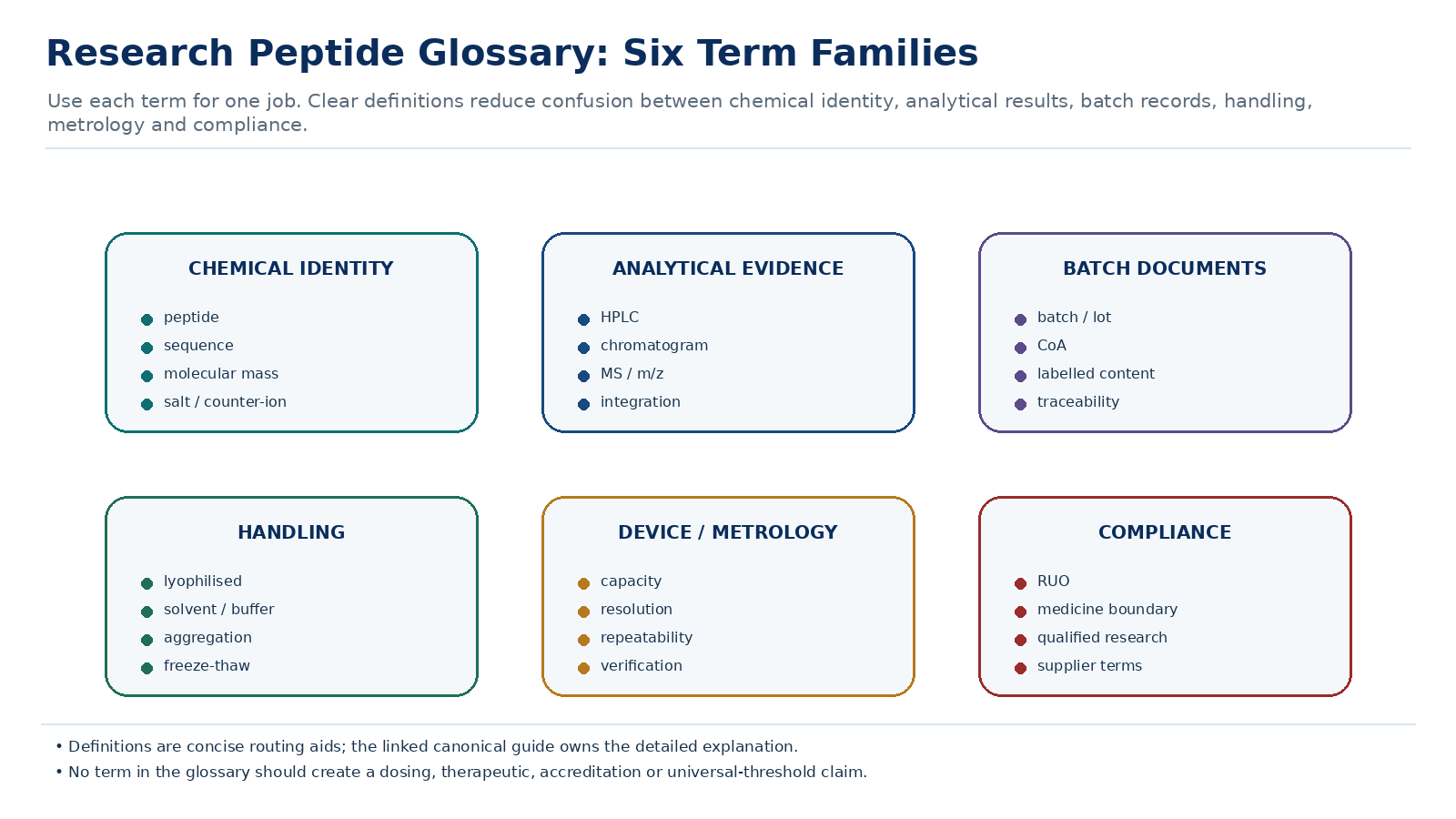
Figure
1. Six term families used across Core Research research-peptide
content.
From Our Work: why these definitions are kept
separate
Core Research
reviews batch evidence as a connected set rather than accepting one
headline number in isolation. The approved review set can include
product and batch match, HPLC purity, MS identity, appearance,
labelled amount or content, applicable water or moisture and
counter-ion information, CoA/document completeness, and storage or
handling status. The analytical testing itself is produced by the
manufacturer and/or third-party laboratories; Core Research reviews
that evidence. When a meaningful mismatch is identified, the batch is
held while clarification and/or a justified retest is requested. This
workflow does not imply in-house analytical testing or any laboratory
accreditation claim.
In that workflow,
“HPLC purity”, “MS identity”, “labelled amount”,
“counter-ion” and “batch number” are deliberately not used as
synonyms. They answer different questions. A concise glossary helps
prevent a document or AI-generated answer from collapsing those
attributes into one unsupported quality claim.
Chemical identity and material terms
Peptide
A compound built
from amino-acid residues joined through peptide bonds. The term is
chemical; it does not by itself specify intended use or regulatory
status. See O01 for the canonical detailed treatment.
Amino-acid residue
The part of an amino
acid incorporated into a peptide chain after peptide-bond formation.
See O01 for the canonical detailed treatment.
Research peptide
A peptide supplied
or used in a laboratory research context. The phrase is not a
universal purity grade or an MHRA authorisation. See O01 / O02 for
the canonical detailed treatment.
Research Use Only (RUO)
Core Research’s
intended-use and supply boundary for laboratory research; it excludes
human/veterinary treatment, dosing and administration guidance. It is
not by itself a medicine-status determination. See O02 / C13 for the
canonical detailed treatment.
Batch documentation and analytical terms
Batch / lot
A traceability
identifier for a defined production lot. It links the physical
material to labels, analytical records and supporting documentation.
See O11 for the canonical detailed treatment.
Certificate of Analysis (CoA)
A batch-specific
document reporting selected product, test and result information. A
CoA should be interpreted field by field; it is not proof of every
possible quality attribute. See O07 / C09 for the canonical detailed
treatment.
HPLC
High-performance
liquid chromatography. A chromatographic separation method used to
generate a profile under stated conditions. See O08 for the canonical
detailed treatment.
HPLC area %
The relative
integrated detector response assigned to a peak within a chromatogram
under the stated method. It is not automatically peptide mass
fraction or absolute content. See O08 / O12 for the canonical
detailed treatment.
Chromatogram
A record of detector
response versus the chromatographic separation coordinate, commonly
time. Interpretation depends on the method, full run and processing
context. See O12 for the canonical detailed treatment.
Retention time
The time associated
with an analyte peak under the stated chromatographic conditions.
Retention time alone is not universal molecular-identity proof. See
O12 for the canonical detailed treatment.
Integration
The data-processing
step used to assign peak boundaries and calculate peak area. Manual
or automatic integration should be interpretable within the method
and data record. See O12 for the canonical detailed treatment.
Mass spectrometry (MS)
Measurement of ions
according to mass-to-charge characteristics to provide molecular
information. In peptide testing it can support identity but does not
by itself establish chromatographic purity. See O09 for the canonical
detailed treatment.
m/z
Mass-to-charge ratio
of an ion. Peptide spectra may contain different charge states, so
the observed m/z value is interpreted in that context. See O09 for
the canonical detailed treatment.
Molecular identity
Evidence that the
material corresponds to the intended molecular entity. Identity and
purity are separate analytical attributes. See O09 / O10 for the
canonical detailed treatment.
Labelled amount / content
The quantity stated
or determined for the product using an appropriate quantitative
basis. It should not be inferred from HPLC area % alone. See O10 for
the canonical detailed treatment.
Counter-ion
An oppositely
charged ion associated with a charged peptide form, such as TFA,
acetate or another stated ion. Identity and amount are separate
questions. See O13 for the canonical detailed treatment.
Residual TFA
Trifluoroacetate
remaining in a peptide sample after synthesis/purification or
counter-ion exchange. “Not detected” is method-specific and is
not identical to absolute zero. See O13 for the canonical detailed
treatment.
Lyophilised
Freeze-dried
physical format produced by removing solvent through a controlled
freeze-drying process. The format does not create a universal storage
life. See O15 for the canonical detailed treatment.
Handling and stability terms
Reconstitution
Preparing a solution
from a dry research material using a laboratory solvent/buffer
selected for the analytical or experimental purpose. This glossary
definition is not a dosing or administration instruction. See O19 for
the canonical detailed treatment.
Solvent / buffer / pH
Solution conditions
that affect solubility, aggregation, chemical stability and assay
compatibility. They should be selected for the specific peptide and
downstream method. See O20 for the canonical detailed treatment.
Aggregation
Association of
peptide molecules into higher-order assemblies. It can be reversible
or irreversible and should be assessed with fit-for-purpose
observation/analytical methods. See O21 for the canonical detailed
treatment.
Surface adsorption
Loss of peptide from
bulk solution through interaction with vessel or interface surfaces.
It is distinct from chemical degradation. See O21 for the canonical
detailed treatment.
Oxidation
Chemical
modification involving oxidation of susceptible residues or other
components. It is one possible degradation pathway, not a synonym for
every stability loss. See O21 for the canonical detailed treatment.
Aliquot
A defined portion
taken from a larger sample for controlled laboratory use or storage.
See O22 for the canonical detailed treatment.
Freeze-thaw cycle
One transition from
frozen to thawed state and back to frozen, when applicable. Effects
are peptide/formulation specific; no universal safe cycle count is
assumed. See O22 for the canonical detailed treatment.
Device and metrology terms
Nominal capacity
The declared
container or cartridge capacity. It is not automatically the verified
usable volume. See O32 for the canonical detailed treatment.
Resolution / graduation
The smallest
indicated increment of a measuring or dispensing device. Resolution
is not the same as accuracy. See O32 for the canonical detailed
treatment.
Repeatability
Closeness of
repeated measurement or dispensing results under defined
repeatability conditions. See O32 for the canonical detailed
treatment.
Calibration
A metrological
operation establishing a relationship between indication and
reference values with associated uncertainty. A mechanical “zero”
check is not automatically calibration. See O32 / O51 for the
canonical detailed treatment.
Verification
Confirmation, using
objective evidence, that specified requirements have been fulfilled.
Verification and calibration are not synonyms. See O32 / O51 for the
canonical detailed treatment.
Peptide pen format
A cartridge/device
format used for controlled laboratory dispensing on this site.
Core Research content must not frame it as a personal administration
device. See O30-O33 / O51 for the canonical detailed treatment.
Key takeaway
Use the glossary to
disambiguate terms, then follow the canonical guide for detail. The
most important distinction across the network is that chemical
identity, analytical results, batch documentation, handling
attributes, device metrology and RUO status are related but not
interchangeable.
References
[1] IUPAC Gold
Book: peptides (P04479). IUPAC. Accessed 14 August 2026. Source.
Primary terminology source for the chemical definition of peptides.
[2] IUPAC Gold
Book: amino-acid residue (A00279). IUPAC. Accessed 14 August
2026. Source.
Primary terminology source for amino-acid residues and peptide-chain
terminology.
[3] IUPAC Gold
Book: chromatography (C01075). IUPAC. Accessed 14 August 2026.
Source.
Primary terminology source for chromatography as a separation method.
[4] IUPAC Gold
Book: mass spectrometry (M03746). IUPAC. Accessed 14 August 2026.
Source.
Primary terminology source for mass-spectrometry terminology.
[5] Q2(R2)
Validation of Analytical Procedures. FDA / ICH. Accessed 14
August 2026. Source.
Used for the principle that analytical results are interpreted
according to the intended purpose and validated performance of the
stated procedure; cited as scientific guidance, not as an RUO legal
requirement.
[6] Borderline
products: how to tell if your product is a medicine. MHRA /
GOV.UK. Accessed 14 August 2026. Source.
Current MHRA page explaining the medicinal-product definition and the
case-by-case factors used for borderline classification.