Description
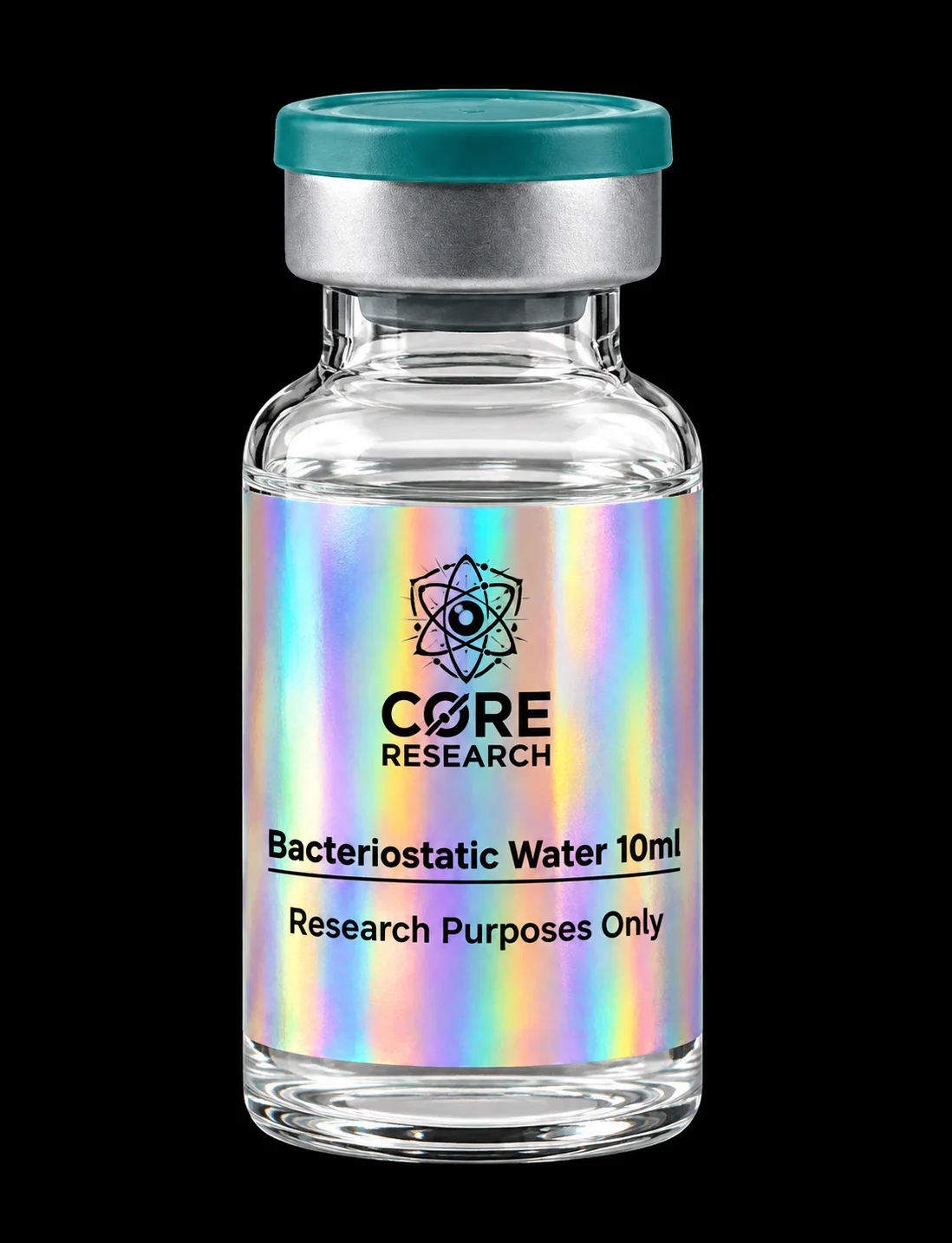
Bacteriostatic Water 10ml is a 10ml laboratory diluent listed by Core Research. The current catalogue declares water with 0.9% benzyl alcohol as its preservative-containing formulation. That is a catalogue declaration, not an independently verified assay of the supplied lot. The exact water grade, preservative result, pH, sterility or microbial release evidence, container specification and after-opening limits must be established from the applicable product and lot documentation where required by a laboratory method.
For laboratory research only. Not for human or veterinary injection or administration. The name bacteriostatic does not independently establish sterility, a pharmacopeial designation or that the supplied item is appropriate for clinical use.
What is in this listing?
| Product attribute | Current supported information |
|---|---|
| Product | Bacteriostatic Water 10ml |
| Nominal volume | 10ml |
| Product class | Preservative-containing aqueous laboratory diluent |
| Declared formulation | Water + 0.9% benzyl alcohol; verify against applicable specification/lot record |
| Verified preservative content | Not independently established for the current lot |
| Water grade, pH and sterility evidence | Require applicable documentation; not inferred from the catalogue name |
| Container and after-opening interval | Confirm from the supplied label or manufacturer specification; no multi-dose claim is made |
| Supply boundary | For research/laboratory use only; not human or veterinary administration |
The 10ml is the nominal container volume. It does not demonstrate the effective preservative level, prove a specific method of microbial-quality testing, or define the volume recoverable after any handling. 0.9% benzyl alcohol is a formulation description on the current catalogue, not a guarantee that the contents have been independently confirmed by an assay we inspected.
What does “bacteriostatic” mean for a laboratory method?
A bacteriostatic preservative is intended to inhibit microbial growth under appropriate conditions. That property is different from proof of initial sterility, the complete absence of contamination, or an unlimited period of safe reuse. The actual microbial-quality specification and whether a container is designed and validated for repeated access must come from its own documentation. Research use only does not turn a product into a clinical-grade preparation.
In a biological experiment, a preservative is another component of the medium. Where its presence matters, an investigator must consider not only the peptide or compound of interest but the response of the cells, proteins, assay reagents or detector to the preservative itself. The name water does not mean the diluent is chemically equivalent to preservative-free water.
Why benzyl alcohol can affect protein and peptide experiments
A positive aggregation finding in one protein model
Roy and colleagues (2005) studied lyophilised recombinant human interleukin-1-receptor antagonist (rhIL-1ra). In their experimental formulations, reconstitution with 0.9% benzyl alcohol in water produced more aggregation than reconstitution with water without the preservative. They also found that prior lyophilisation/formulation conditions affected the extent of aggregation. The result illustrates a material-dependent compatibility question; it is not proof that every peptide aggregates or that a Core Research product was tested in the experiment. 1
A separate study of interferon α-2a reported concentration-dependent aggregation and partial unfolding in the presence of benzyl alcohol. The authors used stability, fluorescence and structural measurements to explore the mechanism. That work identifies a potential preservative-related effect for the particular protein system rather than establishing a fixed outcome for a short synthetic peptide or an 80mg research blend. 2
A contrasting result in a different peptide model
Li and colleagues (2022) studied a 31-residue acylated peptide with NMR methods and compared preservative interactions. In their system, benzyl alcohol did not induce the detected aggregation or NMR chemical-shift changes, whereas m-cresol did produce aggregation under the tested conditions. This is important counter-evidence to any blanket statement that all benzyl-alcohol exposure destabilises all peptides. Sequence, structure, excipients and experimental conditions determine the question. 3
Taken together, these studies give a research decision rule: assess the specific solute/formulation/assay, rather than assuming that a preservative is always inert or always incompatible. The results do not establish clinical use, a product shelf life or lot-specific microbial quality for this supplied laboratory water.
Bacteriostatic Water versus Acetic Water
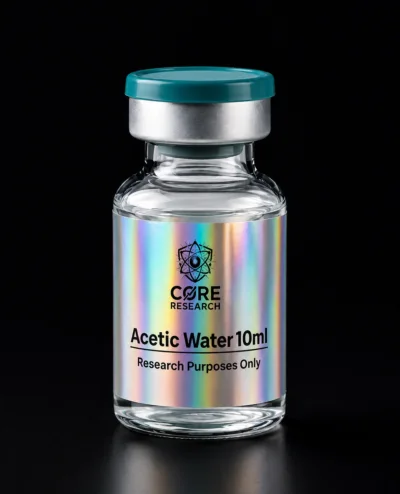
Acetic Water 10ml is a separate Core Research laboratory-supply listing described as an acidic aqueous solvent/diluent. The two products serve different formulation questions and should not be treated as interchangeable.
| Research question | Bacteriostatic Water 10ml | Acetic Water 10ml |
|---|---|---|
| Principal formulation concern | Benzyl-alcohol preservative content and its biological/analytical compatibility | Actual acetic-acid concentration, pH and solvent/ionisation compatibility |
| Is it preservative-free? | Catalogue declares benzyl alcohol, therefore not a preservative-free formulation as described | Preservative status is not established by its name |
| Does the name prove water grade or sterility? | No | No |
| Can it be substituted without testing the method? | No universal compatibility is established | No universal compatibility is established |
See the solvent, buffer and pH compatibility guide for experimental variables to consider. That general guide does not confirm the composition or specifications of either Core Research product.
Documentation, receiving and ordering
Use the Batch Documentation enquiry route or info@core-research.net, specifying “Bacteriostatic Water 10ml”. You can ask before purchase without an order or container lot number. When a precise method is involved, ask for the applicable product/lot record covering actual preservative formulation, water grade, microbial/sterility evidence if claimed, measured pH, container closure, expiry and handling after opening. Avoid inferring a 28-day, multi-dose or other use-life rule from unrelated pharmaceutical labelling.
On receipt, match the product name, nominal volume, manufacturer/lot details and seal to your order. Retain relevant records, check for damage and contact Core Research before using an item with a packaging or identity discrepancy. The research-product receiving checklist supports documentation. Follow the actual label and technical specification for storage and opening; no universal storage temperature or after-opening life has been verified for this catalogue item.
Current price, availability and quantity selection are displayed in the native purchase panel. For delivery information, consult Shipping & Delivery. An order enquiry is not a completed sterility or compatibility verification.
Bacteriostatic Water questions
Is this the same as sterile Bacteriostatic Water for Injection?
That equivalence is not established. The supplied Core Research product is described here as a research-use laboratory diluent. A product or formulation name is not a verified compendial-grade, sterility, nonpyrogenicity or clinical approval claim. Do not use it for injection or human/veterinary administration.
Is 0.9% benzyl alcohol independently verified for this batch?
The catalogue declares 0.9% benzyl alcohol. No manufacturer- or lot-specific assay confirming the percentage was established in this review. Request the applicable specification if your research depends on that concentration.
Does benzyl alcohol guarantee peptide stability?
No. Studies on different proteins and peptides have found both preservative-related aggregation and no detectable aggregation, depending on the molecular and formulation context. 1 2 3
Does “bacteriostatic” mean the contents are sterile indefinitely after opening?
No. Antimicrobial preservation and the actual microbial quality of a specific preparation are different questions. No current-lot sterile-use claim or fixed after-opening interval was authenticated for this product. Follow product-specific evidence and your laboratory’s procedures.
Can I request the available documentation before ordering?
Yes. Use Batch Documentation or info@core-research.net to request the formulation and testing documents applicable to Bacteriostatic Water 10ml.
Selected research references
[1] Roy S et al. (2005). Effects of benzyl alcohol on aggregation of recombinant human interleukin-1-receptor antagonist in reconstituted lyophilised formulations. Journal of Pharmaceutical Sciences. DOI: 10.1002/jps.20258. Protein-formulation study; not testing this supplier’s water.
[2] Kumru OS et al. (2015). Role of benzyl alcohol in the unfolding and aggregation of interferon α-2a. Journal of Pharmaceutical Sciences. DOI: 10.1002/jps.24105. Protein-biophysics study; not peptide-wide validation.
[3] Li M et al. (2022). Molecular mechanism of antimicrobial excipient-induced aggregation in parenteral formulations of peptide therapeutics. Molecular Pharmaceutics 19:3267–3278. DOI: 10.1021/acs.molpharmaceut.2c00449. Contrasting acyl-peptide model; no blanket compatibility claim.