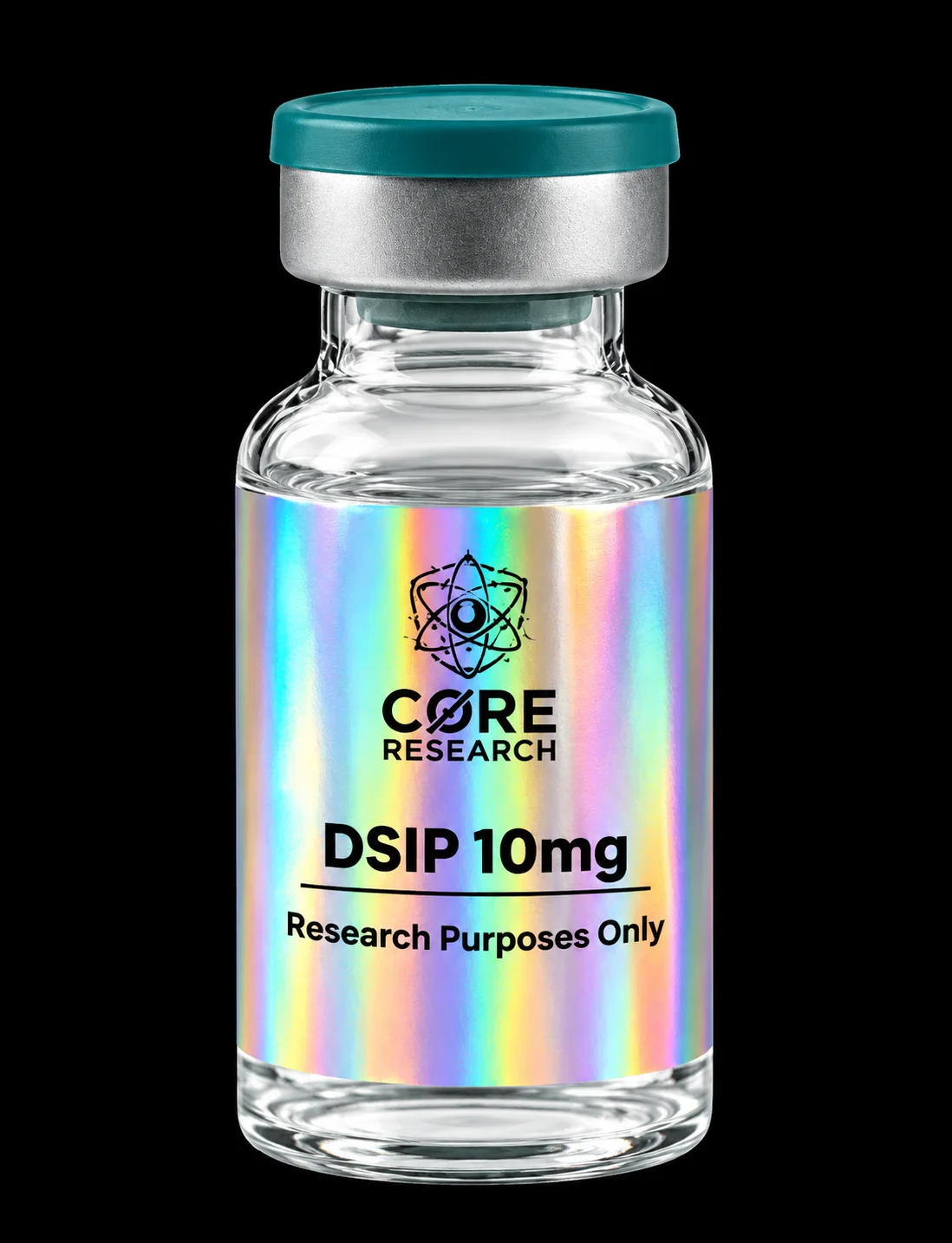
Description
DSIP 10mg is a lyophilised research-peptide vial from Core Research. DSIP stands for delta sleep-inducing peptide, a nine-amino-acid peptide investigated in EEG, neuroendocrine and peptide-stability research. Its historical name comes from an experimental observation; it is not a guarantee of a sleep outcome. 1
This page explains the original research, subsequent controlled findings and why the exact peptide matters. For laboratory research only; not for human or veterinary use. Request batch documentation.
DSIP 10mg: product and molecular identity
| Detail | This listing |
|---|---|
| Product | DSIP 10mg |
| Expanded name | Delta sleep-inducing peptide |
| Labelled amount | 10mg per vial |
| Presentation | Lyophilised research material |
| Researched peptide class | Nonapeptide: nine amino-acid residues 1 |
| Reference sequence | Trp-Ala-Gly-Gly-Asp-Ala-Ser-Gly-Glu 1 |
| Sequence shorthand | WAGGDASGE |
| Price and availability | Current values in the live purchase panel |
The reference sequence identifies the molecule described in the original paper. It does not independently establish the terminal form, salt, purity or measured amount of this lot. A modified analogue should not be treated as native DSIP simply because its name contains “DSIP”.
Catalogue selection: this listing is the standalone 10mg lyophilised DSIP vial, not a structural analogue, prepared solution or finished consumer sleep product. For a laboratory project requiring a particular terminal form, purity test or storage limit, ask for the lot-specific documentation before deciding whether it meets the protocol.
Ordering, dispatch and document questions
Can I request documentation before paying?
Yes. The Core Research batch-documentation enquiry accepts pre-purchase requests: name the exact catalogue item and supplied format, and identify which material or analytical specification your laboratory needs. A received-vial lot number is not needed to ask. Once material arrives, match any report to the lot on its container and your order reference. Where an applicable CoA exists for the supplied lot, the site’s published delivery policy says it is issued with the consignment. This is a policy description, not a claim that a particular batch report was inspected for this draft.
Where is the order dispatched from, and when will it arrive?
Core Research states that it dispatches from Birmingham, UK, in plain outer packaging. Published shipping information explains tracking where provided and conditions affecting processing and carrier transit. Exact charges and arrival estimates depend on the order and destination; they are not guaranteed here. The live product panel and checkout remain the sources for current price, availability and the applicable order total.
What if the item or its documentation does not match?
Keep the packaging and the printed lot identifier, take clear photographs of visible discrepancies, and contact Core Research promptly with the item, order reference and evidence. Raise a discrepancy before using the material; see the receiving checklist and delivery-condition guidance.
Where does the name delta sleep-inducing peptide come from?
Schoenenberger and Monnier reported the isolation and synthesis of a peptide associated with slow-wave and spindle EEG patterns in rabbits. Their double-blind experiments compared synthetic DSIP with several fragments or altered sequences across 58 rabbits including controls. Only the synthetic DSIP showed the significant, specific delta/spindle response reported in that experiment. 1
EEG measures electrical activity. A change in delta-frequency or spindle patterns is not automatically the same endpoint as perceived sleep quality, daytime function or improvement of a sleep disorder. The original observation explains the research name and provides a structure-sensitive experimental question; it does not turn the vial into a sleep treatment.
What is known about DSIP’s mechanism?
DSIP’s biological role is less settled than its name suggests. An orienting review by Kovalzon and Strekalova described unresolved questions about its natural occurrence, related molecular systems and physiological sleep-factor hypothesis. The review also distinguished native DSIP from structural analogues with different experimental activity. It is a review of the research, not a new experiment or proof that every reported effect is absent. 5
This makes careful endpoint selection important when reading the literature. Evidence from an EEG experiment, an immunoreactivity measurement, a modified analogue and a controlled sleep trial should not be combined into one supposedly established mechanism.
The neuroregulatory research comparison explains how DSIP differs from the separate Semax and Selank research programmes.
Native DSIP versus analogues: why sample behaviour matters
Graf and colleagues investigated DSIP and two analogues in plasma and serum. Native DSIP showed degradation behaviour that depended on temperature, time and species. The modified peptides degraded more slowly and showed complex formation or aggregation not observed in the same way for native DSIP. 2
The authors considered whether these differences could help explain variable biological responses. That is a material-specific laboratory question, not a reason to assign an analogue’s results to native DSIP. It also does not establish a storage lifetime for an unopened lyophilised vial: behaviour in blood and storage in a sealed container are different conditions.
What did controlled human sleep studies find?
The 16-patient double-blind study
Bes and colleagues studied 16 people with chronic insomnia using a double-blind, matched-pairs, parallel-group design and objective sleep recordings. Some objective measures favoured DSIP, including sleep efficiency and latency. However, the authors considered the significant effects weak and potentially partly explained by changes in the placebo group. Subjective sleep quality did not improve. 3
The result is neither “nothing happened in any measure” nor evidence of a reliably effective sleep product. It is a mixed, small-study finding whose objective and subjective outcomes need to remain separate.
The earlier crossover study
Monti and colleagues used polysomnographic recordings in a controlled crossover study. Although some sleep measures changed during DSIP treatment, several comparisons were not significant against baseline or placebo. Differences in NREM/stage-2 sleep were already present in baseline values, and the authors judged the improvement of little clinical significance. 4
These findings explain why a product description should do more than repeat the peptide’s historical name. Neither trial establishes efficacy, long-term safety or equivalence of the present commercial vial.
A useful way to read the DSIP literature
| Evidence | What it contributes | Interpretation to preserve |
|---|---|---|
| Original rabbit EEG experiment | A sequence-related delta/spindle signal | Model and electrical endpoint are specific. |
| Plasma/serum experiments | Different degradation and aggregation behaviour | Native peptide and analogues are not interchangeable. |
| Controlled human sleep studies | Objective and subjective outcome comparisons | Small or baseline-sensitive differences need cautious interpretation. |
| Mechanistic review | Unresolved questions and research context | A review is not an independent replication. |
Together, these studies support specific research questions about sequence, sample behaviour and measured responses, rather than a single established sleep mechanism.
Batch documentation and identity checks
Sequence, CAS number, mass, purity and ESI-MS information should be checked against the applicable supplier documentation or lot record rather than assumed from the product name. Request batch documentation using DSIP 10mg and lot/order identifiers.
Before purchase, identify the vial and the information your laboratory needs. After delivery, match the report to the container lot and order. A generic chromatographic purity statement is not automatically a quantitative-content result, and a reference sequence is not a batch test.
The CoA-reading guide and mass-spectrometry guide explain these evidence distinctions.
Storage, receiving and purchasing
Follow the documented conditions for the actual supplied material. At receipt, check the vial, packaging, labelled quantity and lot against the order. Keep the identifiers with the laboratory record. The receiving checklist and storage guide provide practical supporting questions without inventing a universal solution shelf life.
This is the vial-format DSIP record within Neuro & Signalling Research. Related catalogue materials have different molecular identities; their research should not be treated as evidence for DSIP.
Product questions
Does the name mean DSIP is proven to improve human sleep?
No. The name reflects early experimental work. Controlled human studies reported mixed or weak findings, and the evidence described here does not establish this vial as a sleep treatment. 3 4
Is DSIP the same as a phosphorylated or otherwise modified analogue?
No. A modification changes the material being studied. The plasma/serum work illustrates why differences in degradation or aggregation can matter when comparing native DSIP with analogues. 2
What does the 10mg label describe?
It is the nominal amount per vial. It does not specify a dose or solution concentration, and it is separate from a lot-specific quantitative assay.
For ordering information, consult Shipping & Delivery, Testing & Quality Methodology and the research-use boundary. Contact Core Research for product or documentation enquiries.
Selected references
[1] Schoenenberger GA; Monnier M (1977). Characterization of a delta-electroencephalogram (-sleep)-inducing peptide. Proceedings of the National Academy of Sciences 74(3):1282–1286. DOI: 10.1073/pnas.74.3.1282.
[2] Graf MV; Saegesser B; Schoenenberger GA (1987). Degradation and aggregation of delta sleep-inducing peptide (DSIP) and two analogs in plasma and serum.90031-3) Peptides 8(4):599–603. DOI: 10.1016/0196-9781(87)90031-3.
[3] Bes F; Hofman W; Schuur J; Van Boxtel C (1992). Effects of delta sleep-inducing peptide on sleep of chronic insomniac patients. A double-blind study. Neuropsychobiology. DOI: 10.1159/000118919.
[4] Monti JM; Debellis J; Alterwain P; Pellejero T; Monti D (1987). Study of delta sleep-inducing peptide efficacy in improving sleep on short-term administration to chronic insomniacs. International Journal of Clinical Pharmacology Research.
[5] Kovalzon VM; Strekalova TV (2006). Delta sleep-inducing peptide (DSIP): a still unresolved riddle. Journal of Neurochemistry. DOI: 10.1111/j.1471-4159.2006.03693.x.