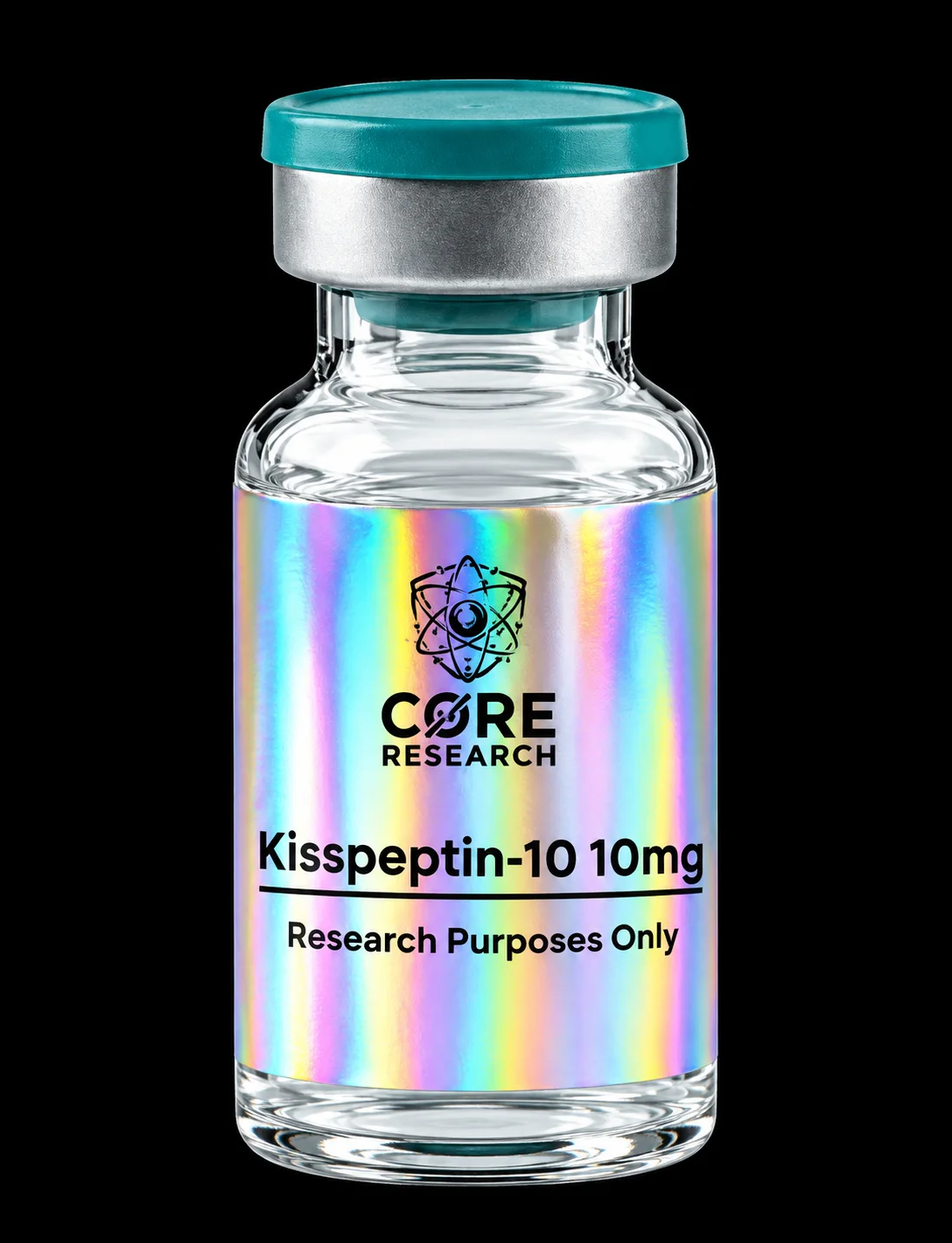
Description
Kisspeptin-10 10mg from Core Research is a research-only catalogue item. Nominal 10mg lyophilised vial of kisspeptin-10 (KP-10). The “10” in the molecule’s name means ten residues; the 10mg on the product label is a separate material quantity. For in-vitro laboratory research only; not for human or veterinary use.
What exactly is supplied?
Nominal 10mg lyophilised vial of kisspeptin-10 (KP-10). The “10” in the molecule’s name means ten residues; the 10mg on the product label is a separate material quantity. The amount on the product name is a catalogue declaration, not a measurement of mass, chemical purity or content for an individual lot. Check the product and the applicable documentation if a specification is essential to your experiment.
| Attribute | What the product page establishes |
|---|---|
| Exact catalogue listing | Kisspeptin-10 10mg |
| Labelled quantity | 10mg nominal per listed item |
| Presentation | Lyophilised vial |
| Research entity | Kisspeptin-10 (KP-10) |
| Declared use | In-vitro laboratory research only; not human or veterinary use |
| Lot evidence | Request the report applicable to the lot and exact format proposed for dispatch |
The supplied label and any quality record should identify the lot. If you need the exact chemical form, sequence, terminal groups, counter-ion, mass basis, analytical identity or content, ask for a record tied to this product. Literature references and reference-database formulae are not supplier assay data.
How does this compare with the other formats?
These are separate catalogue products. A name shared across vial, refill and pen listings does not establish identical packaging, fill, solvent, compatibility, concentration or shelf life. A related molecule is not a substitutable chemical merely because it appears in the same research category.
| Catalogue item | Why the distinction matters |
|---|---|
| Kisspeptin-10 10mg — this listing | Single-material vial listing; lyophilised research product as catalogued. Not a ready-to-use solution, pen or refill. |
| Semax 10mg | Distinct neuropeptide research system |
| Selank 10mg | Distinct tuftsin-derived peptide |
KP-10 is a short kisspeptin, not kisspeptin-54 or an equivalent quantity of the KISS1 precursor. Published receptor responses should be assigned to the peptide length and preparation the investigators actually used.
Why is Kisspeptin-10 (KP-10) researched?
Kisspeptin-10 is a ten-residue C-terminal peptide derived from the KISS1 precursor and an agonist ligand for the kisspeptin receptor KISS1R, formerly GPR54. It is a different molecular entity from kisspeptin-54 or the full precursor.
Scope of the studies selected below: Mouse GnRH-neuron explant calcium experiments and GPR54-mediated signalling in cell migration models; not reproductive treatment or clinical hormone guidance.
KISS1 processing and receptor identity
KISS1 is a precursor that can give rise to kisspeptin peptides of different lengths sharing the bioactive C-terminal region. KP-10 names one such shorter peptide; its ten-residue identity should not be mistaken for the amount in the vial, which is a separate 10mg nominal quantity. Those two uses of “10” identify different properties. 1
KISS1R/GPR54 is a G-protein-coupled receptor. KP-10–receptor activation is studied through phospholipase C-associated signalling and changes in intracellular calcium, but an activated receptor readout is not by itself a direct measure of a whole-body hormone response. 1
Calcium oscillations in mouse GnRH neurons
Constantin and colleagues examined GnRH-1 neurons maintained in mouse nasal explants. Kisspeptin-10 initiated calcium oscillations in previously quiescent neurons and altered spiking patterns in already active cells. The authors connected the response to plasma-membrane electrical activity and PLC-dependent signalling. This is a particularly useful study because it records the cellular measurement and proposed signalling route. 1
The experiments used developing neuronal tissue maintained in a defined laboratory preparation. Such calcium dynamics should not be presented as a clinical reproductive outcome, nor do they quantify an appropriate quantity of supplied peptide for an assay. 1
A separate CXCR4-related question in tumour cells
Navenot and colleagues studied KP-10/GPR54 signalling in cells expressing the chemokine receptor CXCR4. KP-10 exposure affected migration responses to CXCL12 and some downstream signalling measurements. The study concerns cross-talk between receptor systems in a cell model, not prevention of metastatic disease in patients. 2
Its value is the contrast with the neuronal experiment: the same named ligand can be studied against calcium oscillations in one system and chemotaxis in another. Experimental model and comparator determine what has actually been shown. 1, 2
Material identity and translational limits
KP-10, kisspeptin-54 and differently modified fragments should not share one presumed molecular mass, terminal chemistry or preparation stability. No study cited here validates the supplier lot or a human fertility, hormone or oncology application.
What analytical evidence matters for this exact item?
A relevant certificate or analytical report should identify the tested material, reported lot, form and method. Separate identity (what was tested), purity (how the major signal relates to impurities under one method), content (how much material was measured) and the packaging/fill specification. A cited paper investigates the research entity; it does not certify the vial or cartridge supplied here.
Use Batch Documentation to enquire before purchase, specifying “Kisspeptin-10 10mg” and your required tests. No existing order or container lot is needed to make a pre-purchase enquiry under Core Research’s published documentation route. After delivery, match the returned report to the supplied lot rather than assuming a certificate for another item applies.
The guide to reading a peptide CoA explains how to identify the tested sample; the HPLC guide distinguishes chromatographic peak area from measured content, and the mass-spectrometry guide explains how observed ions and expected identity differ. An absent lot-specific result is treated as unknown, never as a default purity or sterility claim.
KP-10 length, terminal form and expected mass
Ensure the specification explicitly names the ten-residue peptide rather than another KISS1-derived isoform. Expected mass and ion assignments depend on terminal chemistry, counter-ion and charge state. A reference value from a sequence database is a check on interpretation, not a lot-specific measurement.
Vial format and nominal amount
This product is the standalone vial listing. A nominal dry-material amount is not an aqueous concentration, a number of samples or a verified peptide-content assay. Any solution properties depend on the actual compound form, solvent, container, method and controls, which this page does not specify.
Storage, dispatch and laboratory receiving
Follow the conditions documented on the supplied label or applicable product/lot specification. Fixed refrigerated/frozen shelf lives, dry-product expiry, prepared-solution lifetime and transport-temperature promises are not inserted without appropriate evidence. An unopened material and a prepared solution have different possible stability concerns.
Proteolysis, surface adsorption, oxidation or aggregation may affect peptide experiments depending on the chemistry and preparation. The relevant tests and any storage conditions belong in the actual specification and laboratory method, not an unsourced universal rule.
At receipt, record the name, quantity, batch/lot identifier, packaging condition and closure. Compare them against the purchase record and any available certificate. The research-product receiving checklist provides the workflow; for delayed or unexpectedly warm deliveries use the arrival-condition guide and retain photographs/tracking where relevant.
Core Research publishes UK dispatch from Birmingham and plain, unmarked outer packaging. Tracking is supplied where provided by the chosen service. The actual delivery charge and expected timing depend on destination, order and checkout options; no universal next-day or temperature-controlled service is promised by this product draft.
Ordering and support
Select the desired quantity using the native WooCommerce purchase panel; current price, availability and the available checkout methods are determined by the live site, not by this static description. For supplier, material or lot questions, contact Core Research before placing an order.
Request batch documentation · Ask about this product · Institutional procurement · Shipping & Delivery
The supplied research material is not intended for clinical treatment, disease prevention, human or veterinary administration, food, cosmetic self-use or any unsupervised personal procedure.
Frequently asked ordering and laboratory questions
What is included in this product?
Single-material vial listing; lyophilised research product as catalogued. Not a ready-to-use solution, pen or refill. The catalogue amount is 10mg nominal. Confirm any accessory, packaging or filled-state requirement before buying.
Can I request batch documentation before ordering?
Yes. The published documentation route accepts pre-purchase enquiries naming the product and presentation. Ask for the actual tests and lot applicability needed by your laboratory; a reply or historical certificate should not be mistaken for a guaranteed current-lot assay.
Does the labelled amount determine the concentration or experimental sample count?
No. A labelled mass is not a liquid volume or measured solution concentration. Experimental consumption depends on method, assay design and validated material-content basis. This page does not provide a preparation or use protocol.
Is this a medicinal or ready-to-administer product?
No. This listing is restricted to in-vitro laboratory research and does not provide a therapeutic, cosmetic, veterinary or personal-use indication.
What research finding is most important to interpret carefully?
KP-10 changed calcium oscillations in mouse GnRH-neuron explants and chemotaxis in a separate cell system; neither is a human fertility outcome.
How do delivery and institutional quotations work?
Use the live checkout for the available price, stock, shipping methods and final charge. Institutions can request quotations or purchase-order references through Core Research’s procurement route; raise any specific lot or documentation condition before ordering.
What should we do if the item is damaged or labelled incorrectly?
Preserve the packaging and lot information, take clear photographs and contact Core Research with your order details before using the material in an experiment.
Research references
[1] Constantin S et al. (2009). KP-10-facilitated calcium oscillations in GnRH-1 neuronal explants. PMID 18948403. View research record
[2] Navenot J-M et al. (2005). KP-10/GPR54 modulation of CXCR4-dependent cell chemotaxis. PMID 16288036. View research record