Description
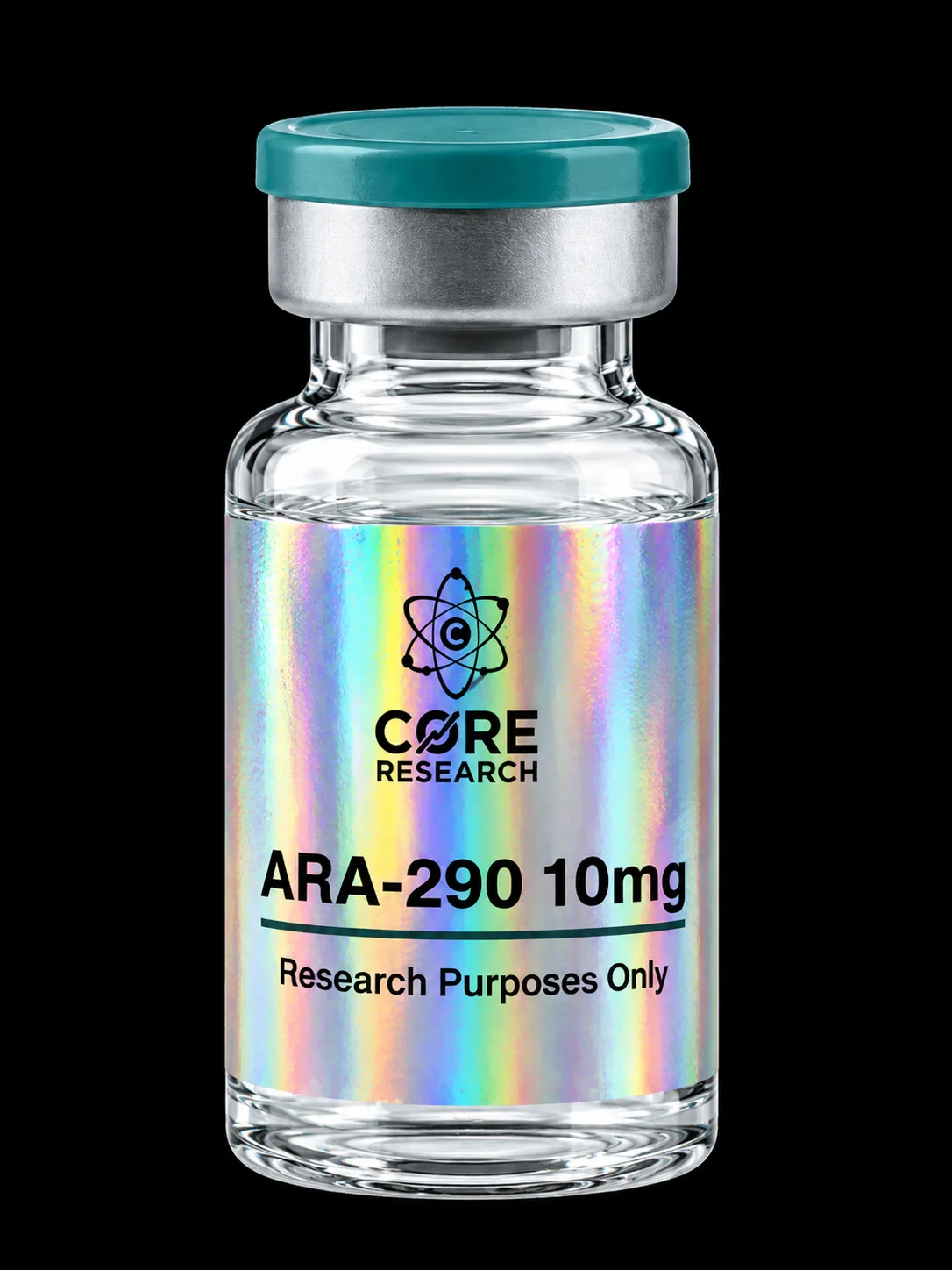
ARA-290 10mg is a lyophilised research-peptide vial from Core Research. Also called cibinetide, ARA-290 was developed from the three-dimensional structure of erythropoietin to investigate tissue-protective signalling separately from red-blood-cell production. Its research spans cellular stress, inflammatory responses and nerve-injury models. 1
This page connects the supplied item with the primary studies and their differing endpoints. For laboratory research only; not for human or veterinary use. Request product-specific batch documentation.
ARA-290 10mg: product details
| Detail | This listing |
|---|---|
| Product | ARA-290 10mg |
| Literature name | Cibinetide; related helix-B surface-peptide terminology |
| Labelled amount | 10mg per vial |
| Presentation | Lyophilised research material |
| Researched peptide design | An 11-amino-acid surface-derived EPO mimetic 1 |
| Analytical identity | Exact sequence, terminal form and counter-ion should match the applicable specification |
| Price and availability | Current values in the live purchase panel |
The scientific literature describes the researched entity. A product name does not independently verify every chemical-form or analytical claim about a supplied lot. Use the exact item and presentation when requesting documents rather than treating every EPO-derived peptide as interchangeable.
This exact item: ARA-290 10mg is one lyophilised vial. Cibinetide is a name used for ARA-290 in published studies, but the name alone does not verify this lot’s exact sequence, terminal chemistry or content. Specify ARA-290 10mg vial in a documentation enquiry rather than supplying a research paper as a substitute for product evidence.
Ordering, dispatch and document questions
Can I request documentation before paying?
Yes. The Core Research batch-documentation enquiry accepts pre-purchase requests: name the exact catalogue item and supplied format, and identify which material or analytical specification your laboratory needs. A received-vial lot number is not needed to ask. Once material arrives, match any report to the lot on its container and your order reference. Where an applicable CoA exists for the supplied lot, the site’s published delivery policy says it is issued with the consignment. This is a policy description, not a claim that a particular batch report was inspected for this draft.
Where is the order dispatched from, and when will it arrive?
Core Research states that it dispatches from Birmingham, UK, in plain outer packaging. Published shipping information explains tracking where provided and conditions affecting processing and carrier transit. Exact charges and arrival estimates depend on the order and destination; they are not guaranteed here. The live product panel and checkout remain the sources for current price, availability and the applicable order total.
What if the item or its documentation does not match?
Keep the packaging and the printed lot identifier, take clear photographs of visible discrepancies, and contact Core Research promptly with the item, order reference and evidence. Raise a discrepancy before using the material; see the receiving checklist and delivery-condition guidance.
What is ARA-290, and how does it differ from erythropoietin?
Erythropoietin is best known for its role in red-blood-cell production. Brines and colleagues examined whether parts of its molecular surface could reproduce tissue-protective responses without reproducing that erythropoietic activity. Their work identified an 11-residue peptide modelled on the aqueous face of helix B and tested it in cell and animal injury models. 1
This makes separating biological functions the central research question. ARA-290 is not full-length erythropoietin, and a short surface-derived peptide should not inherit every property or clinical application of the parent protein. “Nonerythropoietic” describes the tested distinction; it is not a blanket claim of safety or freedom from other biological effects.
Receptor models: functional evidence and direct binding
Much of the ARA-290 literature uses the term innate repair receptor for a proposed relationship involving the erythropoietin receptor, EPOR, and the beta-common receptor, CD131. It is important to distinguish evidence that a receptor component affects a response from direct proof of the proposed receptor assembly.
What the nerve-injury experiments found
Swartjes and colleagues studied tactile and cold allodynia after peripheral nerve injury in rats and mice. ARA-290 changed these responses in rats and wild-type mice, but the effect was absent in beta-common-receptor knockout mice. Allodynia is a response to a stimulus that is ordinarily not painful; it is an experimental endpoint, not a generic measure of “nerve repair”. 2
The knockout comparison supports a functional role for that receptor component in the model. It does not by itself establish the precise extracellular binding arrangement or a clinical effect of this vial.
What the biophysical experiments did not find
Cheung Tung Shing and colleagues examined the isolated extracellular regions of EPOR and the beta-common receptor, with and without EPO or ARA290. Their in-vitro biophysical analysis did not find a specific association between those extracellular regions. 4
These results qualify a simple receptor-diagram explanation. They do not erase every cellular or animal observation; instead, the functional and structural experiments answer different questions. The precise receptor assembly therefore remains an unresolved part of the explanation.
Other preclinical research
Renal ischemia and reperfusion
In a rat renal ischemia/reperfusion study, van Rijt and colleagues compared different experimental timing conditions. Early post-reperfusion treatment improved renal-function measures and reduced inflammation and acute-injury measures. Later or repeated treatment did not produce the same inflammatory or acute-injury effects. 5
The difference is useful: the biological context and timing of an experiment can change the result. It is not a universal kidney-protection claim or a protocol for a supplied research material.
Wound-healing models
Bitto and colleagues examined an incisional-wound model in mice with genetic diabetes. The study measured re-epithelialisation, angiogenesis, wound strength and markers including VEGF, Akt/eNOS signalling and oxidative injury. Cibinetide improved several abnormalities observed in the diabetic model. 6
Those endpoints provide more substance than the label “tissue repair”, but remain specific to the injury model and test material. They do not establish an effect across all tissues or preparations.
What did the controlled human studies measure?
A small exploratory sarcoidosis study
Heij and colleagues enrolled 22 people with sarcoidosis and small-fibre-neuropathy symptoms in a double-blind, placebo-controlled pilot. The study reported a greater improvement in its small-fibre-neuropathy screening-list score with ARA-290. However, Brief Pain Inventory and fatigue scores improved similarly in both groups; those measures did not show the same treatment separation. 3
That distinction matters. An improvement in one symptom instrument is not proof that every pain, fatigue or functional outcome improved relative to placebo. The study was exploratory and does not establish comprehensive safety or efficacy for this commercial vial.
Corneal nerve fibres are not the same endpoint as pain
A later phase 2b trial by Culver and colleagues studied 64 people with sarcoidosis-associated small-nerve-fibre loss and neuropathic pain. Its primary endpoint was corneal nerve-fibre area. One treatment group showed a significant placebo-corrected change in that measure; the reported placebo-corrected pain comparison did not reach statistical significance. 7
The study is useful for understanding surrogate tissue endpoints versus patient-reported symptoms. A favourable nerve-imaging result should not be rewritten as a proven pain outcome, or as proof that an unrelated preparation reproduces the trial material.
Reading the evidence together
| Evidence type | What it helps answer | What it does not settle |
|---|---|---|
| Surface-peptide design | Can functions of a larger protein be separated experimentally? | Every property of erythropoietin or of a commercial lot |
| Receptor knockout | Is a component needed for the measured response in that model? | A complete molecular binding structure |
| Direct binding experiments | Do the tested extracellular regions specifically associate? | All possible signalling behaviour in intact cells |
| Human pilot and surrogate endpoints | Which defined outcomes changed relative to the comparator? | Broad clinical performance, long-term safety or vial equivalence |
For wider material distinctions, use the repair-research comparison. Different experimental programmes are not a basis for treating ARA-290, BPC-157 and other catalogue materials as interchangeable.
Batch documentation and laboratory receiving
Check that the material specification identifies the actual sequence and terminal form, chemical form, nominal amount and relevant lot. Chromatographic purity, molecular-identity evidence and quantitative content answer different questions. Where additional tests are claimed, the applicable report must contain the method and result.
Use the CoA-reading guide, HPLC guide and mass-spectrometry guide to interpret the evidence. Request documentation using ARA-290 10mg, vial format; include lot and order identifiers after receipt.
Follow the storage conditions documented for the supplied material and packaging. Inspect the vial and closure on arrival, compare the item and lot with the order, and retain the records. The receiving checklist and storage guide support those checks without assigning an unsupported universal shelf life.
Product questions
Are ARA-290 and cibinetide the same name in the literature?
Cibinetide is used for ARA-290 in the cited research. Still match the exact sequence, terminal modification and product form when connecting a study, specification and batch report.
Is ARA-290 the same as erythropoietin?
No. It is a short peptide designed from a region of EPO’s molecular surface, not the full EPO protein. The original research explicitly investigated separating tissue-related responses from erythropoiesis. 1
Does a research paper verify this 10mg vial?
No. It establishes findings for the study material and model. Product-specific identity, content and testing claims require the applicable supplier and lot records.
See Shipping & Delivery, Testing & Quality Methodology and the research-use boundary for ordering context. Contact Core Research with a focused product or documentation question.
Selected references
[1] Brines M et al. (2008). Nonerythropoietic, tissue-protective peptides derived from the tertiary structure of erythropoietin. Proceedings of the National Academy of Sciences. DOI: 10.1073/pnas.0805594105.
[2] Swartjes M et al. (2011). ARA290, a peptide derived from the tertiary structure of erythropoietin, produces long-term relief of neuropathic pain: an experimental study in rats and beta-common receptor knockout mice. Anesthesiology 115:1084–1092. DOI: 10.1097/ALN.0b013e31822fcefd.
[3] Heij L et al. (2012). Safety and efficacy of ARA 290 in sarcoidosis patients with symptoms of small fiber neuropathy: a randomized, double-blind pilot study. Molecular Medicine. DOI: 10.2119/molmed.2012.00332.
[4] Cheung Tung Shing KS et al. (2018). EPO does not promote interaction between the erythropoietin and beta-common receptors Scientific Reports 8. DOI: 10.1038/s41598-018-29865-x.
[5] van Rijt WG et al. (2013). Renoprotective capacities of non-erythropoietic EPO derivative, ARA290, following renal ischemia/reperfusion injury. Journal of Translational Medicine 11:286. DOI: 10.1186/1479-5876-11-286.
[6] Bitto A et al. (2018). Activation of the EPOR-beta common receptor complex by cibinetide ameliorates impaired wound healing in mice with genetic diabetes. Biochimica et Biophysica Acta — Molecular Basis of Disease. DOI: 10.1016/j.bbadis.2017.12.006.
[7] Culver DA et al. (2017). Cibinetide Improves Corneal Nerve Fiber Abundance in Patients With Sarcoidosis-Associated Small Nerve Fiber Loss and Neuropathic Pain. Investigative Ophthalmology & Visual Science. DOI: 10.1167/iovs.16-21291.