Description
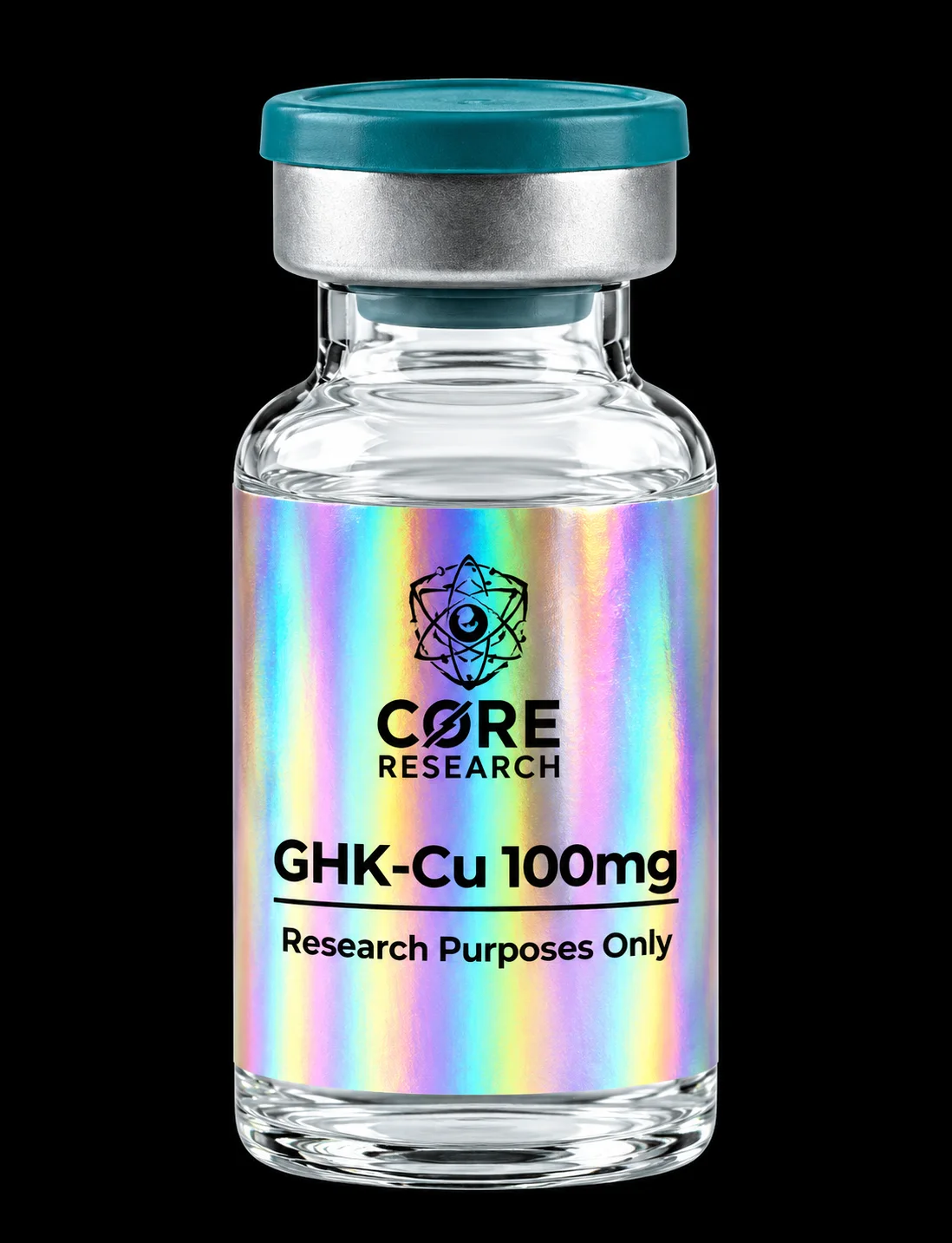
GHK-Cu 100mg is a lyophilised copper-peptide vial from Core Research. The named material combines the tripeptide Gly-His-Lys with copper. Its research spans extracellular-matrix regulation, epithelial barriers and inflammatory signalling; the following sections explain what those studies measured.
This is the 100mg vial, not the 50mg listing, refill or complete pen. For laboratory research only; not for human or veterinary use. Request applicable batch documentation.
GHK-Cu 100mg: identity and supplied presentation
| Detail | This listing |
|---|---|
| Material | Copper complex of glycyl-L-histidyl-L-lysine |
| Peptide notation | Gly-His-Lys; GHK |
| Labelled quantity | 100mg per vial |
| Presentation | Lyophilised material in a sealed vial |
| Catalogue salt designation | Acetate; confirm the applicable specification and content basis |
| Quantity interpretation | Named copper-peptide material, not 100mg of elemental copper |
| Price and availability | Current values in the native purchase panel |
GHK and GHK-Cu are not identical analytical entities. The copper-free peptide, its copper complex and an acetate-containing preparation need to be distinguished when reading molecular formulas, spectra or weighed amounts.
For reference, PubChem lists copper-free GHK as C₁₄H₂₄N₆O₄, 340.38 g/mol. Its specifically charged prezatide-copper entry is C₁₄H₂₃CuN₆O₄⁺, 402.92 g/mol. The charge is part of that reference identity. Neither database entry measures this vial’s counter-ion, water or other formulation content. 6 7
The GHK-Cu research overview provides wider compound context. Match the named chemical form on the label, specification and report before interpreting a molecular-ion result.
Before choosing a format: this is the 100mg lyophilised vial, not the separately listed 50mg vial, refill or pen. A shared compound name does not establish the same formula basis, vehicle or device. Compare GHK-Cu 50mg, 100mg refill and 100mg pen.
Lot verification: a paper describing the copper-peptide complex is not a certificate for this vial. Request the applicable batch report before relying on a purity, content, counter-ion or storage claim.
Ordering, dispatch and document questions
Can I request documentation before paying?
Yes. The Core Research batch-documentation enquiry accepts pre-purchase requests: name the exact catalogue item and supplied format, and identify which material or analytical specification your laboratory needs. A received-vial lot number is not needed to ask. Once material arrives, match any report to the lot on its container and your order reference. Where an applicable CoA exists for the supplied lot, the site’s published delivery policy says it is issued with the consignment. This is a policy description, not a claim that a particular batch report was inspected for this draft.
Where is the order dispatched from, and when will it arrive?
Core Research states that it dispatches from Birmingham, UK, in plain outer packaging. Published shipping information explains tracking where provided and conditions affecting processing and carrier transit. Exact charges and arrival estimates depend on the order and destination; they are not guaranteed here. The live product panel and checkout remain the sources for current price, availability and the applicable order total.
What if the item or its documentation does not match?
Keep the packaging and the printed lot identifier, take clear photographs of visible discrepancies, and contact Core Research promptly with the item, order reference and evidence. Raise a discrepancy before using the material; see the receiving checklist and delivery-condition guidance.
Why researchers study GHK-Cu
A useful organising question is how tissue context changes matrix and inflammatory responses. Increased collagen production in dermal cells and reduced excessive collagen deposition in a fibrotic lung model are different findings, not a universal instruction to raise or lower collagen. 3 4
The research also examines junctional proteins between epithelial cells, oxidative-stress responses, matrix-regulating enzymes and their inhibitors. These are more informative than a single claim that a copper peptide “rejuvenates” every tissue.
Epithelial barriers: junction proteins and STAT3
Mao and colleagues investigated chemically induced colitis in mice and a co-culture of epithelial cells and macrophages. They reported greater ZO-1 and occludin expression and improved epithelial-cell healing in the co-culture system. These proteins and measurements address barrier organisation and cell behaviour. 1
Reducing STAT3 experimentally cancelled the additional closure and junction-protein responses, while some anti-inflammatory activity remained. That supports more than one signalling contribution. SIRT1 was identified as a potential target using the study’s combined approaches; this is not settled proof of direct binding. The findings concern those preclinical systems, not a demonstrated effect of this vial in people. 1
Inflammation and oxidative stress: NF-κB and p38 MAPK
Park and colleagues examined LPS-stimulated macrophages and a mouse acute-lung-injury model. GHK-Cu exposure reduced reactive oxygen species and selected inflammatory cytokines, increased superoxide-dismutase activity, and suppressed NF-κB p65 and p38 MAPK signalling. Lung inflammatory-cell infiltration was also reduced in the model. 2
This separates two related questions: inflammatory signalling and oxidative stress. The separate cytokine, reactive-oxygen and tissue measurements help identify which part of the response changed. 2
Matrix remodelling and fibrosis
In bleomycin-induced mouse lung fibrosis, Ma and colleagues reported reduced collagen deposition and inflammatory changes. The work investigated Nrf2, NF-κB and TGF-β/Smad signalling, matrix-enzyme balance and markers associated with epithelial-to-mesenchymal transition. 3
The model helps explain why GHK-Cu research is about regulated matrix turnover rather than simply “more collagen”. It does not establish an anticancer effect, prevention of metastasis or a uniform response across tissues. 3
What do skin and topical-formulation studies show?
Badenhorst and colleagues combined dermal-fibroblast work with a separate study of a nano-carrier topical serum. The cell work examined collagen, elastin and matrix-regulating proteins. The topical component tested the formulated serum, not an unformulated research vial. 4
In the eight-week vehicle-control comparison, mean wrinkle-volume change from baseline was −24.1% with the GHK-Cu serum and −15.0% with control serum. The paper’s 55.8% figure is a different between-treatment comparison, not the serum’s baseline percentage reduction. The study was small, formulation-specific and commercially funded. 4
A different study by Miller and colleagues assessed a GHK-Cu skincare regimen after CO₂ laser resurfacing. Thirteen participants completed it. Objective assessments did not show significant between-group differences in redness, wrinkles or overall skin quality, although a participant-reported measure favoured the GHK-Cu regimen. Different formulations and procedures mean the two studies are not identical tests. 5
The practical reading rule is to retain the tested formulation, comparator and endpoint. A positive result for a formulated topical product cannot establish cosmetic performance, purity or suitability of this research vial.
Comparing the evidence
| Research setting | Useful question |
|---|---|
| Epithelial-cell models | Which junction proteins and signalling dependencies changed? |
| Macrophage and injury models | Were inflammatory and oxidative-stress endpoints measured separately? |
| Fibrotic tissue | Did matrix deposition or turnover change in that injury context? |
| Topical formulations | What vehicle, comparator, population and outcome were actually tested? |
The repair-research comparison distinguishes GHK-Cu from BPC-157, TB-500 and KPV. It does not rank the materials as interchangeable substitutes.
Analytical quality and batch documentation
Check identity, chromatographic purity and content as separate questions. A relevant report should identify the sample and chemical form, analytical method, result and lot. Where a spectrum is supplied, the ion and charge assignment matter. An HPLC peak-area percentage is not automatically a mass-content result.
Copper-containing species also need appropriate interpretation: colour alone is not proof of identity, coordination state or purity. Likewise, an endotoxin result does not establish sterility, and dry appearance does not establish a measured moisture value.
Use the CoA-reading guide, HPLC guide and mass-spectrometry guide to interpret available records. These describe evidence questions, not a claim that every test was performed on every batch.
For a documentation enquiry, specify GHK-Cu 100mg, lyophilised vial. Before purchase, state the information required; after delivery, include the container lot and order reference. Keep the report linked to the correct batch record.
Storage, receiving and related formats
Use the conditions documented for the supplied material and packaging. Unopened lyophilised material and prepared solutions have different stability questions; a generic peptide identity does not establish a universal expiry or shipping-excursion tolerance.
On receipt, check the item, nominal amount, lot, closure and packaging. Blue or blue-green appearance can be consistent with a copper-peptide description but is not an analytical release test. The receiving checklist, storage guide, handling hub and solvent/buffer guide provide supporting context. Record any unexpected arrival condition using the warm or delayed delivery guide.
| Related item | Difference to check |
|---|---|
| GHK-Cu 50mg | Lower nominal amount of the same named compound |
| GHK-Cu 100mg Refill | Separate refill presentation |
| GHK-Cu 100mg Pen | Separate pen-format item |
Use the vial-versus-pen comparison to assess format and documentation differences; a shared name does not establish identical formulation or device compatibility.
Product questions
Is GHK-Cu 100mg the same as 100mg of copper?
No. The label describes the named copper-peptide material, not an elemental-copper amount. Interpret quantities using the applicable chemical form and content basis.
Does the 100mg vial have different biological effects from the 50mg vial?
The catalogue distinguishes nominal amounts. That difference alone does not establish a different mechanism, formulation or biological outcome. Compare the actual specifications and relevant experimental conditions.
Is this a finished skincare product?
No. This is a laboratory material. References to topical research describe the studied formulations and do not convert the vial into a finished cosmetic product.
For ordering, consult Shipping & Delivery, Testing & Quality Methodology and the research-use boundary. Contact Core Research about a specific product or document question.
Selected references
[1] Mao S et al. (2025). Exploring the beneficial effects of GHK-Cu on an experimental model of colitis and the underlying mechanisms Frontiers in Pharmacology 16. DOI: 10.3389/fphar.2025.1551843.
[2] Park JR; Lee H; Kim SI; Yang SR (2016). The tri-peptide GHK-Cu complex ameliorates lipopolysaccharide-induced acute lung injury in mice. Oncotarget. DOI: 10.18632/oncotarget.11168.
[3] Ma WH et al. (2020). Protective effects of GHK-Cu in bleomycin-induced pulmonary fibrosis via anti-oxidative stress and anti-inflammation pathways. Life Sciences. DOI: 10.1016/j.lfs.2019.117139.
[4] Badenhorst T; Svirskis D; Merrilees M; Bolke L; Wu Z (2016). Effects of GHK-Cu on MMP and TIMP Expression, Collagen and Elastin Production, and Facial Wrinkle Parameters. Journal of Aging Science 4:166. DOI: 10.4172/2329-8847.1000166.
[5] Miller TR; Wagner JD; Baack BR; Eisbach KJ (2006). Effects of topical copper tripeptide complex on CO2 laser-resurfaced skin. Archives of Facial Plastic Surgery. DOI: 10.1001/archfaci.8.4.252.
[6] NCBI PubChem (accessed 5 November 2026). Glycyl-L-histidyl-L-lysine, CID 73587 PubChem reference record.
[7] NCBI PubChem (accessed 5 November 2026). Prezatide copper, CID 71587328 PubChem reference record.