Description
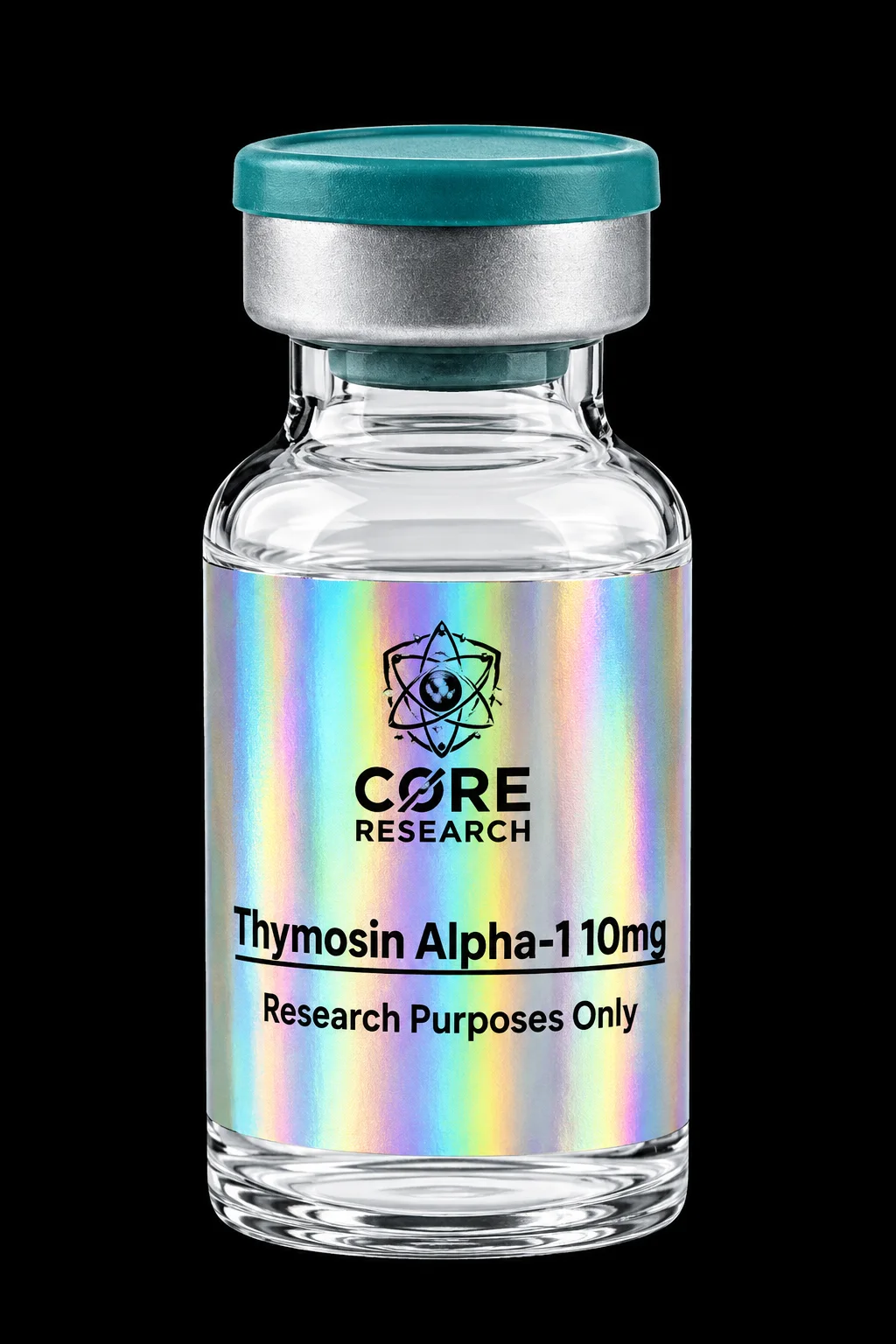
Thymosin Alpha-1 10mg from Core Research is a research-only catalogue item. Nominal 10mg vial of thymosin alpha-1 (thymalfasin) for research, with selected dendritic-cell and Toll-like-receptor experiments distinguished from medicinal and human clinical claims. For in-vitro laboratory research only; not for human or veterinary use.
What exactly is supplied?
Nominal 10mg vial of thymosin alpha-1 (thymalfasin) for research, with selected dendritic-cell and Toll-like-receptor experiments distinguished from medicinal and human clinical claims. The amount on the product name is a catalogue declaration, not a measurement of mass, chemical purity or content for an individual lot. Check the product and the applicable documentation if a specification is essential to your experiment.
| Attribute | What the product page establishes |
|---|---|
| Exact catalogue listing | Thymosin Alpha-1 10mg |
| Labelled quantity | 10mg nominal per listed item |
| Presentation | Lyophilised vial |
| Research entity | Thymosin alpha-1 (thymalfasin) |
| Declared use | In-vitro laboratory research only; not human or veterinary use |
| Lot evidence | Request the report applicable to the lot and exact format proposed for dispatch |
The supplied label and any quality record should identify the lot. If you need the exact chemical form, sequence, terminal groups, counter-ion, mass basis, analytical identity or content, ask for a record tied to this product. Literature references and reference-database formulae are not supplier assay data.
How does this compare with the other formats?
These are separate catalogue products. A name shared across vial, refill and pen listings does not establish identical packaging, fill, solvent, compatibility, concentration or shelf life. A related molecule is not a substitutable chemical merely because it appears in the same research category.
| Catalogue item | Why the distinction matters |
|---|---|
| Thymosin Alpha-1 10mg — this listing | Single-material vial listing; lyophilised research product as catalogued. Not a ready-to-use solution, pen or refill. |
| TB-500 10mg | Not thymosin alpha-1; thymosin-beta-related research |
| Glutathione 1500mg | A different molecule and biological research question |
Thymosin alpha-1 should not be confused with thymosin beta-4/TB-500. Their primary sequences and research questions are different; a study about actin binding by beta-4 cannot verify the immunological response of alpha-1.
Why is Thymosin alpha-1 (thymalfasin) researched?
Thymosin alpha-1 is an acetylated 28-residue peptide investigated in innate and adaptive immunological signalling. It is chemically unrelated to thymosin beta-4/TB-500 despite sharing the broad “thymosin” name.
Scope of the studies selected below: Dendritic-cell differentiation and maturation in cultures of human CD14+ monocytes, mouse models of fungal immune responses and their mechanistic limitations.
Thymosin alpha-1 is not TB-500
Thymosin alpha-1 and thymosin beta-4 represent different peptide entities from distinct research literatures. Alpha-1 is commonly described as an N-acetylated 28-amino-acid peptide; beta-4 is a different actin-associated protein fragment system. Similar family labels do not establish similar sequence, mechanism or assay interpretation. 1, 2
In experimental immunology, thymosin alpha-1 is studied against cell differentiation, receptor-driven signalling and inflammatory mediators. It is not adequately described by the broad phrase “boosts the immune system”, because immune responses are pathway-, cell- and context-dependent.
Human-derived dendritic-cell culture findings
Yao and colleagues cultured CD14-positive human peripheral-blood monocytes and followed their differentiation into dendritic cells. In the presence of thymosin alpha-1 the resulting cells showed altered maturation markers including CD40, CD80 and MHC molecules. The authors also found reduced dextran-antigen uptake in one differentiation context and increased ability of matured cells to stimulate allogeneic T-cell proliferation. These different assays are not contradictory: maturation can change antigen acquisition and presentation capacity in different ways. 1
The study also observed signalling changes involving p38 MAPK and NF-κB. Those pathway names describe the molecular context of that culture; they are not evidence that this research vial has been quality-tested or that its use produces a clinical benefit. 1
Toll-like-receptor responses in a fungus model
Romani and colleagues examined thymosin alpha-1 in dendritic cells challenged with Aspergillus-related experimental conditions and in susceptible mice. They reported IL-12-related dendritic-cell responses and MyD88-dependent signalling involving Toll-like receptors, with additional observations in mouse immune-response models. 2
MyD88 is an adaptor used by many innate-receptor pathways; it does not uniquely identify one direct thymosin-alpha-1 binding receptor. The mouse outcome concerns a defined infection and immune environment and should not be converted into a general statement about human infection treatment or disease prevention. 2
Model interpretation and source boundaries
A direct cultured human immune-cell response is not a human clinical trial. Likewise, immune recovery in a particular transplanted-mouse model does not establish general clinical efficacy or use conditions for a supplier vial. The selected studies explain mechanistic questions without prescribing treatment or conferring medicinal equivalence on a catalogue material.
What analytical evidence matters for this exact item?
A relevant certificate or analytical report should identify the tested material, reported lot, form and method. Separate identity (what was tested), purity (how the major signal relates to impurities under one method), content (how much material was measured) and the packaging/fill specification. A cited paper investigates the research entity; it does not certify the vial or cartridge supplied here.
Use Batch Documentation to enquire before purchase, specifying “Thymosin Alpha-1 10mg” and your required tests. No existing order or container lot is needed to make a pre-purchase enquiry under Core Research’s published documentation route. After delivery, match the returned report to the supplied lot rather than assuming a certificate for another item applies.
The guide to reading a peptide CoA explains how to identify the tested sample; the HPLC guide distinguishes chromatographic peak area from measured content, and the mass-spectrometry guide explains how observed ions and expected identity differ. An absent lot-specific result is treated as unknown, never as a default purity or sterility claim.
Different thymosin families require different identification
Confirm the alpha-1 peptide identity and terminal modifications rather than accepting an assay for TB-500 or a generic “thymosin” material. Such a report also needs explicit batch linkage and method context if purity or content is important to your laboratory.
Vial format and nominal amount
This product is the standalone vial listing. A nominal dry-material amount is not an aqueous concentration, a number of samples or a verified peptide-content assay. Any solution properties depend on the actual compound form, solvent, container, method and controls, which this page does not specify.
Storage, dispatch and laboratory receiving
Follow the conditions documented on the supplied label or applicable product/lot specification. Fixed refrigerated/frozen shelf lives, dry-product expiry, prepared-solution lifetime and transport-temperature promises are not inserted without appropriate evidence. An unopened material and a prepared solution have different possible stability concerns.
Proteolysis, surface adsorption, oxidation or aggregation may affect peptide experiments depending on the chemistry and preparation. The relevant tests and any storage conditions belong in the actual specification and laboratory method, not an unsourced universal rule.
At receipt, record the name, quantity, batch/lot identifier, packaging condition and closure. Compare them against the purchase record and any available certificate. The research-product receiving checklist provides the workflow; for delayed or unexpectedly warm deliveries use the arrival-condition guide and retain photographs/tracking where relevant.
Core Research publishes UK dispatch from Birmingham and plain, unmarked outer packaging. Tracking is supplied where provided by the chosen service. The actual delivery charge and expected timing depend on destination, order and checkout options; no universal next-day or temperature-controlled service is promised by this product draft.
Ordering and support
Select the desired quantity using the native WooCommerce purchase panel; current price, availability and the available checkout methods are determined by the live site, not by this static description. For supplier, material or lot questions, contact Core Research before placing an order.
Request batch documentation · Ask about this product · Institutional procurement · Shipping & Delivery
The supplied research material is not intended for clinical treatment, disease prevention, human or veterinary administration, food, cosmetic self-use or any unsupervised personal procedure.
Frequently asked ordering and laboratory questions
What is included in this product?
Single-material vial listing; lyophilised research product as catalogued. Not a ready-to-use solution, pen or refill. The catalogue amount is 10mg nominal. Confirm any accessory, packaging or filled-state requirement before buying.
Can I request batch documentation before ordering?
Yes. The published documentation route accepts pre-purchase enquiries naming the product and presentation. Ask for the actual tests and lot applicability needed by your laboratory; a reply or historical certificate should not be mistaken for a guaranteed current-lot assay.
Does the labelled amount determine the concentration or experimental sample count?
No. A labelled mass is not a liquid volume or measured solution concentration. Experimental consumption depends on method, assay design and validated material-content basis. This page does not provide a preparation or use protocol.
Is this a medicinal or ready-to-administer product?
No. This listing is restricted to in-vitro laboratory research and does not provide a therapeutic, cosmetic, veterinary or personal-use indication.
What research finding is most important to interpret carefully?
The dendritic-cell and mouse fungal-immune results concern specific laboratory systems, not a universal immune-boosting effect of this vial.
How do delivery and institutional quotations work?
Use the live checkout for the available price, stock, shipping methods and final charge. Institutions can request quotations or purchase-order references through Core Research’s procurement route; raise any specific lot or documentation condition before ordering.
What should we do if the item is damaged or labelled incorrectly?
Preserve the packaging and lot information, take clear photographs and contact Core Research with your order details before using the material in an experiment.
Research references
[1] Yao Q et al. (2007). Thymosin alpha-1 and human monocyte-derived dendritic-cell maturation. PMID 17532057. View research record
[2] Romani L et al. (2004). Thymosin alpha-1 and Toll-like-receptor-related antifungal immune responses. PMID 14982877. View research record