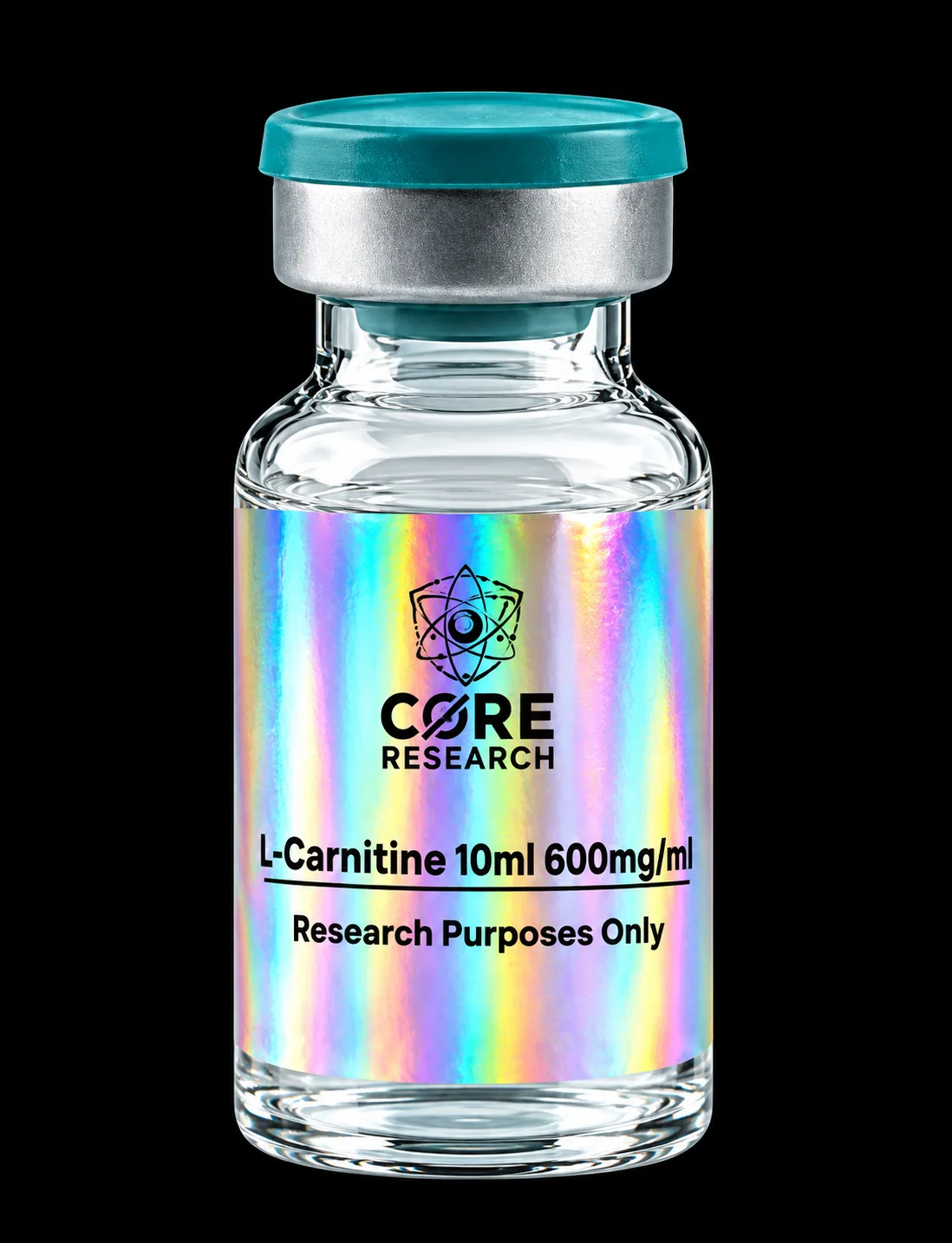
Description
L-Carnitine 600mg/ml 10ml is the Core Research listing for 600mg/ml × 10ml (6000mg nominal) in a finished liquid research preparation supplied in a 10ml container. L-carnitine in a finished liquid preparation. It is supplied for in-vitro laboratory research only, not for human or veterinary use. The exact supplied chemical form, current batch results and any finished-format specifications must be checked against the documentation applicable to this item.
What you receive and what the label means
The current catalogue identifies this product as L-Carnitine 600mg/ml 10ml. This page distinguishes the material name and labelled quantity from independently measured content. Stock and current price are supplied by the live WooCommerce purchase panel rather than duplicated as static claims in the description.
The stated nominal amount is not a prepared solution concentration, analytical purity percentage or guarantee of the number of experiments possible. Those further properties depend on the exact material form, documentation and laboratory method.
| Item | Detail |
|---|---|
| Catalogue product | L-Carnitine 600mg/ml 10ml |
| Labelled amount | 600mg/ml × 10ml (6000mg nominal) |
| Named material / declared composition | L-carnitine in a finished liquid preparation |
| Physical presentation | a finished liquid research preparation supplied in a 10ml container |
| Supply boundary | Laboratory research only; no human or veterinary use |
How this format differs from other products
This listing is a distinct purchasable item. Similar names or family research do not establish identical quantities, chemical forms, solution properties or packaging for another catalogue product.
Concentration and labelled total
The label states 600mg/ml in a 10ml container. Multiplying labelled concentration by labelled fill volume gives 6000mg nominal total. This is a derived label calculation (600mg/ml × 10ml), not a quantitative assay of the specific container or a recommendation for administration.
Research mechanisms and what studies actually found
The following sections distinguish the molecular identity, measured experimental endpoint and limitations of published work. Literature on a pure molecule, animal model or clinical formulation is not analytical evidence for this particular Core Research supply. The cited sources support the described scientific context, not a product-specific efficacy or batch claim.
Long-chain fatty-acid transport into mitochondria
L-carnitine is a small zwitterionic metabolite—not a peptide. The carnitine shuttle enables transport of long-chain fatty-acyl groups across the inner mitochondrial membrane. CPT1 forms acylcarnitine on the outer-facing side, carnitine-acylcarnitine translocase moves it across, and CPT2 regenerates fatty acyl-CoA for mitochondrial β-oxidation. 1
Enzymes and carrier proteins form the pathway
L-carnitine itself is not an enzyme that “burns fat.” The metabolic outcome depends on transporters, the pool of free versus acylated carnitine, acyl-CoA availability and mitochondrial pathways. A purified compound and a living metabolic system are not interchangeable measurements. 1,2
What clinical deficiency research can establish
Longo and colleagues review inherited disorders affecting carnitine transport and the carnitine cycle. Their account is relevant to why OCTN2 and the CPT/CACT proteins matter, but clinical management of deficiency states is not evidence of performance, weight-loss or safety claims for this supplier’s research liquid. 1
Why this formulation differs from a dry peptide vial
A labelled liquid concentration can be checked directly against a formulation assay. The solution also raises questions about pH, vehicle, preservative, impurities, volume accuracy, container compatibility and product-specific storage. None can be inferred from the molecular pathway or the nominal 600mg/ml label. A label alone is not an independently measured content determination.
Batch documentation and evidence before purchase
For a pre-purchase question, use Request batch documentation or email info@core-research.net, naming L-Carnitine 600mg/ml 10ml and its liquid format. You do not need a previous container lot number to enquire. Ask which dispatch lot and exact presentation any proposed report covers.
Read the certificate for sample identification, test method, analyte(s), units, measured content, chromatographic results and issuer. Identity, chromatographic purity and quantitative content answer different questions; one HPLC peak-area value alone does not prove the labelled mass. Laboratory handling and evidence requirements depend on the actual chemical form.
For context see how to read a peptide CoA, HPLC and purity testing and mass-spectrometry identity testing. These guides explain how documents are read; they do not assert that a current lot passed any unobserved test.
Additional documentation for the finished format
For this presentation, check the container and product specification in addition to material identity: fill volume or dry-fill basis, declared constituents, formulation vehicle where applicable, lot traceability, container integrity and any validated compatibility or dispensing property your method requires.
Do not automatically transfer an HPLC result, solvent condition or expiry statement from a different vial, refill, pen or manufacturing lot. Where a material attribute is essential to procurement, request it before ordering rather than assuming it from related items.
Storage, receipt and handling
Follow the storage instructions supplied for this particular product and lot. A fixed dry-material temperature or shelf life is not stated here without authenticated product-specific evidence. Solution stability, if applicable, is a separate question that can depend on solvent, pH, concentration, container and exposure history.
At receipt, inspect the material label, lot and quantity, packaging and closure against the order; record discrepancies before laboratory use. See the research-product receiving checklist and laboratory storage guidance. For late or unexpectedly warm delivery, consult warm or delayed research shipments.
Ordering and laboratory procurement questions
Can I ask for the lot documentation before ordering?
Yes. The Request batch documentation route accepts product/presentation enquiries before an order. Ask whether the available report covers the lot expected to be supplied; availability and analytical scope must not be assumed.
Is this a dry powder needing reconstitution?
No. The catalogue identifies a finished liquid preparation at 600mg/ml in 10ml. Verify its vehicle, pH, storage and concentration assay from product-specific documentation.
Where do orders ship from?
Core Research’s published shipping policy describes dispatch from Birmingham, UK, in plain outer packaging. Available carrier options, shipping charges and tracking depend on the actual order and service. The checkout and shipping policy provide the applicable current information.
Does the labelled amount determine experimental concentration?
No. The labelled mass alone does not determine a prepared concentration, method, recovery, sample number or material content verified by assay. Those require defined volume and material-specific laboratory controls; the page provides no personal-use or administration directions.
Can an institution ask for a quotation?
Yes. The Institutional Procurement page provides a quotation and purchase-order-reference enquiry pathway. State the requested item, quantity, delivery details and any need for a particular lot or document before ordering.
What if the item arrives damaged or differs from the order?
Contact info@core-research.net with the order number, labelled product/lot identifiers and photographs. Keep the packaging and segregate the item from laboratory use until the discrepancy is addressed.
Order or enquire about L-Carnitine 600mg/ml 10ml
Use the native purchase panel for current pricing, stock and quantity selection. For an analytical or format question, contact Core Research before purchase; for shipping information see Shipping & Delivery.
The research discussed above is not a human-use instruction or a claim about medical effects of the supplied item. Read the Research Use Only policy and testing and quality methodology for the published supply and quality framework.
Selected research and identity references
[1] Longo N, Amat di San Filippo C, Pasquali M. (2006), Disorders of carnitine transport and the carnitine cycle. American Journal of Medical Genetics. Source.
[2] Virmani MA, Cirulli M. (2022), The Role of L-Carnitine in Mitochondria, Prevention of Metabolic Inflexibility and Disease Initiation (review). Source.