Description
SS-31 10mg — Product Identity and Format
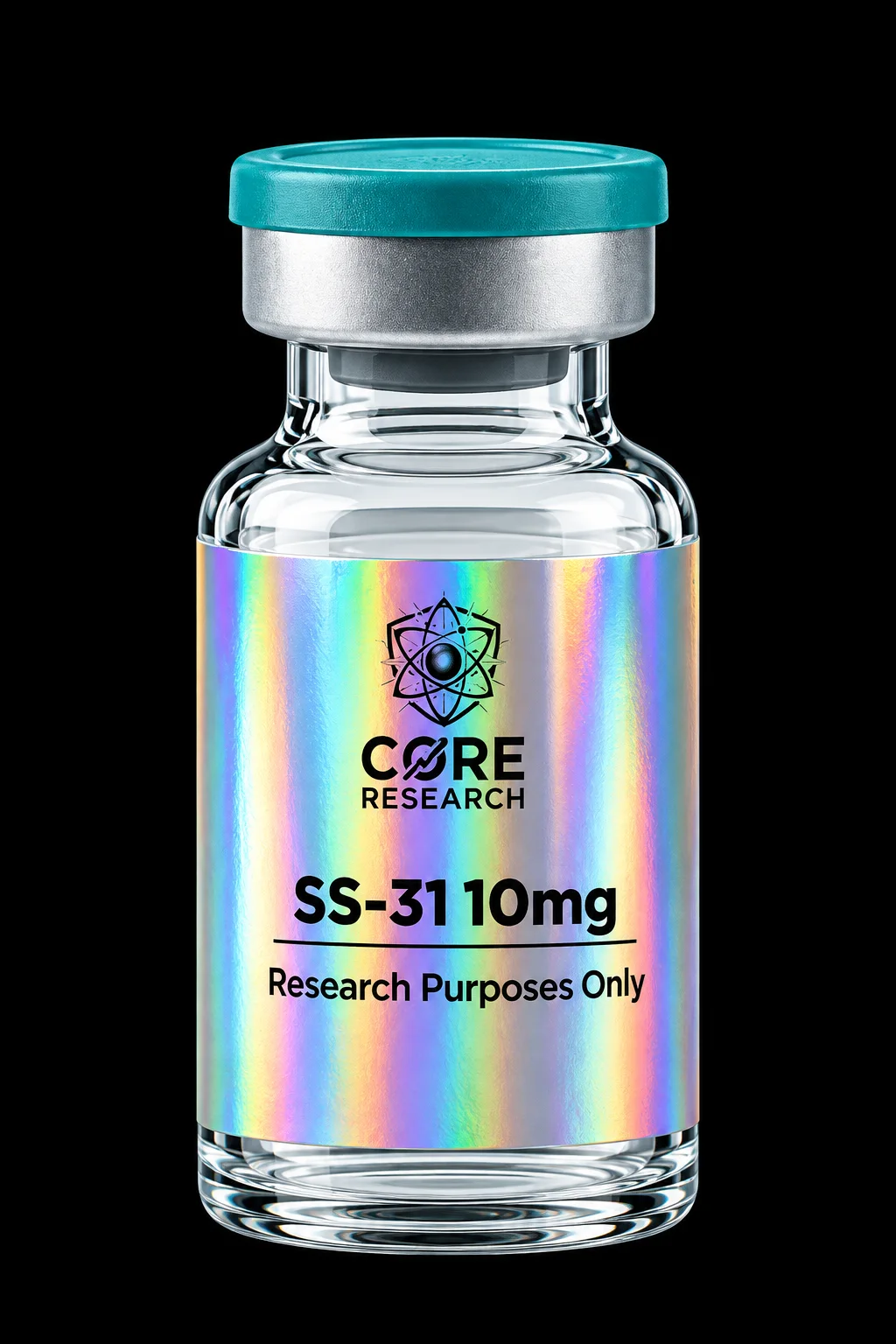
SS-31 10mg is a research-grade lyophilised preparation of SS-31 (known in the scientific literature as elamipretide, MTP-131, or Bendavia), a synthetic tetrapeptide with the sequence D-Arg-2′,6′-Dmt-Lys-Phe-NH₂ (MW 639.8 Da, free base). SS-31 belongs to the Szeto-Schiller (SS) family of mitochondria-targeted peptides, characterised by an alternating aromatic-cationic motif that confers selective accumulation within the inner mitochondrial membrane (IMM). The defining biochemical property of SS-31 in experimental systems is its interaction with cardiolipin — a unique phospholipid found almost exclusively in the IMM that is essential for the structural integrity and function of the electron transport chain (ETC). Each vial supplied by Core Research contains 10mg of SS-31, verified by RP-HPLC to ≥99.0% purity with identity confirmed by ESI-MS.
SS-31 Research Material vs Elamipretide Medicinal Product — Mandatory Distinction
Regulatory Status Notice
That approval applies to the authorised Forzinity medicinal product, its specific formulation, manufacturing controls, and approved labelling. It does not confer medicinal-product status on this Core Research Research Use Only material and does not establish clinical interchangeability. The Core Research SS-31 10mg is a research-grade lyophilised material supplied for in vitro laboratory research only. It is not the authorised Forzinity medicine, is not manufactured to the same GMP standards, and must not be used in humans or animals. FDA press release →
Compound Identity
| Attribute | Value | Notes |
|---|---|---|
| Common Names | SS-31, Elamipretide, MTP-131, Bendavia | Szeto-Schiller peptide family; elamipretide is the INN used in the scientific literature |
| Sequence | D-Arg-2′,6′-Dmt-Lys-Phe-NH₂ | 4 amino acids; alternating aromatic-cationic; C-terminal amide |
| CAS Number | 736992-21-5 | SS-31 acetate salt |
| Molecular Formula | C32H49N9O5 | Free base |
| Molecular Weight | 639.8 Da | Free base (monoisotopic) |
| Primary Interaction | Cardiolipin (IMM phospholipid) | High-affinity binding via electrostatic and hydrophobic interactions; demonstrated in membrane model systems and cell-based assays |
| Associated Proteins | Cytochrome c, ETC complexes I–IV | Protein interactions reported in preclinical models; not validated direct binding targets in all systems |
| Localisation | Inner mitochondrial membrane (IMM) | Concentration gradient vs extracellular reported in experimental systems |
| Salt Form | Acetate | Research-grade lyophilised preparation |
| Physical Form | White lyophilised powder | Research-grade lyophilised preparation |
Analytical Specification and Release Testing
| Test Parameter | Method | Specification |
|---|---|---|
| Purity (RP-HPLC) | C18 column, UV 220 nm, area normalisation | ≥99.0% |
| Identity (ESI-MS) | Electrospray ionisation MS | ±0.1 Da of theoretical MW (639.8 Da) |
| Endotoxin (LAL) | Kinetic turbidimetric LAL | <1.0 EU/mg |
| Residual Moisture | Karl Fischer titration | <5.0% w/w |
| Appearance | Visual inspection | White lyophilised powder |
Analytical Note — Core Research Quality Team
SS-31 contains a non-standard amino acid residue — 2′,6′-dimethyltyrosine (Dmt) — which is not present in standard amino acid libraries. ESI-MS identity confirmation verifies the intact tetrapeptide mass ([M+H]⁺ at m/z 640.8 for the free base) and distinguishes SS-31 from related SS-family peptides (SS-02, SS-20) which differ in sequence and mass. The D-Arg residue at position 1 is confirmed by the characteristic fragmentation pattern in MS/MS analysis. Batch-specific CoA documents are available through the CoA Portal.
SS-31 in Mitochondrial Membrane Research — Cardiolipin Interaction and Membrane Electrostatics
The alternating aromatic-cationic motif of SS-31 (D-Arg-Dmt-Lys-Phe) enables electrostatic interaction with the negatively charged phosphate head groups of cardiolipin, whilst the dimethyltyrosine (Dmt) and phenylalanine (Phe) residues provide hydrophobic anchoring within the lipid bilayer. This dual-mode interaction results in selective accumulation of SS-31 at the IMM in experimental systems, where it modulates membrane surface electrostatics and cardiolipin organisation.
Research using biophysical membrane model systems (cardiolipin-containing liposomes, giant unilamellar vesicles) and cell-based assays has characterised SS-31’s interaction with cardiolipin-rich bilayers. In these systems, SS-31 binding has been associated with changes in membrane curvature, cardiolipin clustering, and the organisation of ETC protein complexes within the IMM.
Downstream associations reported in preclinical models include changes in ETC complex activity, mitochondrial membrane potential (ΔΨm), cytochrome c interactions, and mitochondrial protein network organisation. These findings are from cell culture and animal models and represent mechanistic research context rather than established clinical outcomes.
Storage and Transport
| Condition | Specification |
|---|---|
| Long-Term Storage (lyophilised, sealed) | −20°C, protected from light and moisture |
| Stability Period | Stated on the batch-specific CoA |
| Transit | Ambient; cold-chain packaging included |
Note: Reconstituted solution storage, solvent selection, working concentration, and stability period guidance are not provided, consistent with Core Research’s Research Use Only supply policy. Researchers should refer to their institutional SOPs and the published literature for handling reconstituted peptide solutions.
Batch Documentation
Every batch of SS-31 10mg dispatched by Core Research is accompanied by a batch-specific Certificate of Analysis confirming RP-HPLC purity (≥99.0%), ESI-MS identity, endotoxin result, and Karl Fischer moisture. CoA documents are available via the Certificate of Analysis Portal. For further information on our analytical methodology, refer to the guide on HPLC Purity in Peptide Research.
Frequently Asked Questions
What is the difference between SS-31 and MitoQ?
Both SS-31 and MitoQ are mitochondria-targeted compounds, but they differ fundamentally in mechanism and localisation. MitoQ is a ubiquinone derivative conjugated to a triphenylphosphonium (TPP+) cation, which drives its accumulation in the mitochondrial matrix via membrane potential-dependent uptake. SS-31 is a tetrapeptide that accumulates specifically in the inner mitochondrial membrane (IMM) by interacting directly with cardiolipin — independent of membrane potential. This IMM-specific localisation means SS-31 is positioned at the site of ETC supercomplex organisation and cardiolipin-rich bilayer dynamics, making it mechanistically distinct from matrix-targeted compounds like MitoQ.
What is the molecular weight and sequence of SS-31?
The molecular weight of SS-31 (elamipretide) free base is 639.8 Da. The molecular formula is C₃₂H₄₉N₉O₅ and the CAS number is 736992-21-5 (acetate salt). The sequence is D-Arg-2′,6′-Dmt-Lys-Phe-NH₂ (C-terminal amide). The Dmt residue (2′,6′-dimethyltyrosine) is a non-standard amino acid that is not present in standard amino acid libraries.
Is a Certificate of Analysis available?
Yes. Batch-specific CoA documents — including annotated HPLC chromatograms and MS data — are available through the Core Research CoA Portal and are included with each order.
Research context
The published literature on this material is summarised in the laboratory guides linked below. This record describes the material as supplied: identity, format, analytics, storage and documentation. It does not describe effects, and none should be inferred from the catalogue category.
For Research Use Only
SS-31 is supplied exclusively for in vitro laboratory research. Not for human or veterinary use. No dosing, reconstitution, or administration guidance is provided.