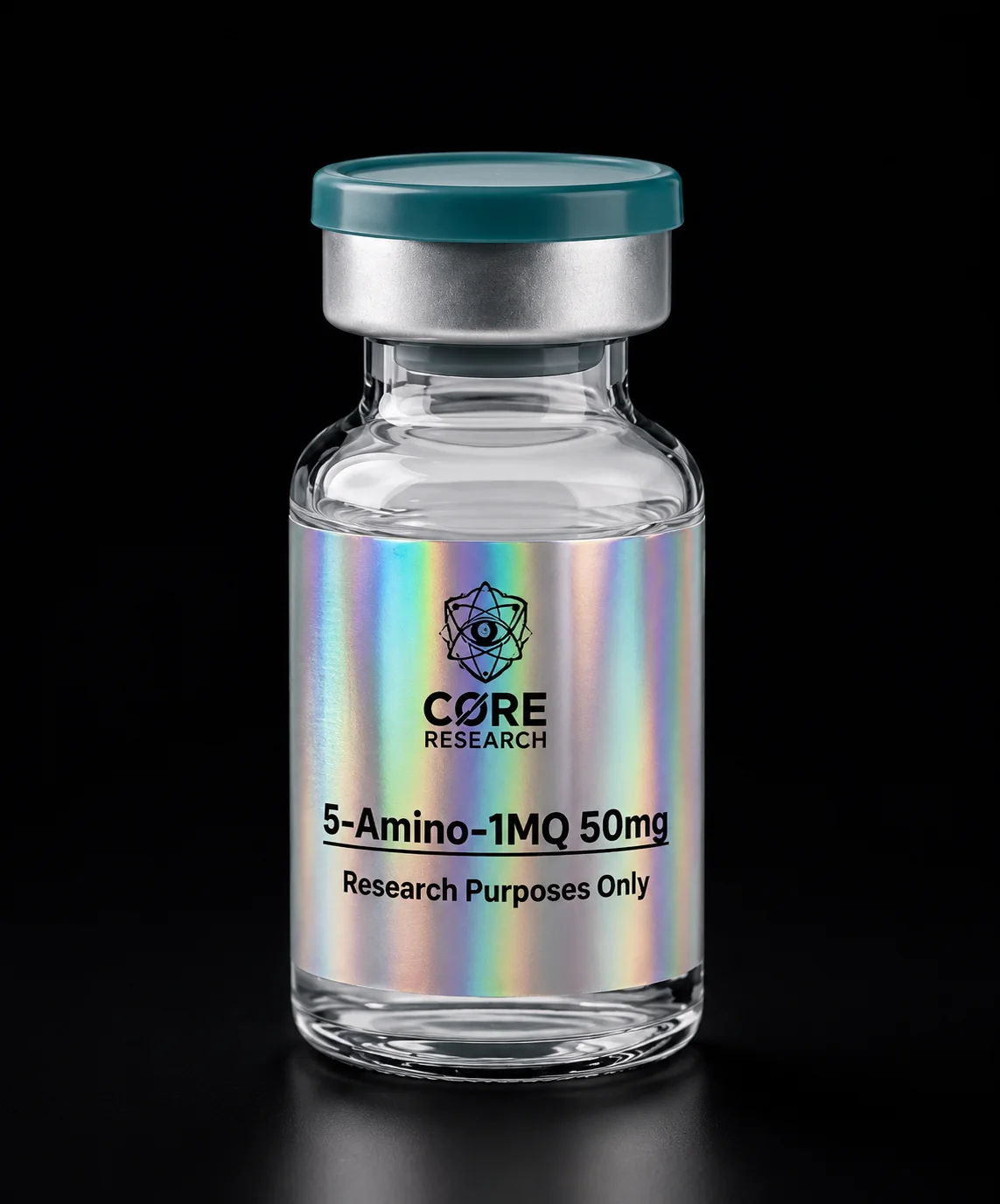
Description
5-Amino-1MQ 50mg is the Core Research catalogue item for 50mg nominal of a quinolinium-derived small-molecule NNMT inhibitor. It is supplied as one sealed vial containing dry laboratory research material for in-vitro laboratory research only; not for human or veterinary use. The material and model-level science below must be distinguished from product-specific analytical results and finished-format performance.
What you receive and what needs verifying
| Field | What this product listing establishes |
|---|---|
| Exact catalogue item | 5-Amino-1MQ 50mg |
| Labelled amount | 50mg nominal; not an independently measured quantitative assay |
| Presentation | one sealed vial containing dry laboratory research material |
| Research identity | a quinolinium-derived small-molecule NNMT inhibitor |
| Supply boundary | In-vitro laboratory research only; no personal or veterinary use |
| Current price and stock | Shown by the live WooCommerce purchase panel; not fixed in this description |
The sealed vial contains a nominal quantity of dry small-molecule research material; the label does not establish a liquid concentration, or certify an accessory, solvent or delivery device. This catalogue record does not establish that the material was lyophilised.
Before ordering, check the material identity, the form on the actual label and any information your assay needs from the applicable certificate. An unrelated paper, a general PubChem record or another catalogue format cannot establish a batch value for this particular item.
Which compound or format is the right laboratory item?
Not a peptide. 5-Amino-1MQ is a small molecule rather than a peptide. NAD+, MOTS-c, SS-31 and related products belong to different compound classes and study questions; a shared metabolism category does not imply interchangeable chemistry or mechanism.
Related formats and research alternatives
In the Metabolic & NAD+ Research catalogue, this NNMT-inhibitor small molecule is separate from the NAD+ cofactor, SS-31 mitochondrial tetrapeptide and MOTS-c peptide. Choose by the actual biochemical assay target, chemical identity and supplied form; category membership is not evidence of a shared effect.
Scientific research: mechanisms, measured results and limits
The following is a selected, model-specific evidence summary, not a systematic review, treatment recommendation or release test of this product. Read the study species, methods and measured endpoints beside each finding before transferring an interpretation to a different assay.
The reaction NNMT catalyses
Nicotinamide N-methyltransferase (NNMT) is a metabolic enzyme that transfers a methyl group from S-adenosylmethionine (SAM) to nicotinamide, producing 1-methylnicotinamide and S-adenosylhomocysteine. The chemistry links use of a methyl donor to nicotinamide and NAD-related metabolic networks. Inhibiting NNMT is therefore a way of changing a defined biochemical reaction; it is not equivalent to simply adding NAD+, increasing cellular energy, or producing a particular body-composition outcome. The distinction between direct enzyme inhibition and whole-organism phenotypes is essential when designing assays. 1
Selective inhibitors and the methylquinolinium scaffold
Neelakantan and colleagues investigated membrane-permeable methylquinolinium NNMT inhibitors in biochemical assays, adipocyte experiments and a high-fat-diet mouse model. The study reported that the compounds lowered intracellular 1-methylnicotinamide and affected cellular NAD+ and SAM measurements; treated obese mice also showed changes in adipose and body-weight endpoints. The paper tested a chemical series rather than establishing the composition of this supplier vial. It also does not show that every compound inhibiting NNMT shares the same distribution, selectivity or toxicity profile. 1
What the 2024 5A1MQ mouse experiment adds
In a later diet-induced-obese mouse experiment that specifically examined 5A1MQ, investigators reported changes in the rate of weight and fat-mass gain, glucose tolerance, insulin-related variables and liver steatosis endpoints during a 28-day study. These are measured rodent outcomes under a defined experimental regime. They are not evidence of a validated human weight-management intervention, and they do not validate this 50mg item as the chemically identical preparation used in the study. 2
Microbiome and cell studies require their own context
A 2022 mouse study examined a reduced-calorie dietary intervention combined with NNMT inhibition and the resulting microbiome pattern. Because diet and inhibitor exposure were part of the study design, changes attributed to that combination should not be promoted as an effect of 5A1MQ alone. Separately, Akar and colleagues studied a 5MQ NNMT inhibitor in cultured HeLa cells and measured viability and expression markers, but an experiment in a tumour cell line is not a clinical cancer result. These models ask distinct questions rather than adding up to proof of broad therapeutic activity. 3,4
Chemical-identity and mass-basis distinctions
The 5-Amino-1MQ name can refer to a methylquinolinium-derived cation, while a supplied solid may contain a counter-ion. The named ion, its salt and a formulated sample have different mass-accounting implications. A study using an NNMT inhibitor from the same scaffold does not itself establish the salt identity, formula, water content or milligrams of active cation in the listed product. For a concentration calculation or analytical comparison, the laboratory must use the specific material certificate and its reporting basis, not a database formula applied blindly to the vial. 1
How to interpret the evidence for this product
| Research context | Reported or relevant endpoint | Interpretation limit |
|---|---|---|
| Biochemical assays | NNMT activity and methyl-transfer products | Inhibitor activity is not a human metabolic outcome |
| Cultured adipocytes / cells | 1-methylnicotinamide and related metabolic markers | Cell responses may differ across tissues |
| Diet-induced-obese mice | Body composition, glucose/insulin and liver pathology | Not proof of human efficacy or this batch specification |
Batch documentation before purchase
Core Research allows a pre-purchase batch-documentation enquiry. Use Batch Documentation or email info@core-research.net with the exact product name and presentation. An order or container lot number is not needed to ask the question before purchase; to match a supplied item after delivery, retain its lot identifier and order reference. The published delivery policy says a certificate is issued with a consignment where one exists for the supplied lot; that is not a promise of a current certificate for every item.
Ask whether documentation applies to the lot proposed for supply and identifies the tested chemical form, sample description, method, result, reporting basis, testing issuer and relevant dates. The difference between chromatographic peak-area purity, identity/mass and quantitative vial content matters.
For interpretation, use guide to reading a CoA, HPLC testing guide and mass-spectrometry guide. A theoretical molecular formula is not a batch-assay result, and a product label does not certify sterility.
For 5-Amino-1MQ 50mg, request the exact quaternary-cation versus counter-ion salt identity and mass basis; a chromatographic result and an active-cation amount may refer to different numerators. Do not infer iodide content, purity percentage, residual solvent compliance or shelf life from the catalogue name.
Storage, receiving and laboratory quality control
The supplied small molecule may require storage conditions different from peptides. Follow its applicable material specification and lot documentation rather than using reconstitution or solution-stability periods published for peptides.
Follow the supplied label and product-specific documentation for storage conditions, temperature excursions and expiry. A dry small-molecule research material and a prepared solution may have different conditions. No generic fixed storage term, purity threshold or cold-chain guarantee is inserted here without applicable evidence. See peptide storage guidance and research-product receiving checklist for general laboratory-record practices.
At receipt, compare the product name, labelled amount and presentation with your order. Inspect the vial closure or cartridge/packaging, record the lot identifier and retain the accompanying paperwork. If damaged, delayed or different from the order, record photographs and contact Core Research before using the material. This records receipt conditions; it does not substitute for an identity assay.
Ordering questions
Does the labelled milligram amount state purity or a prepared concentration?
No. 50mg is the catalogue-labelled quantity for this item. It does not by itself establish analytical content, purity, final liquid concentration, sample mass basis or number of experiments. The applicable material documentation and your laboratory’s own method establish those details.
Where is the product dispatched from and what is the delivery policy?
Core Research states that it dispatches from Birmingham, United Kingdom, using plain external packaging. Delivery service, charge and arrival estimates depend on the destination and order; see Shipping & Delivery. Tracking is provided in dispatch communications where available. There is no universal next-day delivery or free-shipping promise on this page.
Can I obtain an applicable certificate before ordering?
You can request information before ordering through Batch Documentation. Specify 5-Amino-1MQ 50mg, the vial presentation and any required test/method. Whether a particular current lot has a document, and what it actually reports, must be checked rather than assumed.
Can an institution request a quotation?
Yes. Institutional Procurement describes the written quotation and purchase-order-reference enquiry route. Include the institution, delivery details, exact product and quantity, and any lot or technical requirements. An enquiry does not itself reserve stock or guarantee credit terms.
Is this product suitable for human or veterinary use?
No. This listing is for in-vitro laboratory research only. Neither a positive model result nor a named medicinal compound establishes human-use suitability, and this page gives no preparation, dosing or administration instructions. See Research Use Only policy.
Order or enquire about 5-Amino-1MQ 50mg
Use the native product purchase panel to select the listed quantity and the checkout options available for your order. For identity, format, lot-documentation or delivery questions, contact Core Research before purchase. Current price and stock remain controlled by WooCommerce, not hard-coded in this description.
Selected research references
[1] Neelakantan H et al. (2018). Selective and membrane-permeable small molecule inhibitors of NNMT reverse high-fat-diet-induced obesity in mice. Biochemical Pharmacology. PMID 29155147. DOI 10.1016/j.bcp.2017.11.007. Primary research record.
[2] Nicotinamide N-methyltransferase inhibition mitigates obesity-related metabolic dysfunction (2024). Diet-induced-obese mouse study. PMID 39161060. Primary research record.
[3] Dimet-Wiley et al. (2022). Reduced calorie diet combined with NNMT inhibition establishes a distinct microbiome in diet-induced-obese mice. Scientific Reports. PMID 35013352. Primary research record.
[4] Akar S et al. (2021). Small molecule inhibitor of NNMT shows anti-proliferative activity in HeLa cells. Journal of Obstetrics and Gynaecology. PMID 33645410. Primary research record.