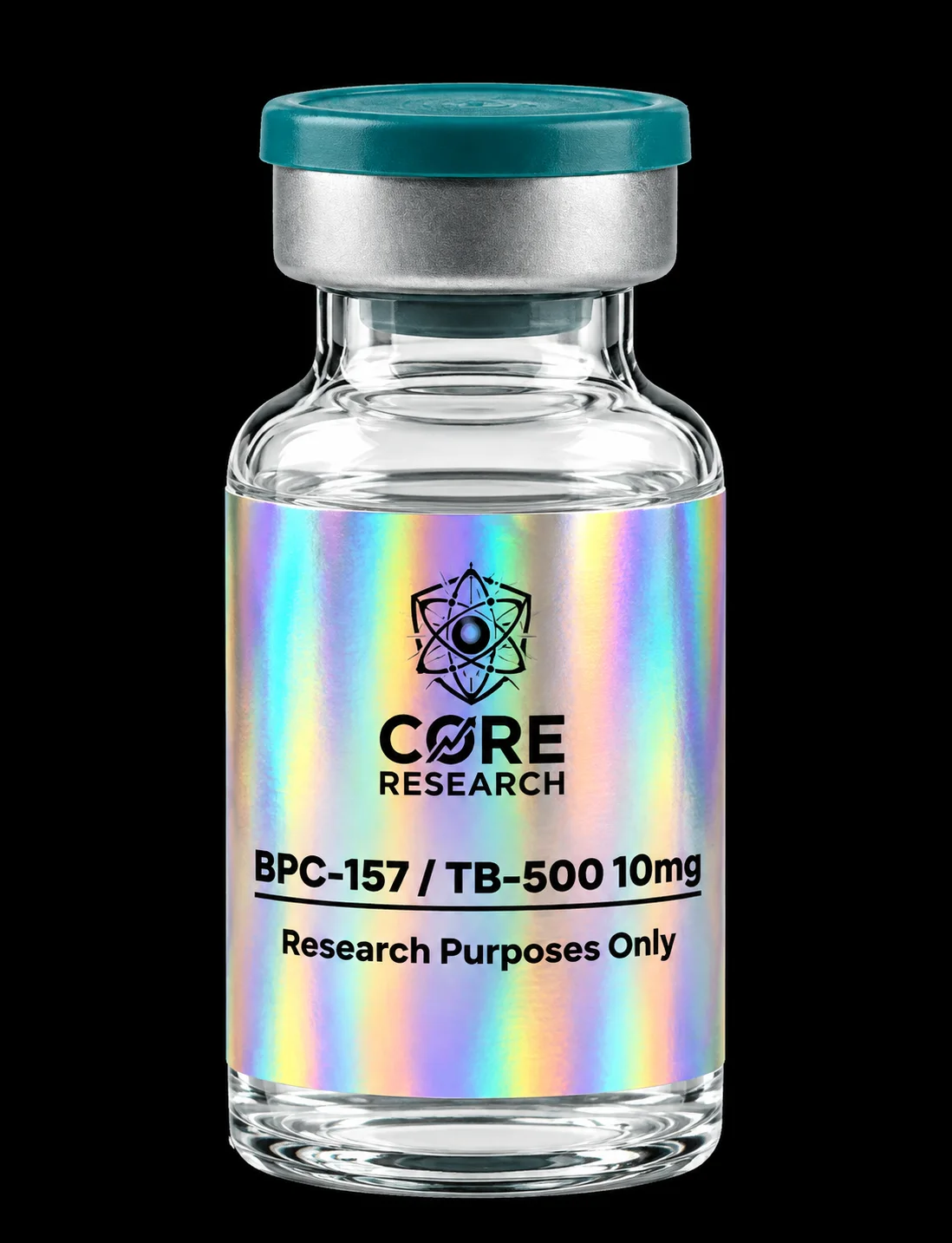
Description
BPC-157 / TB-500 Blend 10mg contains a declared combined 5mg BPC-157 + 5mg TB-500 in one co-lyophilised vial. This is 10mg total, not 10mg of each peptide. The components have separate scientific literatures, and evidence for either one alone does not automatically establish an additive or synergistic response from the blend.
Core Research supplies this as a laboratory research material only, not for human or veterinary use. See the native purchase panel for current price and availability or request applicable blend-lot documentation before ordering.
Exactly what is in this listing?
| Attribute | Catalogue declaration |
|---|---|
| Product | BPC-157 / TB-500 Blend 10mg |
| Nominal BPC-157 content | 5mg |
| Nominal TB-500 content | 5mg |
| Combined labelled quantity | 10mg in one vial |
| Presentation | Co-lyophilised research material in one sealed vial |
| Constituent identity | Exact peptide chemical forms require the applicable specification and lot report |
| Price, availability and quantity selector | Current native WooCommerce purchase panel |
These quantities are the catalogue’s labelled composition, not measurements independently obtained from this particular batch. The BPC-157 reference sequence is Gly-Glu-Pro-Pro-Pro-Gly-Lys-Pro-Ala-Asp-Asp-Ala-Gly-Leu-Val. For the second constituent, the label TB-500 should not be assumed to identify an exact sequence until the applicable specification confirms it. The literature distinguishes Ac-LKKTETQ, related fragments and full-length thymosin beta-4. 1
Blend versus standalone materials or other formats
| Product | Key distinction |
|---|---|
| This blend vial | 5mg BPC-157 + 5mg TB-500 in one co-lyophilised vial |
| BPC-157 10mg | One 10mg vial of BPC-157 alone |
| TB-500 10mg | One 10mg vial of TB-500 alone |
| BPC-157 / TB-500 Refill 10mg | Separate refill presentation of the named blend |
| BPC-157 / TB-500 Blend 10mg Pen | Separate pen-format blend listing |
The two standalone vials are not equivalent to a single pre-combined vial. The blend introduces a second named constituent and separate requirements for composition, analytical separation, stability and control conditions. See single versus blended research peptides for the underlying laboratory distinction.
Why are BPC-157 and TB-500 discussed together?
Both appear in experimental tissue-response literature, but the biological questions are not the same. BPC-157 is a synthetic 15-residue peptide investigated in tendon-fibroblast movement, signalling responsiveness and endothelial models. TB-500 is a name used in thymosin-beta-4-related fragment research, where actin-associated cellular processes and metabolite chemistry are prominent. A proposed combined experiment must specify both molecular identities, the model and the result to be measured rather than assume that two individually interesting mechanisms produce synergy.
BPC-157: migration and stress survival, not automatically proliferation
Chang and colleagues studied rat tendon explants and tendon-derived fibroblasts. They reported enhanced outgrowth, migration and spreading, and increased survival under oxidative challenge. Their assay did not find a direct increase in cell proliferation with BPC-157 alone. Increased phosphorylation of FAK and paxillin pointed to signalling connected with cell attachment and movement. These were BPC-157 constituent experiments, not assays of this blend. 2
A second study found increased growth-hormone receptor expression in rat tendon fibroblasts after BPC-157 exposure. The increased proliferation-related response and JAK2 activation occurred when growth hormone was subsequently added. Keeping that additional signal in view avoids misdescribing a conditioned cellular response as a direct proliferative effect of a two-peptide blend. 3
In vascular research, Hsieh and colleagues reported increased VEGFR2 expression and internalisation, with related Akt/eNOS responses, in endothelial and animal models. The cultured-cell result did not include a corresponding VEGF-A increase. These measurements concern receptor-associated signalling and angiogenic models, not a demonstrated clinical repair effect or an interaction with TB-500 in this product. 4
TB-500-related work: fragment chemistry and actin
Esposito and colleagues identified the acetylated thymosin-beta-4-derived Ac-LKKTETQ fragment in a TB-500 preparation in 2012. That establishes the identity of the sample they analysed, not a universal specification for all marketplace vials. A full-length thymosin beta-4 study, an unacetylated LKKTETQ experiment and an acetylated-fragment assay require separate attribution. 1
Full-length thymosin beta-4 has actin-interacting regions beyond the short motif; Van Troys and colleagues demonstrated contributions from different parts of the full sequence. Philp and colleagues observed skin-repair-related findings in animal experiments with full-length thymosin beta-4 and an unacetylated synthetic motif. A short-fragment result in aged mice cannot be assigned to this mixed vial before its constituent is identified. 5 6
A more recent analytical study of Ac-LKKTETQ and its metabolites found that the metabolite Ac-LKKTE, rather than every tested compound, showed a significant wound-healing-assay response compared with control in their fibroblast screen. The active species and test system matter. This does not demonstrate that the supplied blend contains that metabolite or generates the same conditions. 7
Has the combined preparation itself been studied?
A small 2021 retrospective clinical report discussed BPC-157 alone and alongside a preparation called TB4 in people who reported knee-pain outcomes. Of the 16 participants contacted, four had received both named preparations; three of those four reported improvement. The study had no randomised comparison, varying follow-up and no specific tools for measuring functional changes. TB4 naming did not verify the molecular form of the TB-500 constituent in this vial. The report is evidence that such combinations have been discussed, not a controlled demonstration of this commercial blend’s composition, synergy or efficacy. 8
To establish an interaction experimentally, the comparison needs the exact constituent forms, matched controls, measurements for each separately and for the mixture, and a defined endpoint. Equally labelled masses are not necessarily equimolar amounts. A positive result in the combined group without appropriate comparators does not establish synergy.
The analytical questions are different for a blend
| Question | What an applicable report would need to show |
|---|---|
| Are both named constituents present? | Each component’s identity, not only a total peak area |
| What is the TB-500 chemical form? | Exact modification and sequence relevant to the sample |
| How much of each is present? | Component-specific quantitative results where claimed |
| Can the components be distinguished? | Suitable chromatography, mass-spectral assignments or another demonstrated method |
| Does the document cover the final blend? | Named product, co-lyophilised sample, batch/lot identifier, issuer and date |
| What does a percentage represent? | Chromatographic area, content, mass fraction or another clearly defined basis |
An HPLC purity percentage for one precursor does not validate both component quantities in the co-lyophilised blend. Likewise, detecting two ions does not automatically prove the labelled masses. Request the current lot’s records using the full name and format, then consult how to read a peptide certificate and the mass-spectrometry primer.
Storage, dispatch and receiving
Storage information must apply to the actual co-formulated material and its container, not merely to one peptide studied alone. A lyophilised-blend specification does not establish a universal lifetime for a prepared solution. When the laboratory protocol requires an exact temperature, expiry or excursion limit, request the product-specific evidence before purchasing.
At delivery, verify the name, total amount, both constituent declarations, lot identifier and closure against the order. Keep any certificate with that lot. The receiving guide and storage guide support these checks; report damage, unexpected warmth or mismatch using the delivery-condition guide.
Core Research’s shipping policy describes dispatch from Birmingham, UK, with plain packaging and tracking where provided. Current delivery charges and estimated transit depend on the actual order and destination. The live price/stock and checkout remain the sources for changing commercial values. Contact Core Research about specification questions or an existing order.
Questions before ordering
Is the 10mg blend 10mg of BPC-157 and another 10mg of TB-500?
No. It is labelled 5mg + 5mg, totalling 10mg. The standalone 10mg BPC-157 and 10mg TB-500 products are different listings with different nominal component quantities.
Is TB-500 interchangeable with full-length thymosin beta-4?
Not by name alone. The research identifies chemically different full-length molecules, fragments, acetylated forms and metabolites. A supplier or lot record must identify the actual named constituent when that distinction is material.
Does buying a blend establish that it produces a stronger outcome?
No. Neither separate constituent experiments nor a small retrospective report establish synergy or the performance of this co-lyophilised lot. A comparison requires adequate controls and verified chemical identities.
Can I request the blend report before placing an order?
Yes. Batch Documentation accepts a pre-purchase enquiry without a received lot number. State that you need BPC-157 / TB-500 Blend 10mg, co-lyophilised vial, and ask which sample and lot any report actually covers.
Research references
[1] Esposito S et al. (2012). Synthesis and characterization of an acetylated thymosin beta-4 fragment identified in TB-500. Drug Testing and Analysis.
[2] Chang CH et al. (2011). BPC 157: tendon outgrowth, cell survival and migration. Journal of Applied Physiology.
[3] Chang CH et al. (2014). BPC 157 increases growth-hormone-receptor expression in tendon fibroblasts. Molecules.
[4] Hsieh MJ et al. (2017). BPC157 and VEGFR2 activation/upregulation. Journal of Molecular Medicine.
[5] Van Troys M et al. (1996). The actin-binding site of thymosin beta-4 mapped by mutational analysis. EMBO Journal.
[6] Philp D et al. (2003). Full-length thymosin beta-4 and a synthetic actin-domain peptide in animal wound models. Wound Repair and Regeneration.
[7] Rahaman KA et al. (2024). TB-500 metabolites and fibroblast wound-healing assays. Journal of Chromatography B.
[8] Lee E, Padgett B (2021). Intra-Articular Injection of BPC 157 for Multiple Types of Knee Pain. Alternative Therapies in Health and Medicine. Retrospective report; included a TB4-named combination group.