Description
GHK-Cu 50mg — Product Identity and Format
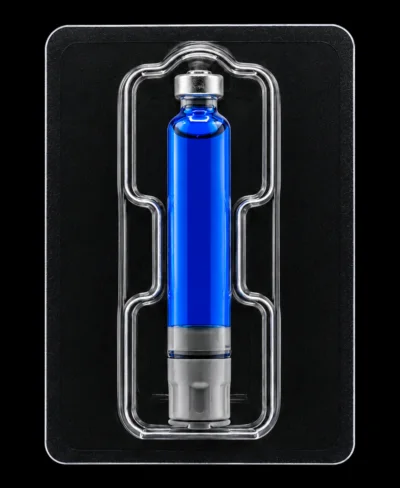
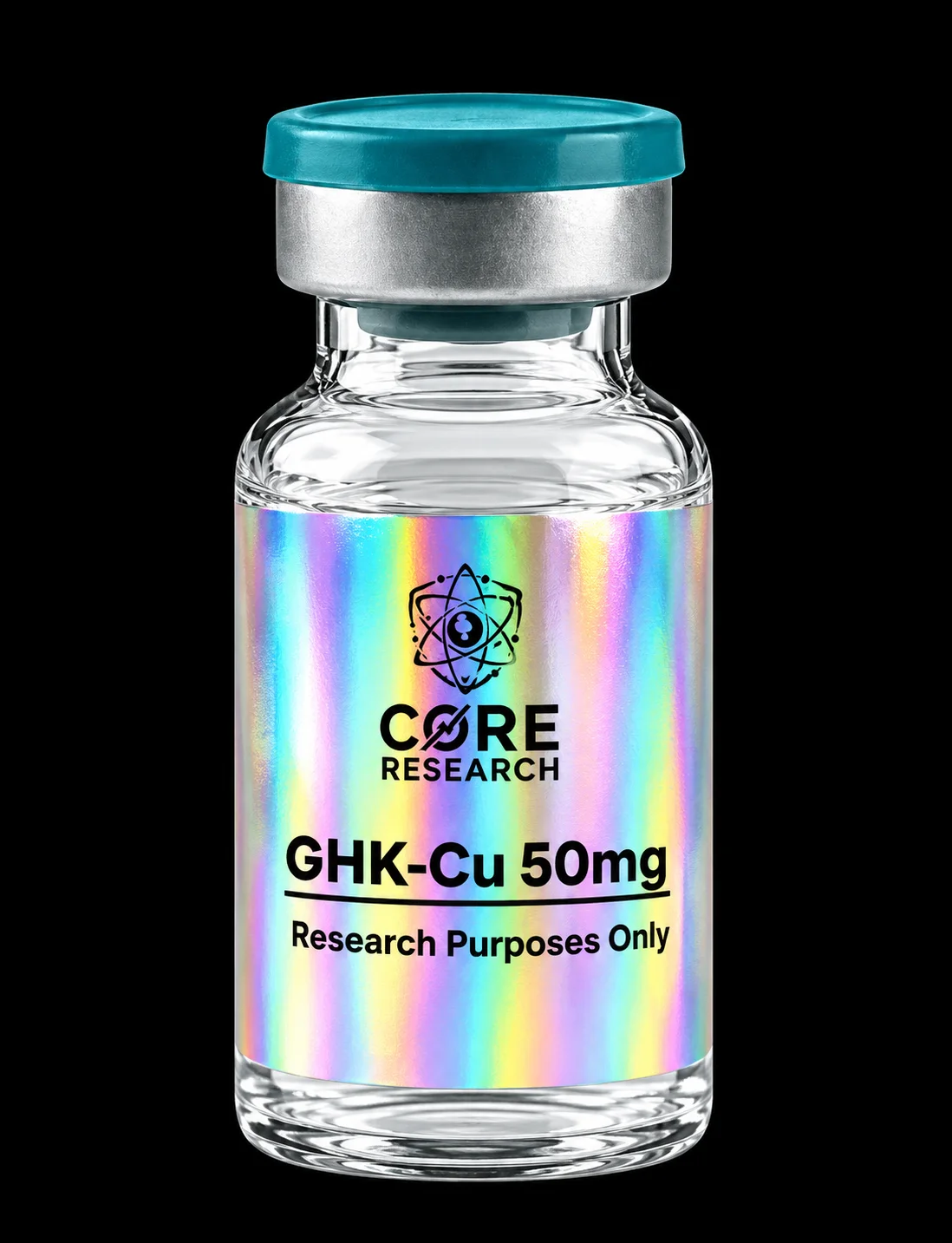
GHK-Cu 50mg is a lyophilised preparation of copper(II) glycyl-L-histidyl-L-lysinate, the copper-chelated form of the tripeptide GHK, supplied in a sealed vial with a labelled fill of 50 mg. It is the lighter of the two GHK-Cu loadings in the Core Research catalogue: the 100 mg presentation is listed under repair & recovery research, and both strengths are also offered in refill-cartridge format. This record describes the material as supplied and the analytical checks that apply to it; the biological literature is summarised separately in the GHK-Cu research overview.
Compound Identity
| Attribute | Value |
|---|---|
| Compound | GHK-Cu — copper(II) glycyl-L-histidyl-L-lysinate |
| Peptide sequence | Gly-His-Lys (glycyl-L-histidyl-L-lysine) |
| Free peptide | C14H24N6O4; monoisotopic mass approx. 340.19 Da |
| Coordination complex | Nominal mass approx. 403.92 Da including Cu2+ (63.55 Da); published values vary with whether the counter-ion (typically acetate or chloride) is counted |
| Appearance | Blue to blue-green lyophilised powder; the colour comes from the d–d transitions of the Cu2+ centre and is itself a check on chelation |
| Labelled fill | 50 mg per vial, expressed as the copper-peptide complex |
| Format | Sealed vial (this listing); a 50 mg refill cartridge is listed separately |
| Catalogue category | Cosmetic & Skin Research |
Synthesis and Coordination Chemistry
The free tripeptide is assembled by solid-phase peptide synthesis using Fmoc chemistry, with the histidine imidazole side chain protected during coupling, then cleaved, deprotected and purified by reverse-phase HPLC. Copper complexation is carried out afterwards in aqueous solution at controlled pH (typically 6.5–7.5) with a stoichiometric copper(II) salt, and the complex is lyophilised. The lyophilised material is hygroscopic: moisture ingress is the principal degradation route, which is why it is stored desiccated and protected from light.
In the complex the cupric ion sits in a square-planar coordination environment. Organic solvents disturb that geometry and can cause partial dechelation, so the compound is handled in aqueous media, in which it dissolves readily (typically above 10 mg/mL in ultrapure water at ambient temperature).
Analytical Verification
Three measurements together identify GHK-Cu and distinguish it from the free tripeptide or from a partially chelated batch:
- RP-HPLC — peptide purity by peak-area integration, typically monitored at 214 nm, with any co-eluting impurity reported against the main peak.
- UV-Vis spectroscopy — the characteristic d–d absorption band at about 580–620 nm confirms that copper is coordinated; dechelated material lacks it.
- ESI-MS — molecular identity, with the 63Cu/65Cu isotope doublet acting as a spectroscopic fingerprint of copper incorporation.
Moisture content by Karl Fischer titration is the fourth figure worth reading on a certificate for this compound. The values that apply to the material you receive are those on the certificate of analysis for its lot; request it with the lot number from the vial label. This page publishes no purity threshold of its own.
Storage and Stability
| Condition | Recommendation |
|---|---|
| Lyophilised, long term | −20 °C, desiccated, protected from light |
| Lyophilised, in transit or short term | 2–8 °C, desiccated, vial sealed |
| In solution | Refrigerated at 2–8 °C and used promptly; aliquot rather than re-freeze |
Research Context
GHK was first isolated from human plasma in 1973 by Loren Pickart, and its copper complex has since become one of the most studied small peptide–metal complexes, with in-vitro, ex-vivo and animal-model literature on gene expression and tissue-remodelling pathways. That literature, and the questions researchers most often ask about the compound, are set out in the GHK-Cu research overview linked below. This product record stops at identity, format, analytics and storage: it does not describe effects, and none should be inferred from the catalogue category.
Documentation
Each vial carries a lot number. A batch-specific certificate of analysis is available on request for the lot supplied, and the testing and quality methodology guide explains what each figure on it does and does not demonstrate.
For Research Use Only
GHK-Cu 50mg is supplied exclusively for in vitro laboratory and pre-clinical research. Not for human or veterinary use. No dosing, reconstitution, or administration guidance is provided. Purchase confirms the buyer is a qualified researcher.