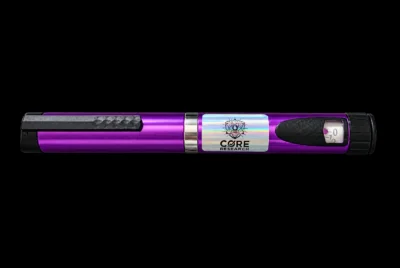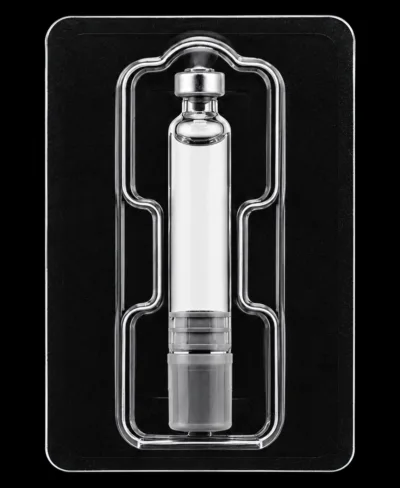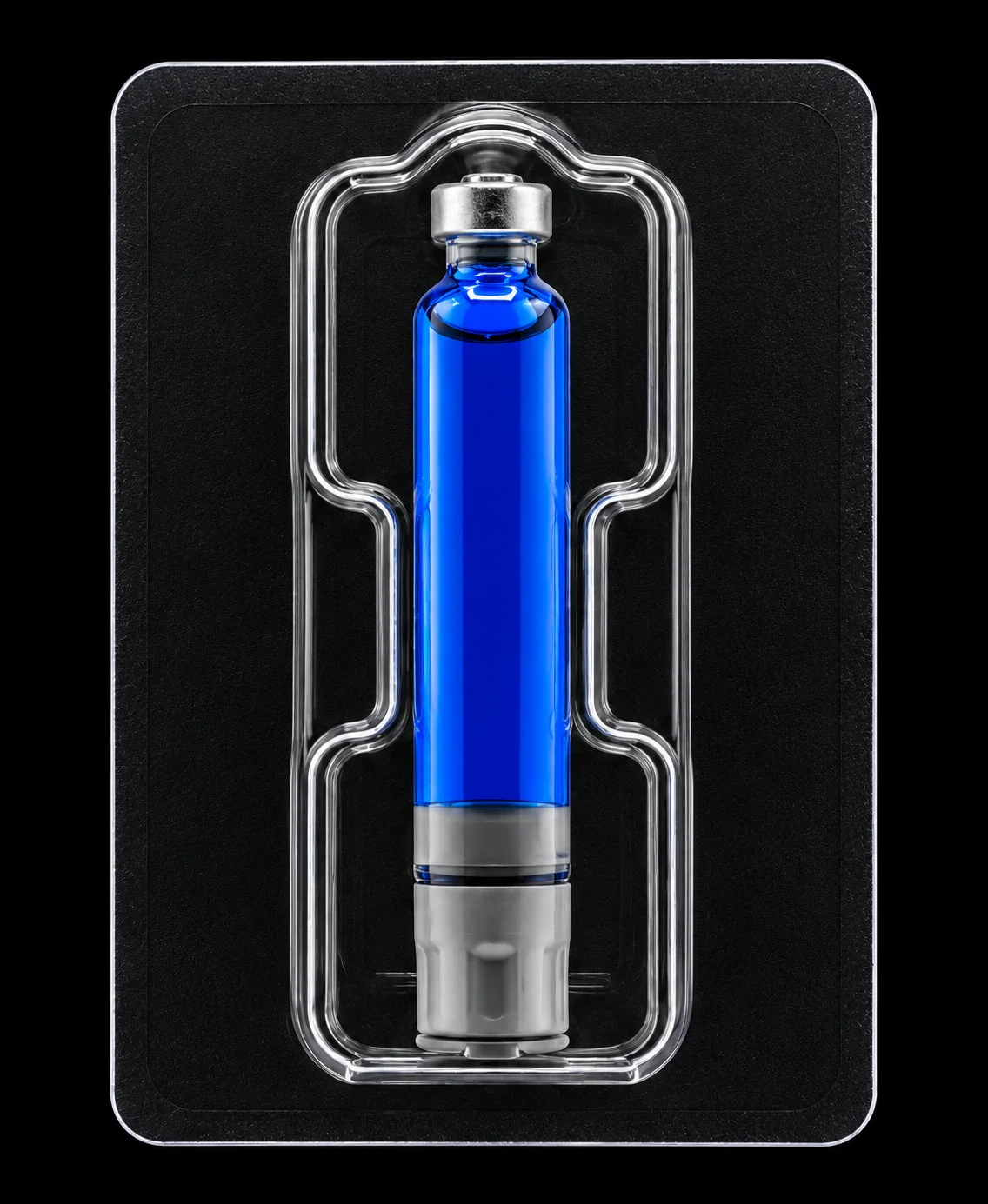
Description
GHK
The labelled mass of every GHK-Cu presentation refers to the copper-peptide complex, not the peptide component alone.
GHK-Cu Refill is a research-grade lyophilised preparation of GHK-Cu (Copper(II) glycyl-L-histidyl-L-lysine), a naturally occurring copper-binding tripeptide complex first isolated from human plasma albumin by Loren Pickart in 1973. GHK (glycyl-L-histidyl-L-lysine) is a tripeptide with the sequence Gly-His-Lys that forms a stable 2:1 or 1:1 complex with copper(II) ions through coordination bonds involving the imidazole nitrogen of histidine and the terminal amino groups of glycine and lysine. Each vial supplied by Core Research contains lyophilised GHK-Cu, verified by RP-HPLC to a minimum purity of ≥99.0%, with molecular identity confirmed by ESI-MS.
The compound’s ability to chelate copper(II) ions and deliver them to copper-dependent enzymes — including lysyl oxidase (essential for collagen and elastin crosslinking), superoxide dismutase (SOD), and cytochrome c oxidase — is thought to underlie many of its biological effects. GHK-Cu is one of the most extensively characterised peptide-metal complexes in biomedical research, with a literature spanning more than five decades.
Compound Identity Matrix
| Attribute | Value | Specification |
|---|---|---|
| Common Name | GHK-Cu; Copper(II) GHK; Copper Tripeptide-1 | Naturally occurring copper-binding tripeptide complex |
| Sequence | Gly-His-Lys · Cu(II) | Tripeptide; Cu(II) coordination via His imidazole and terminal amines |
| CAS Number | 89030-95-5 | GHK-Cu (Copper(II) glycyl-L-histidyl-L-lysine) |
| Molecular Formula | C14H23CuN6O4⁺ | Copper complex cation |
| Molecular Weight | 403.91 Da | Copper complex (monoisotopic) |
| Physical Form | Blue-green lyophilised powder | Characteristic colour from Cu(II) coordination complex |
| Purity (RP-HPLC) | ≥99.0% | C18 column, UV 220 nm |
| Identity Confirmation | ESI-MS | ±0.1 Da of theoretical MW |
Analytical Specification & Release Testing
Every batch of GHK-Cu supplied by Core Research is manufactured under GMP-aligned conditions and subjected to a comprehensive analytical release protocol. Purity is determined by RP-HPLC (C18 column, UV 220 nm) confirming ≥99.0% purity with a maximum single impurity of ≤0.5%. Molecular identity is confirmed by ESI-MS with the observed [M+H]⁺ or [M+nH]ⁿ⁺ ion series matched against the theoretical mass of GHK-Cu (MW 403.91 Da) to within ±0.1 Da. Copper content is confirmed by ICP-MS to ensure stoichiometric Cu(II) complexation. Endotoxin content is confirmed at <1.0 EU/mg by LAL kinetic turbidimetric assay.
| Test Parameter | Method | Specification | Typical Result |
|---|---|---|---|
| Purity (RP-HPLC) | C18 column, UV 220 nm | ≥99.0% | ≥99.5% |
| Identity (ESI-MS) | Electrospray ionisation MS | ±0.1 Da of theoretical MW | Conforms |
| Copper Content (ICP-MS) | Inductively coupled plasma MS | Stoichiometric Cu(II) | Conforms |
| Endotoxin (LAL) | Kinetic turbidimetric LAL | <1.0 EU/mg | <0.5 EU/mg |
| Appearance | Visual inspection | Blue-green lyophilised powder | Conforms |
Storage, Stability & Handling
| Condition | Specification | Notes |
|---|---|---|
| Long-term storage (lyophilised) | −20°C | Stable for ≥24 months from manufacture date |
| Short-term storage (lyophilised) | 2–8°C | Acceptable for up to 4 weeks; desiccated |
| Reconstituted solution | 2–8°C, use within 14 days | Aliquot and freeze at −80°C for extended storage |
| Light sensitivity | Protect from light | Cu(II) complexes may be light-sensitive; store in amber vials |
| Humidity | Low humidity environment | Hygroscopic; desiccant recommended |
Frequently Asked Questions
What is the molecular weight of GHK-Cu?
The molecular weight of GHK-Cu (Copper(II) glycyl-L-histidyl-L-lysine) is 403.91 Da. The molecular formula is C14H23CuN6O4⁺ and the CAS number is 89030-95-5. GHK-Cu is a blue-green lyophilised powder due to the characteristic colour of the Cu(II) coordination complex.
Why does GHK-Cu appear blue-green?
The blue-green colour of GHK-Cu is characteristic of the Cu(II) coordination complex formed between the GHK tripeptide and the copper(II) ion. Copper(II) complexes absorb light in the red-orange region of the visible spectrum (~600–700 nm) and therefore appear blue-green. This colour is a useful visual indicator of successful Cu(II) complexation and is expected in correctly manufactured GHK-Cu preparations.
What is the difference between the 50mg and 100mg refill formats?
The GHK-Cu 50mg and 100mg refill formats contain the same active compound at the same purity specification. The 100mg format is designed for research programmes requiring larger quantities of GHK-Cu, offering a more economical option for high-throughput or large-scale studies. Both formats are supplied with batch-specific CoA documentation.
Is a Certificate of Analysis available?
Yes. Batch-specific CoA documents — including annotated HPLC chromatograms, MS data, and ICP-MS copper content data — are available through the Core Research CoA Portal and are included with each order.
Related Research Guides
Related Compound
SNAP-8 10mg — SNARE Complex Research
Related Compound
Glutathione 1500mg — Antioxidant Research
Quality
Certificate of Analysis Portal
Category
Cosmetic Research Catalogue
Research context
The published literature on this material is summarised in the laboratory guides linked below. This record describes the material as supplied: identity, format, analytics, storage and documentation. It does not describe effects, and none should be inferred from the catalogue category.
For Research Use Only
GHK-Cu is supplied exclusively for in vitro laboratory and pre-clinical research. Not for human or veterinary use. No formulation, application, or usage guidance is provided. Purchase confirms the buyer is a qualified researcher.