Description
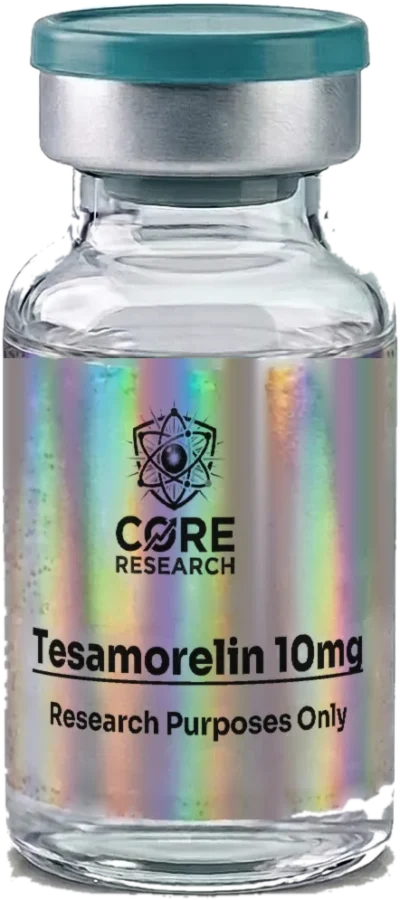
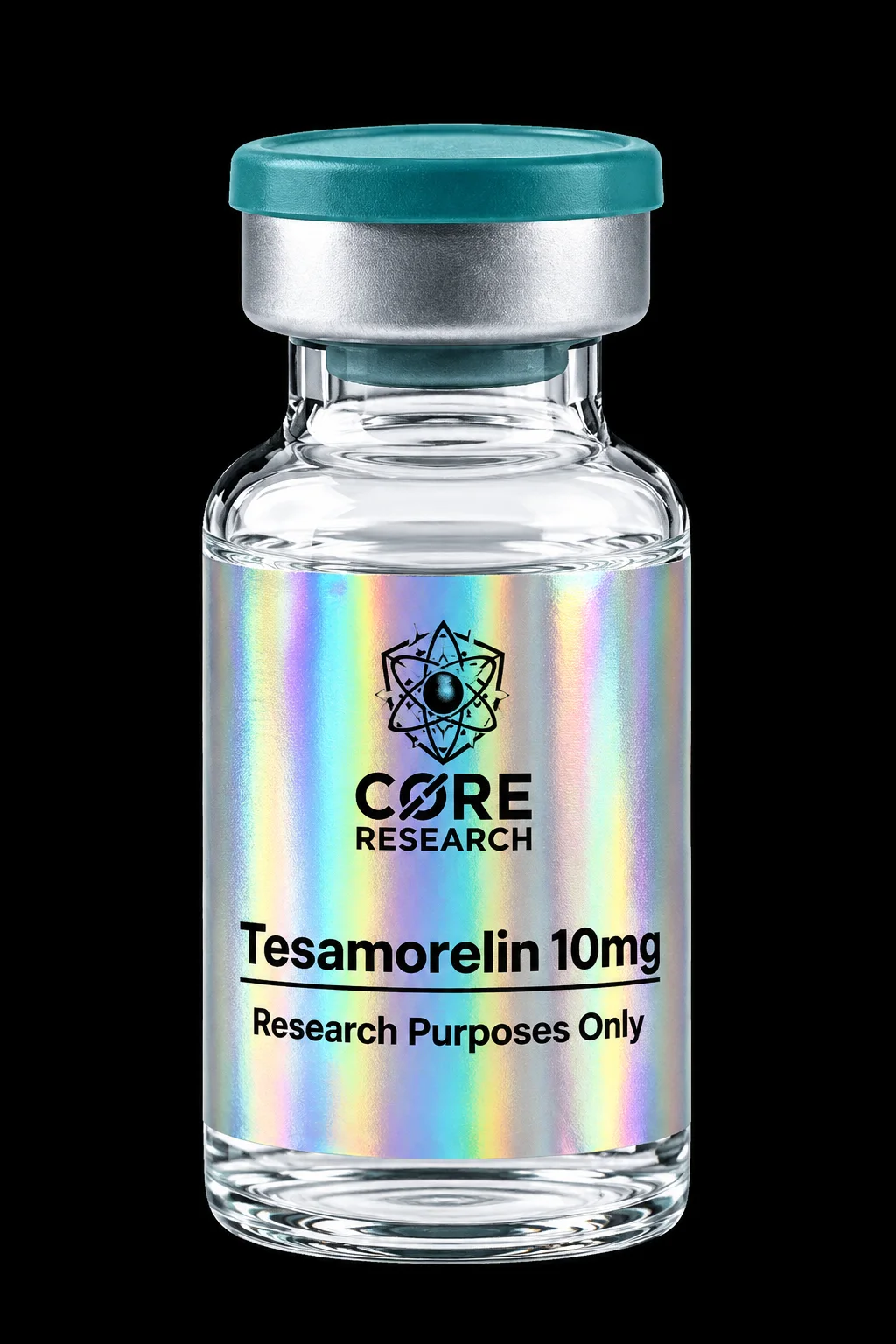
Tesamorelin 10mg is a lyophilised research-peptide vial supplied under the tesamorelin (TH9507) name. Tesamorelin is a growth-hormone-releasing-hormone analogue studied through the pituitary GHRH receptor. Unlike shorter modified GRF(1–29) products, its research structure is based on human GRF(1–44)-amide with an N-terminal trans-3-hexenoyl modification. That chemistry and the exact study formulation matter when interpreting published results. 1
For in-vitro laboratory research only, not human or veterinary use. Check the native product panel for current price and availability, and request product-specific documentation if you require the exact salt, terminal form or batch assay before ordering.
What is included in this 10mg Tesamorelin listing?
| Product information | Catalogue scope |
|---|---|
| Product | Tesamorelin 10mg |
| Named research compound | Tesamorelin / TH9507 |
| Labelled amount | 10mg per vial |
| Physical format | Lyophilised material in a sealed vial |
| Studied molecular design | Modified 44-residue GHRH/GHRF analogue with N-terminal structural modification 1 |
| Exact lot form, measured identity, content and purity | Must match relevant material/lot documentation; not established by a paper |
| Purchasing | Native price, stock and quantity controls |
The listed 10mg is a nominal amount per vial. It does not specify a solution volume, concentration, administration dose or number of experiments. A database entry or scientific paper can identify a reference chemical species; it is not an assay for the supplied material’s salt form, water content or quantitative peptide mass.
How does this vial differ from the refill or other GHRH materials?
The Tesamorelin Refill 10mg is a separate catalogue presentation whose container and finished-format information must be checked independently. CJC-1295 No DAC 10mg is a shorter modified-GRF(1–29)-type material, not tesamorelin. Ipamorelin 10mg belongs to a different growth-hormone-secretagogue receptor class. Compare the named compound, chemical form, labelled quantity and supplied format rather than assuming identical action from a shared “growth peptide” category.
Why is tesamorelin’s molecular modification important?
Natural GHRH/GHRF signalling begins with binding of a peptide to the GHRH receptor on relevant pituitary cells. Peptide-cleaving enzymes can limit the duration of an unmodified research peptide’s activity. Tesamorelin’s added group was designed to change aspects of stability while preserving the research-relevant GHRH pathway.
TH9507 non-clinical pharmacology
Ferdinandi and colleagues investigated TH9507 and described the trans-3-hexenoyl addition to the N-terminal Tyr1 of human GRF(1–44)-amide. Their nonclinical studies reported resistance to inactivation by dipeptidyl peptidase IV (DPP-IV) and evaluated pharmacological responses compared with the unmodified hormone analogue. 1
The conclusion is a structure–stability relationship for the studied material. It does not establish a universal expiry, container storage period or potency for an independently supplied lyophilised product. Enzyme resistance in a pharmacological experiment and long-term stability on a laboratory shelf are different questions.
GHRH receptor biology versus GH-secretagogue receptors
Tesamorelin belongs to the GHRH-receptor side of growth-hormone-release research. In contrast, Ipamorelin is commonly investigated through the ghrelin/GHS-R1a secretagogue receptor. The systems can converge on measured GH output, but receptor class and peptide structure alter the comparison. The growth-signalling comparison provides the larger context without implying that the listed materials can be substituted for one another.
What did controlled human studies actually measure?
Unlike many research peptides with mainly animal or cell findings, tesamorelin has controlled human trial literature. Those studies examined defined formulations, populations, treatment conditions and outcomes; they do not serve as product-validation reports for this commercial laboratory vial.
Early randomised evidence in a defined patient population
A 2005 randomised, double-blind, placebo-controlled dose-ranging study by Falutz and colleagues enrolled 61 people with HIV and increased abdominal fat. It assessed metabolic and abdominal-adiposity measurements. The trial is evidence for the studied TH9507 programme in a specific population, not a general claim about changes to weight, body composition or the laboratory performance of the current product. 2
A larger randomised study used imaging outcomes
In a 2007 trial, Falutz and colleagues reported randomisation of 412 adults with HIV-associated abdominal fat accumulation to the studied tesamorelin or placebo regimen. The researchers measured visceral adipose tissue and metabolic outcomes under defined clinical-study conditions. Those findings must be understood in the context of the population and studied formulation, and cannot be copied as a forecast for a research vial or unrelated user. 3
Pooled phase 3 data show why the endpoint matters
A 2010 pooled analysis of two phase 3 trials included 806 participants in the antiretroviral-treated HIV-associated abdominal-fat population. The authors reported a significant improvement in visceral-fat measures relative to placebo at the specified trial endpoint, but a comparison of subcutaneous abdominal fat was not statistically significant. They also reported changes in IGF-I and several metabolic measures. 4
The scientifically useful distinction is between visceral and subcutaneous adipose tissue, measured using specific methods, and between a hormonal marker and a broader health outcome. A result in one fat compartment is not proof of equivalent change in another; a biochemical change is not a safety certification for a supplier’s vial.
Scientific evidence by question
| Research question | Relevant source | Interpretation that must remain attached |
|---|---|---|
| Does the N-terminal modification alter enzyme susceptibility? | TH9507 nonclinical work [1] | The tested compound and enzyme system, not dry-vial expiry |
| Does the studied formulation affect defined outcomes in patients? | Early controlled human trial [2] | Population/formulation and comparator are material |
| What did a larger trial measure? | 2007 randomised study [3] | Imaging and metabolic outcomes under study-specific conditions |
| Did every fat compartment respond alike? | 2010 pooled trials [4] | Visceral change differed from a non-significant subcutaneous comparison |
| Does this Core Research lot meet an assay specification? | Product-specific records | No clinical paper establishes lot identity, purity or content |
This is a selected evidence account, not a systematic review, medical recommendation or permission to use this material in people. The subject matter of a clinical study does not change the intended use of the supplier’s research vial.
Identity and analytical documentation for the supplied lot
When requesting batch information, specify “Tesamorelin 10mg, lyophilised vial” and ask whether the current record identifies the expected terminal groups, N-terminal modification, chemical form and sample lot. HPLC purity, molecular identity, actual content and any additional testing are distinct attributes; look for reported methods and results rather than treating a generic “research grade” label as a complete specification.
The CoA-reading guide, HPLC reference and mass-spectrometry guide explain how to assess these records. A pre-purchase enquiry does not need a received-container lot number; after delivery, the lot identifier must match the applicable report. This draft does not invent a purity value, sterility status or finished-format test.
Storage, UK delivery and receipt
Follow the conditions documented for the actual tesamorelin vial and its packaging. Published pharmacology does not establish an unopened-powder expiry, a universal prepared-solution lifetime, or acceptable transport-temperature excursions. Where an exact condition is necessary to a laboratory protocol, request material-specific evidence before purchase and use the storage-temperature guide for general considerations.
Core Research states that shipments are dispatched from Birmingham, UK, in plain outer packaging; tracking information is supplied where applicable. Delivery charges and arrival estimates depend on the order and destination, as explained on Shipping & Delivery. Current price and stock remain dynamic in the WooCommerce panel, not embedded into fixed copy.
At receipt, compare Tesamorelin 10mg, the vial format, nominal amount and container lot against the order and documentation. Keep the packaging if there is damage or an unexpected transit condition, use the receiving checklist and contact support promptly.
Questions about Tesamorelin 10mg
Is tesamorelin the same as CJC-1295 No DAC?
No. Tesamorelin is a modified GHRF(1–44) analogue; CJC-1295 No DAC is listed as a modified-GRF(1–29)-type material. Both sit in GHRH-related research but are distinct structures and catalogue products.
Do the clinical trials show what this vial will do?
No. They studied specified trial formulations, populations and endpoints. No trial presented here independently validates this vial’s lot, storage or suitability for human use. The material is sold for laboratory research only.
Can I rely on a generic storage period or purity percentage?
No. Laboratory acceptance should use the actual product/lot evidence. The label and documented material conditions govern the unopened vial, and prepared-sample behaviour requires a validated laboratory method.
How do I obtain a document or institutional purchase quotation?
Use Batch Documentation to ask about the current lot or Institutional Procurement for a quotation or purchase-order reference. The purchase panel supplies the changing commercial details.
Selected references
[1] Ferdinandi ES et al. (2007). Non-clinical pharmacology and safety evaluation of TH9507, a human growth hormone-releasing factor analogue. Basic & Clinical Pharmacology & Toxicology 100:49–58. PMID 17214611.
[2] Falutz J et al. (2005). A placebo-controlled, dose-ranging study of a GH-releasing factor in HIV-associated abdominal fat accumulation. AIDS. PMID 16052083.
[3] Falutz J et al. (2007). Metabolic Effects of a Growth Hormone-Releasing Factor in Patients with HIV. New England Journal of Medicine 357:2359–2370.
[4] Falutz J et al. (2010). Effects of tesamorelin: pooled phase 3 results and safety extension. Journal of Clinical Endocrinology & Metabolism 95:4291–4304. PMID 20554713.