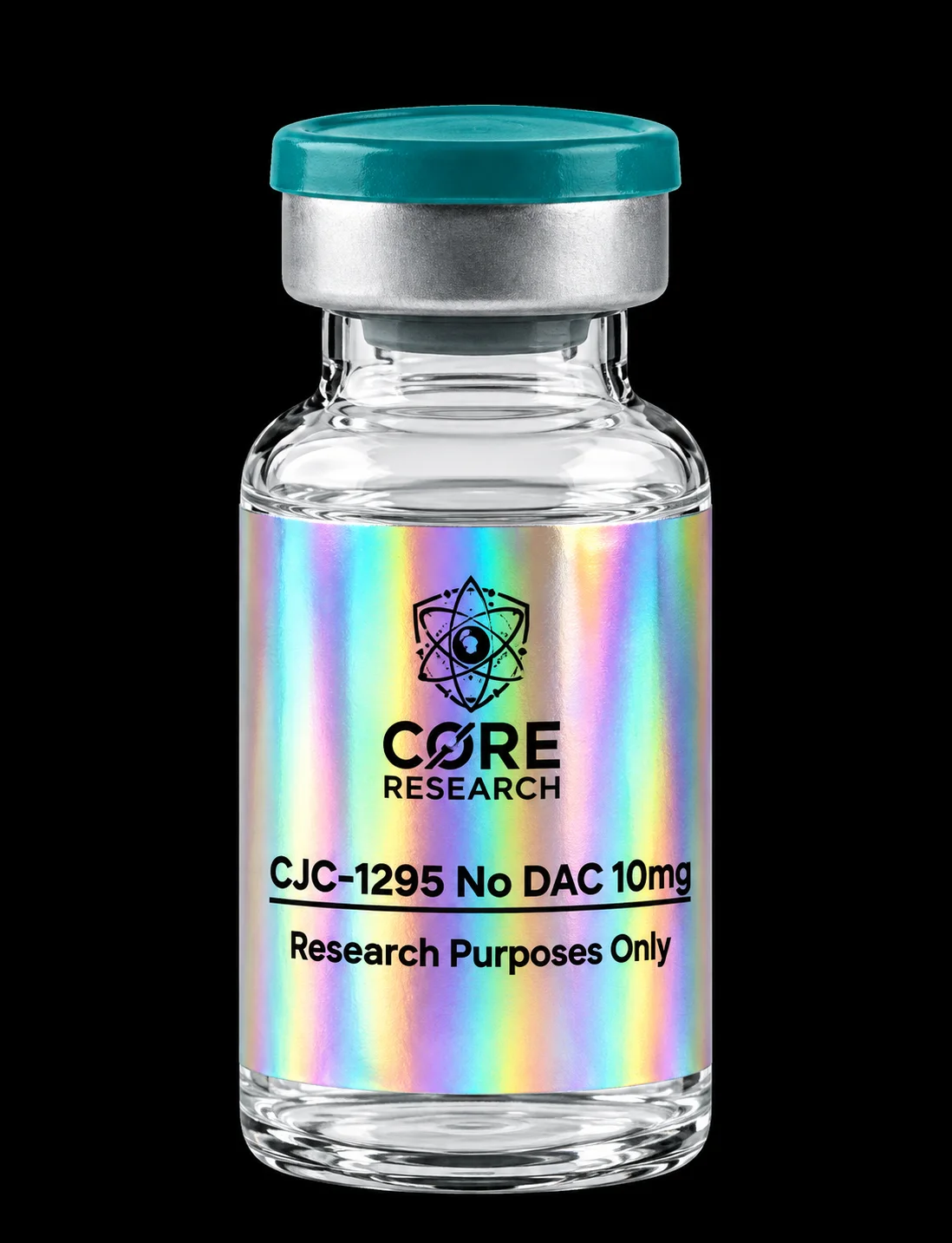
Description
CJC-1295 No DAC 10mg is a lyophilised research vial listed as a modified GRF(1-29)-type growth-hormone-releasing-hormone (GHRH) analogue without DAC. The absence of the albumin-binding Drug Affinity Complex (DAC) is the critical distinction from the long-acting CJC-1295 studied in several frequently quoted papers. A finding about a DAC-linked compound should not be presented as the kinetic behaviour or human effect of this No-DAC vial. 3 4
For in-vitro laboratory research only, not human or veterinary use. The product’s live price, stock and purchase controls remain with WooCommerce. Ask for its applicable chemical-form and batch documentation before ordering.
What is this CJC-1295 No DAC product?
| Product attribute | This listing |
|---|---|
| Product name | CJC-1295 No DAC 10mg |
| Supplier presentation | Sealed vial of lyophilised research material |
| Labelled quantity | 10mg per vial |
| Compound class | Modified GRF(1-29)-type GHRH analogue, without DAC |
| Chemical-form distinction | Does not include the DAC albumin-binding feature present in the long-acting research analogue |
| Exact substitutions, terminal group, counter-ion and measured content | Requires matching material specification and lot evidence |
| Price and availability | Current purchase panel, not a static article figure |
What “No DAC” does and does not say: the catalogue differentiates an unconjugated analogue from the albumin-binding form. It does not, by itself, specify the exact peptide sequence, degree of purity, time in circulation, half-life or potency of the supplied lot. Those are different questions requiring a chemically matched study or actual analytical record.
This vial versus the combination products
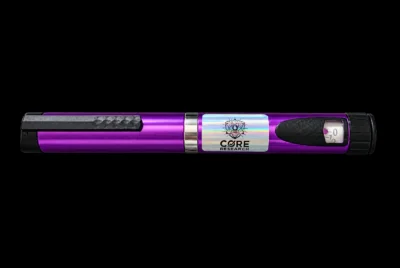
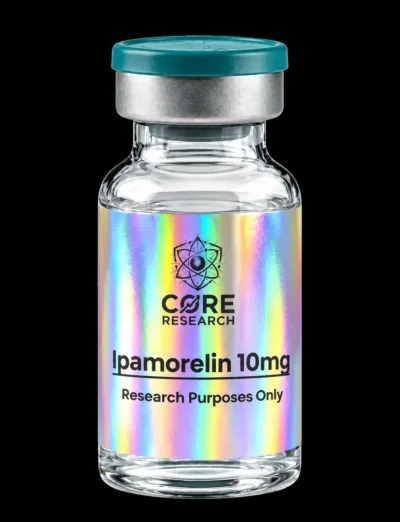
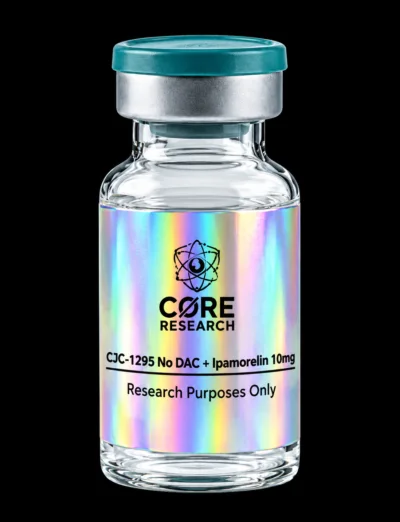
The CJC-1295 No DAC + Ipamorelin 10mg vial is a separate two-constituent blend, not another name for this standalone CJC vial. The CJC-1295 / Ipamorelin Refill 10mg and complete 10mg pen use different presentations. Ipamorelin 10mg is a separate peptide acting through a different receptor class. A total mass in a blend title must be read alongside its constituent quantities and format.
What do GHRH(1-29) analogue studies show?
GHRH acts through the GHRH receptor on pituitary cells, leading to intracellular signalling connected with growth-hormone release. A GRF(1-29) analogue is a shortened, chemically modified research form of the hormone’s N-terminal receptor-active region. Modifications can change enzyme stability, binding and the duration of a measured response; there is no reason to assume two analogues behave identically just because both are called “CJC”.
Sequence substitutions can change potency
Lance and colleagues compared several human GRF(1-29)-amide analogues in rat and pig experiments. In the rat model, the D-Ala2 substitution gave a much larger growth-hormone response than the parent molecule under the reported conditions. This establishes a structure–activity principle in that model, not a potency specification or human-study result for the present No-DAC vial. 1
Campbell and colleagues subsequently investigated receptor-binding relationships across GRF analogues and fragments. An Ala15 substitution was associated with increased receptor affinity in their assay, whereas certain truncated fragments lost activity alongside poorer receptor binding. The result illustrates why exact substitutions and terminal chemistry must be connected to the material used in each experiment. 2
Why the original CJC-1295 long-acting work is different
Jetté and colleagues studied maleimide-modified human GRF(1-29) derivatives designed to bind serum albumin. Their selected CJC-1295 form carried a reactive albumin-binding moiety and was evaluated in cultured rat pituitary cells and animal pharmacology experiments. Albumin conjugation changed the molecule’s stability and measured persistence. 3
The study did not describe this catalogue’s unconjugated No-DAC vial. The modified sequence alone and the additional albumin-binding group serve different chemical functions, and the latter cannot be inferred where it is absent.
Human findings from long-acting CJC-1295 do not transfer automatically
Teichman and colleagues studied the long-acting CJC-1295 analogue in placebo-controlled human pharmacology trials and reported sustained changes in growth hormone and IGF-I. These are meaningful results for the tested DAC-associated compound and study conditions, not a clinical efficacy or half-life estimate for No-DAC material. 4
A hormone response and a lasting clinical outcome are also distinct endpoints. A laboratory product page can explain the receptor and pharmacology literature without treating a hormonal biomarker as proof that the supplied vial changes a health outcome.
Understanding the “DAC” distinction at a glance
| Material or evidence | Chemical distinction | Appropriate conclusion |
|---|---|---|
| hGRF(1-29)-NH₂ and modified analogues [1,2] | Different substitutions/terminal chemistry | Receptor binding and response can change with structure |
| Original long-acting CJC-1295 [3,4] | Includes albumin-binding modification | Published kinetic/hormonal observations apply to that tested compound |
| This CJC-1295 No DAC 10mg vial | Listed without DAC group | Do not copy long-acting exposure values or assume the exact lot identity from the name |
| CJC-1295 No DAC + Ipamorelin blend | Two different receptor-class constituents | Blend-specific identity, component quantities and comparisons are needed |
The DAC versus No-DAC research guide explains the molecular differences in more depth. The growth-signalling comparison places this family alongside other catalogue materials.
Analytical identity and batch records
Before ordering, request available batch documentation using the full product name “CJC-1295 No DAC 10mg, lyophilised vial”. Where the laboratory requires exact sequence or chemical form, ask for the applied specification and analytical result rather than assigning a vendor-agnostic sequence from another publication. Identity evidence, chromatographic purity and quantitative peptide content answer different questions.
An HPLC peak percentage does not automatically establish the measured amount per vial. A mass-spectrum assignment depends on the predicted chemical form and observed ion, including any counter-ion or modification that affects interpretation. The CoA-reading guide, HPLC guide and mass-spectrometry primer explain these distinctions. A compound-level paper is not a lot report for Core Research stock.
Storage, delivery and receiving
Use the storage conditions supplied for the actual lyophilised vial. The present evidence does not justify a universal temperature, expiry, stability period after preparation or compatibility claim for this product. Relevant variables include the actual chemical form, packaging, solvent and experimental exposure history. See the storage decision guide and laboratory handling hub for research context without a personal-use preparation method.
Core Research’s published shipping policy describes dispatch from Birmingham, UK, plain outer packaging, tracking where provided and variable delivery times. The fee and estimated timing depend on destination and order. After receipt, compare the labelled item, amount and lot to the order; inspect packaging/closure and retain the lot record. Report any discrepancy to Core Research support before using the material. The receiving checklist provides a structured record.
Questions about CJC-1295 No DAC 10mg
Is CJC-1295 No DAC identical to original long-acting CJC-1295?
No. The original long-acting research compound included an albumin-binding DAC feature. This catalogue listing identifies a No-DAC material, so the published long-acting kinetic measurements cannot simply be reassigned to it.
Does this vial already contain Ipamorelin?
No. This is a single named GHRH-analogue listing. The separate CJC-1295 No DAC + Ipamorelin blend is a two-constituent product with its own composition.
Can the 10mg amount be used to determine a concentration or experiment count?
Not alone. It is a nominal mass per vial. Concentration additionally requires an appropriate material basis and a defined volume; a protocol needs its own validated laboratory parameters. This page does not provide administration instructions.
How do I order an exact chemical form or obtain a quotation?
Use the batch-documentation enquiry to confirm the current applicable specification and institutional procurement for a quotation or purchase-order reference. Current price and availability are supplied by the live purchasing controls.
Selected references
[1] Lance VA et al. (1984). Super-active analogs of growth hormone-releasing factor (1–29)-amide91647-4). Biochemical and Biophysical Research Communications 119:265–272.
[2] Campbell RM et al. (1991). GRF analogs and fragments: correlation between receptor binding, activity and structure90103-v). Peptides 12:569–574.
[3] Jetté L et al. (2005). Human GRF(1–29)-albumin bioconjugates: identification of CJC-1295 as a long-lasting GRF analog. Endocrinology 146:3052–3058.
[4] Teichman SL et al. (2006). Prolonged stimulation of GH and IGF-I secretion by long-acting CJC-1295 in healthy adults. Journal of Clinical Endocrinology & Metabolism 91:799–805.