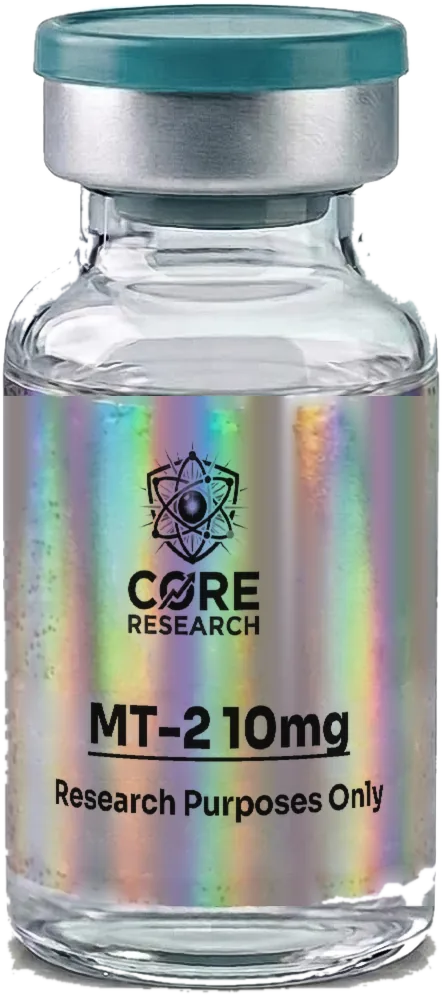
Description
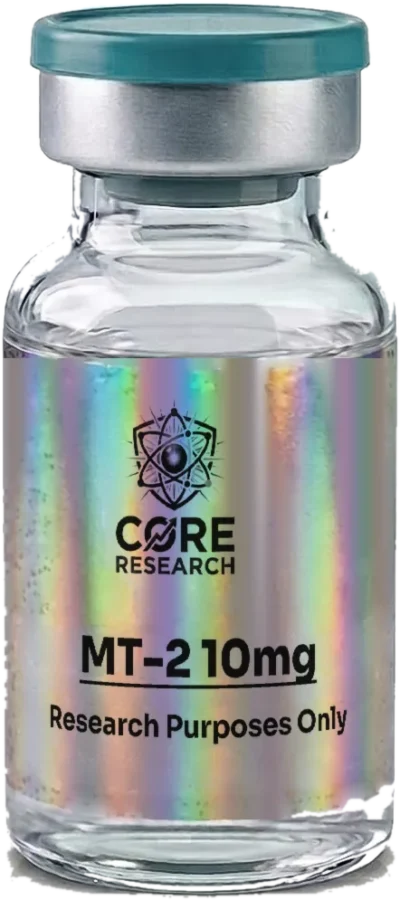
MT-2 10mg Pen from Core Research is a research-only catalogue item. Preloaded pen-format catalogue presentation of the MT-2 cyclic melanocortin research analogue. It is a separate listing from the vial and refill. Confirmation of device components, filled volume and dispensation performance requires the exact format record. For in-vitro laboratory research only; not for human or veterinary use.
What exactly is supplied?
Preloaded pen-format catalogue presentation of the MT-2 cyclic melanocortin research analogue. It is a separate listing from the vial and refill. Confirmation of device components, filled volume and dispensation performance requires the exact format record. The amount on the product name is a catalogue declaration, not a measurement of mass, chemical purity or content for an individual lot. Check the product and the applicable documentation if a specification is essential to your experiment.
| Attribute | What the product page establishes |
|---|---|
| Exact catalogue listing | MT-2 10mg Pen |
| Labelled quantity | 10mg nominal per listed item |
| Presentation | Preloaded pen-format product |
| Research entity | Melanotan II (MT-2) |
| Declared use | In-vitro laboratory research only; not human or veterinary use |
| Lot evidence | Request the report applicable to the lot and exact format proposed for dispatch |
The supplied label and any quality record should identify the lot. If you need the exact chemical form, sequence, terminal groups, counter-ion, mass basis, analytical identity or content, ask for a record tied to this product. Literature references and reference-database formulae are not supplier assay data.
How does this compare with the other formats?
These are separate catalogue products. A name shared across vial, refill and pen listings does not establish identical packaging, fill, solvent, compatibility, concentration or shelf life. A related molecule is not a substitutable chemical merely because it appears in the same research category.
| Catalogue item | Why the distinction matters |
|---|---|
| MT-2 10mg Pen — this listing | Pen-format product listing with preloaded cartridge presentation as described in the current catalogue. Verify the physical accessories, working volume and dispensing specification against the actual product record. |
| MT-2 10mg vial | Standalone vial, not a pen |
| MT-2 Refill 10mg | Refill cartridge, not the complete pen |
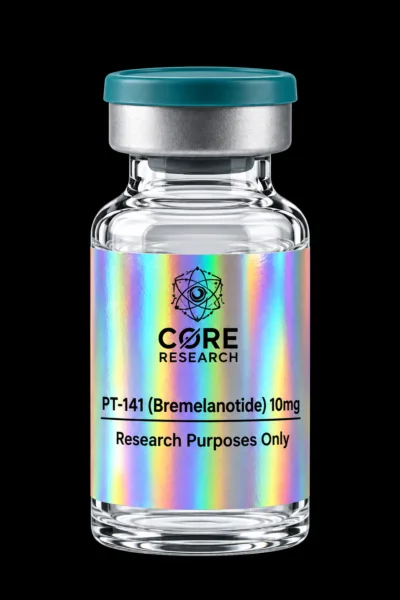
| PT-141 (Bremelanotide) 10mg | Related but chemically distinct melanocortin research entity |
If you require MT-II alone in lyophilised vial form, follow the vial listing. If you require a refill rather than a pen-format unit, follow the refill listing. For molecular selectivity questions, the MT-II/PT-141 comparison is more useful than assuming those related compounds are identical.
Why is Melanotan II (MT-2) researched?
Melanotan II, often abbreviated MT-II, is a cyclised alpha-melanocyte-stimulating hormone analogue investigated as a ligand at several melanocortin-receptor subtypes. Its ring and terminal chemistry distinguish it from linear MT-I and from PT-141/bremelanotide.
Scope of the studies selected below: Melanocortin-receptor assays, alpha-MSH-derived analogue structure–activity research, and selected animal physiology models. This is not a clinical outcome assessment of the supplied Core Research pen.
Cyclic scaffold and receptor recognition
The parent alpha-melanocyte-stimulating hormone belongs to a signalling family whose receptors include MC1R, MC3R, MC4R and MC5R. MT-II preserves a conserved His–D-Phe–Arg–Trp region within a cyclic scaffold. In receptor experiments the molecule is described as broadly active across several human melanocortin subtypes rather than universally selective for a single receptor. Receptor expression, species and the chosen functional assay all affect how a result should be interpreted. 1
Binding affinity and an intracellular cAMP response are different measurements. Binding indicates interaction under the assay conditions; cAMP formation reports one downstream signalling route. A positive value at an engineered cell line does not establish tissue distribution, biological exposure, lasting effects or an outcome in humans. This is why subtype labels belong with their measured context. 1
Structure–activity evidence: nearby analogues are not the same compound
Bednarek and colleagues constructed cyclic alpha-MSH analogues based on MT-II and tested binding and cAMP signalling at human melanocortin receptors. Some analogues retained substantial activity at MC1b while their responses at other subtypes differed. These experiments are a useful demonstration that apparently small sequence edits can strongly shift the receptor profile. The results for newly synthesised analogues should not be attributed to the unmodified MT-II reagent. 1
Gao and colleagues subsequently reported a distinct MT-II-related analogue in frog pigmentation experiments. The comparator was MT-II, but the newly designed F-peptide had its own structure and response. Its frog-chromatophore readout does not prove that a different commercial MT-II format shares the same potency, persistence or pigment response. 2
Animal nerve models: endpoints and qualifications
In a rat sciatic-nerve injury study, ter Laak and colleagues compared experimental responses to melanotan-II in a nerve-crush model and a toxic neuropathy model. They reported changes in sensory-function recovery under particular experimental conditions. The response was not uniform across all tested conditions, an important warning against treating the observation as a universal property of every exposure. 3
An animal sensory-reflex measurement is not equivalent to human clinical nerve repair, nor does a preclinical study certify the identity or biological activity of the material supplied in this catalogue. Different experimental aims—receptor screening, frog chromatophore movement and nerve-injury physiology—must be kept separate when interpreting a broad research history. 1, 2, 3
Boundaries of the evidence
The papers cited here are selected receptor, analogue and animal-model studies. They do not establish a human-use method, a treatment effect, or a universal melanocortin receptor selectivity claim for the supplied pen. The catalogue identity and the analytical evidence for the physical unit have to be checked independently of the literature.
What analytical evidence matters for this exact item?
A relevant certificate or analytical report should identify the tested material, reported lot, form and method. Separate identity (what was tested), purity (how the major signal relates to impurities under one method), content (how much material was measured) and the packaging/fill specification. A cited paper investigates the research entity; it does not certify the vial or cartridge supplied here.
Use Batch Documentation to enquire before purchase, specifying “MT-2 10mg Pen” and your required tests. No existing order or container lot is needed to make a pre-purchase enquiry under Core Research’s published documentation route. After delivery, match the returned report to the supplied lot rather than assuming a certificate for another item applies.
The guide to reading a peptide CoA explains how to identify the tested sample; the HPLC guide distinguishes chromatographic peak area from measured content, and the mass-spectrometry guide explains how observed ions and expected identity differ. An absent lot-specific result is treated as unknown, never as a default purity or sterility claim.
Confirm the cyclic analogue and the pen presentation
A parent MT-II sequence, a newly designed cyclic analogue and a PT-141-related molecule can have different chromatographic or mass-spectrometric identities. The pen-format unit also has its own physical and filled-product questions. Separate those from the molecular literature when seeking quality evidence.
Pen-format testing beyond compound identity
The pen-format catalogue description is not a device-performance certificate. Verify which physical components are supplied, whether the cartridge is preloaded, fill status and volume if relevant, device compatibility and the kind of dispensing verification available for this exact presentation. Avoid applying specifications from a refill or vial to a pen without evidence.
The research-pen verification guide covers the distinction between the named compound and a functioning finished delivery assembly. This page gives no human-use instructions or dispensing settings.
Storage, dispatch and laboratory receiving
Follow the conditions documented on the supplied label or applicable product/lot specification. Fixed refrigerated/frozen shelf lives, dry-product expiry, prepared-solution lifetime and transport-temperature promises are not inserted without appropriate evidence. An unopened material and a prepared solution have different possible stability concerns.
Exact cyclic-peptide identity, counter-ion and formulated state may affect how results from solution and solid-state studies are compared. Product-specific validated storage conditions take precedence over generic peptide advice.
At receipt, record the name, quantity, batch/lot identifier, packaging condition and closure. Compare them against the purchase record and any available certificate. The research-product receiving checklist provides the workflow; for delayed or unexpectedly warm deliveries use the arrival-condition guide and retain photographs/tracking where relevant.
Core Research publishes UK dispatch from Birmingham and plain, unmarked outer packaging. Tracking is supplied where provided by the chosen service. The actual delivery charge and expected timing depend on destination, order and checkout options; no universal next-day or temperature-controlled service is promised by this product draft.
Ordering and support
Select the desired quantity using the native WooCommerce purchase panel; current price, availability and the available checkout methods are determined by the live site, not by this static description. For supplier, material or lot questions, contact Core Research before placing an order.
Request batch documentation · Ask about this product · Institutional procurement · Shipping & Delivery
The supplied research material is not intended for clinical treatment, disease prevention, human or veterinary administration, food, cosmetic self-use or any unsupervised personal procedure.
Frequently asked ordering and laboratory questions
What is included in this product?
Pen-format product listing with preloaded cartridge presentation as described in the current catalogue. Verify the physical accessories, working volume and dispensing specification against the actual product record. The catalogue amount is 10mg nominal. Confirm any accessory, packaging or filled-state requirement before buying.
Can I request batch documentation before ordering?
Yes. The published documentation route accepts pre-purchase enquiries naming the product and presentation. Ask for the actual tests and lot applicability needed by your laboratory; a reply or historical certificate should not be mistaken for a guaranteed current-lot assay.
Does the product automatically include a compatible pen device?
No universal compatibility or accessory bundle should be inferred from the name. This listing is a pen-format product. Confirm the actual package contents and device compatibility with Core Research before procuring for a defined apparatus.
Can a vial certificate validate this cartridge or pen?
Not by itself. A compound-level report may establish a specified chemical test for the named lot, but cartridge seal, fill, compatibility and dispensing are separate finished-format questions.
What research finding is most important to interpret carefully?
The subtype-binding and cAMP literature includes closely related analogues, while animal nerve or pigment-model outcomes are separate endpoints. They are not direct performance tests of this pen.
How do delivery and institutional quotations work?
Use the live checkout for the available price, stock, shipping methods and final charge. Institutions can request quotations or purchase-order references through Core Research’s procurement route; raise any specific lot or documentation condition before ordering.
What should we do if the item is damaged or labelled incorrectly?
Preserve the packaging and lot information, take clear photographs and contact Core Research with your order details before using the material in an experiment.
Research references
[1] Bednarek MA et al. (2008). Cyclic alpha-MSH analogues at human melanocortin receptors; receptor binding and cAMP assays. PMID 18378043. View research record
[2] Gao L et al. (2015). A distinct MT-II analogue in frog chromatophore experiments. PMID 26095376. View research record
[3] Ter Laak MP et al. (2003). MT-II in a rat sciatic-nerve injury and neuropathy model. PMID 12591111. View research record