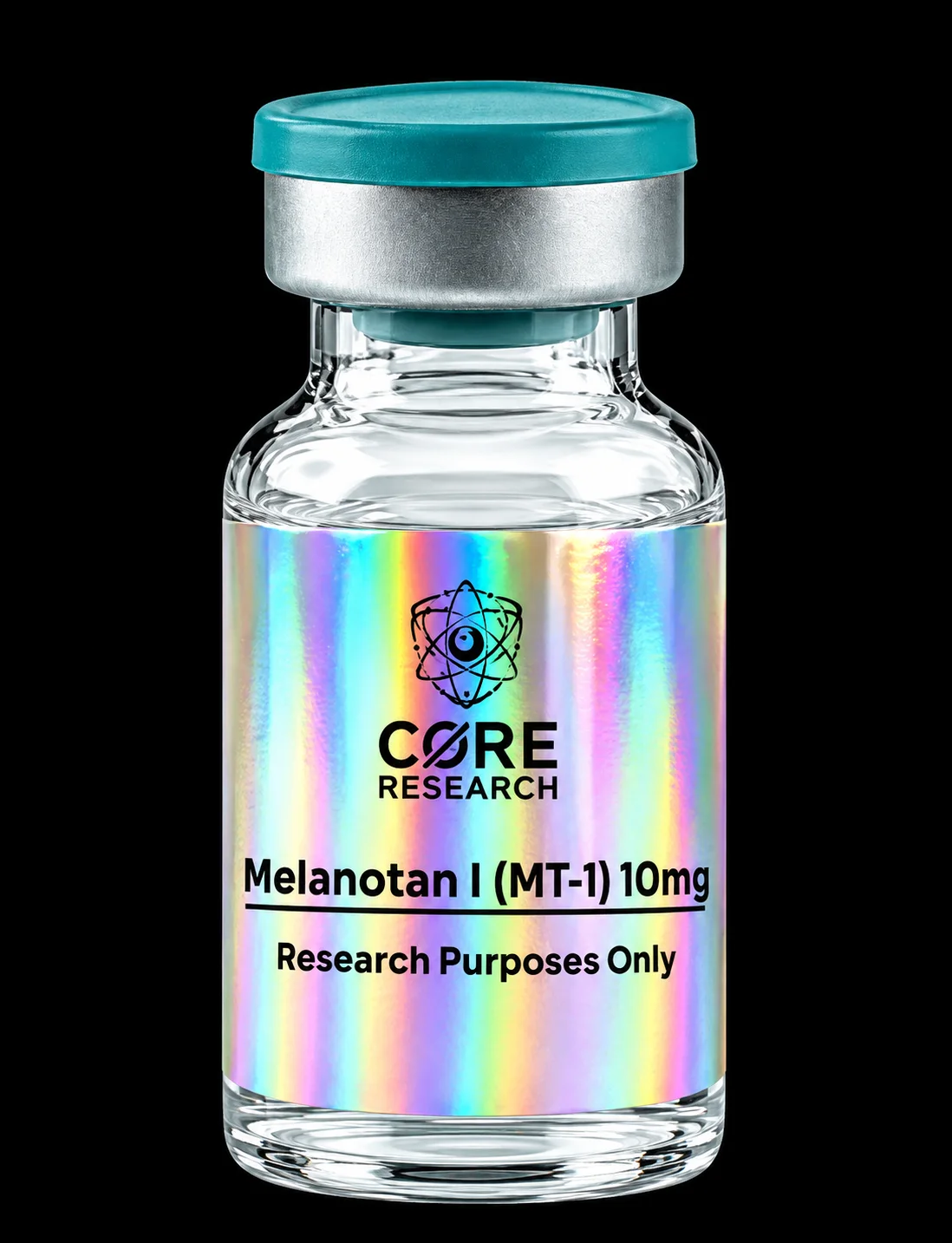
Description
Melanotan I (MT-1) 10mg is the Core Research catalogue item for 10mg nominal of an MT-1 melanocortin analogue, related by catalogue naming to [Nle4,D-Phe7]-alpha-MSH. It is supplied as one lyophilised vial for in-vitro laboratory research only; not for human or veterinary use. The material and model-level science below must be distinguished from product-specific analytical results and finished-format performance.
What you receive and what needs verifying
| Field | What this product listing establishes |
|---|---|
| Exact catalogue item | Melanotan I (MT-1) 10mg |
| Labelled amount | 10mg nominal; not an independently measured quantitative assay |
| Presentation | one lyophilised vial |
| Research identity | an MT-1 melanocortin analogue, related by catalogue naming to [Nle4,D-Phe7]-alpha-MSH |
| Supply boundary | In-vitro laboratory research only; no personal or veterinary use |
| Current price and stock | Shown by the live WooCommerce purchase panel; not fixed in this description |
The vial is the catalogue item: no cartridge, dispensing pen, buffer or administration accessory is stated as part of this purchase. The labelled milligram value is an amount per vial, not a prepared-solution concentration.
Before ordering, check the material identity, the form on the actual label and any information your assay needs from the applicable certificate. An unrelated paper, a general PubChem record or another catalogue format cannot establish a batch value for this particular item.
Which compound or format is the right laboratory item?
Different from MT-2. MT-1 and cyclic MT-2 differ in peptide scaffold and studied receptor interactions. Product names, labels and medicinal-formulation results are not interchangeable; select the actual catalogue item required for the laboratory study.
Related formats and research alternatives
| Format or material | Catalogue listing | Evidence boundary |
|---|---|---|
| 10mg vial | Melanotan I (MT-1) 10mg | This item |
| 10mg refill | MT-1 Refill 10mg | Separate catalogue record; verify its amount, components and lot evidence |
| 10mg pen | MT-1 10mg Pen | Separate catalogue record; verify its amount, components and lot evidence |
| MT-2 vial — different analogue | Melanotan II (MT-2) 10mg | Separate catalogue record; verify its amount, components and lot evidence |
A medicinal formulation or clinical study of a related melanocortin analogue does not validate the laboratory catalogue item. The relevant comparison is identity, sequence/cyclisation, receptor assay, exact format and applicable lot report—not a consumer outcome expectation.
Scientific research: mechanisms, measured results and limits
The following is a selected, model-specific evidence summary, not a systematic review, treatment recommendation or release test of this product. Read the study species, methods and measured endpoints beside each finding before transferring an interpretation to a different assay.
An analogue of alpha-MSH, not the native hormone
The research designation Melanotan I generally concerns the modified alpha-melanocyte-stimulating hormone analogue [Nle4,D-Phe7]-alpha-MSH, also called afamelanotide in defined pharmaceutical research. Substitutions at specific residues can change ligand stability and receptor pharmacology. The marketing abbreviation MT-1 is not enough to certify the exact sequence, terminal form, counter-ion or formulation of this laboratory product; those details belong to the applicable material record. 1
Melanocyte signalling is receptor- and cell-dependent
The melanocortin receptor 1 (MC1R) is a G-protein-coupled receptor that can activate cAMP signalling in pigment-producing cells, leading through downstream transcriptional responses to pigmentation-related enzyme expression. Other melanocortin-receptor subtypes occur in different tissues. A ligand’s activity in a pigmented tissue or melanoma cell line should not be used to label it absolutely MC1R-selective under all assay conditions. Biological response depends on the receptor, cell, ligand concentration and endpoint measured. 2
What early comparative vertebrate experiments found
Hadley and colleagues compared [Nle4,D-Phe7]-alpha-MSH with native alpha-MSH in chromatophores from several vertebrate species. The analogue produced stronger and more prolonged melanotropic responses in the selected frog, lizard and other skin/chromatophore systems. These experiments were not clinical cosmetic trials and did not test Core Research material; their relevance is to ligand structure and comparative melanocortin signalling. 1
A receptor-binding assay is not a human outcome
Libert and colleagues used a radiolabelled [Nle4,D-Phe7]-alpha-MSH analogue in a binding assay on cultured human melanoma-cell lines. They assessed signal behaviour and receptor-detection performance, not an intervention in people. The study illustrates that radioligand displacement or receptor-binding readouts answer molecular assay questions, while pigmentation or clinical responses require different experiments. 2
Why afamelanotide trials do not validate a research vial
Two randomised placebo-controlled studies of afamelanotide medicinal implants in people with erythropoietic protoporphyria were reported in 2015. The measured outcomes concerned painful photosensitivity, time in sunlight without pain and quality of life for that specific diagnosis and formulation. Those trials cannot establish tanning benefits, dosing, sterility, efficacy or product equivalence for this supplier’s lyophilised vial, refill cartridge or pen. Using the study as background scientific evidence must not imply the item for sale is an approved clinical product. 3
How to interpret the evidence for this product
| Research context | Reported or relevant endpoint | Interpretation limit |
|---|---|---|
| Vertebrate chromatophore preparations | Comparative pigment-cell responses | Animal model; not human-product efficacy |
| Human melanoma cell lines | Radioligand displacement and receptor-detection sensitivity | Cell assay, not human intervention |
| Controlled afamelanotide implant trials | Condition-specific pain-free sunlight outcome | Different medicinal formulation, not supplier vial/refill/pen |
Batch documentation before purchase
Core Research allows a pre-purchase batch-documentation enquiry. Use Batch Documentation or email info@core-research.net with the exact product name and presentation. An order or container lot number is not needed to ask the question before purchase; to match a supplied item after delivery, retain its lot identifier and order reference. The published delivery policy says a certificate is issued with a consignment where one exists for the supplied lot; that is not a promise of a current certificate for every item.
Ask whether documentation applies to the lot proposed for supply and identifies the tested chemical form, sample description, method, result, reporting basis, testing issuer and relevant dates. The difference between chromatographic peak-area purity, identity/mass and quantitative vial content matters.
For interpretation, use guide to reading a CoA, HPLC testing guide and mass-spectrometry guide. A theoretical molecular formula is not a batch-assay result, and a product label does not certify sterility.
For this melanocortin research product, ask the supplier to match the sequence, stereochemistry, terminal groups, cyclic-versus-linear scaffold and counter-ion to the actual lot. The shorthand MT-1 or MT-2 alone cannot verify these fields.
Storage, receiving and laboratory quality control
A lyophilised vial is different from a liquid solution. Check the lot-specific storage document rather than importing a generic reconstitution or stability period.
Follow the supplied label and product-specific documentation for storage conditions, temperature excursions and expiry. The time limits for dry peptide, a mixed solution, or a liquid-filled cartridge can differ. No generic fixed storage term, purity threshold or cold-chain guarantee is inserted here without applicable evidence. See peptide storage guidance and research-product receiving checklist for general laboratory-record practices.
At receipt, compare the product name, labelled amount and presentation with your order. Inspect the vial closure or cartridge/packaging, record the lot identifier and retain the accompanying paperwork. If damaged, delayed or different from the order, record photographs and contact Core Research before using the material. This records receipt conditions; it does not substitute for an identity assay.
Ordering questions
Does the labelled milligram amount state purity or a prepared concentration?
No. 10mg is the catalogue-labelled quantity for this item. It does not by itself establish analytical content, purity, final liquid concentration, sample mass basis or number of experiments. The applicable material documentation and your laboratory’s own method establish those details.
Where is the product dispatched from and what is the delivery policy?
Core Research states that it dispatches from Birmingham, United Kingdom, using plain external packaging. Delivery service, charge and arrival estimates depend on the destination and order; see Shipping & Delivery. Tracking is provided in dispatch communications where available. There is no universal next-day delivery or free-shipping promise on this page.
Can I obtain an applicable certificate before ordering?
You can request information before ordering through Batch Documentation. Specify Melanotan I (MT-1) 10mg, the vial presentation and any required test/method. Whether a particular current lot has a document, and what it actually reports, must be checked rather than assumed.
Can an institution request a quotation?
Yes. Institutional Procurement describes the written quotation and purchase-order-reference enquiry route. Include the institution, delivery details, exact product and quantity, and any lot or technical requirements. An enquiry does not itself reserve stock or guarantee credit terms.
Is this product suitable for human or veterinary use?
No. This listing is for in-vitro laboratory research only. Neither a positive model result nor a named medicinal compound establishes human-use suitability, and this page gives no preparation, dosing or administration instructions. See Research Use Only policy.
Order or enquire about Melanotan I (MT-1) 10mg
Use the native product purchase panel to select the listed quantity and the checkout options available for your order. For identity, format, lot-documentation or delivery questions, contact Core Research before purchase. Current price and stock remain controlled by WooCommerce, not hard-coded in this description.
Selected research references
[1] Hadley ME et al. (1985). [Nle4,D-Phe7]-alpha-MSH and prolonged activity in vertebrate chromatophore models. Comparative Biochemistry and Physiology. PMID 2859941. Primary research record.
[2] Libert A et al. (1989). An alpha-MSH analogue used in radioligand receptor-binding assays on human melanoma cell lines. Pigment Cell Research. PMID 2557606. Primary research record.
[3] Langendonk JG et al. (2015). Afamelanotide for erythropoietic protoporphyria: two controlled trials using medicinal implants. New England Journal of Medicine. PMID 26132941. DOI 10.1056/NEJMoa1411481. Primary research record.