Description
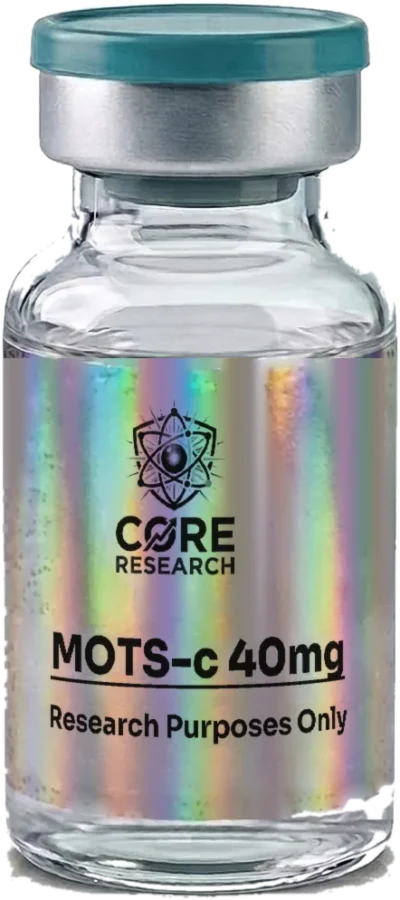
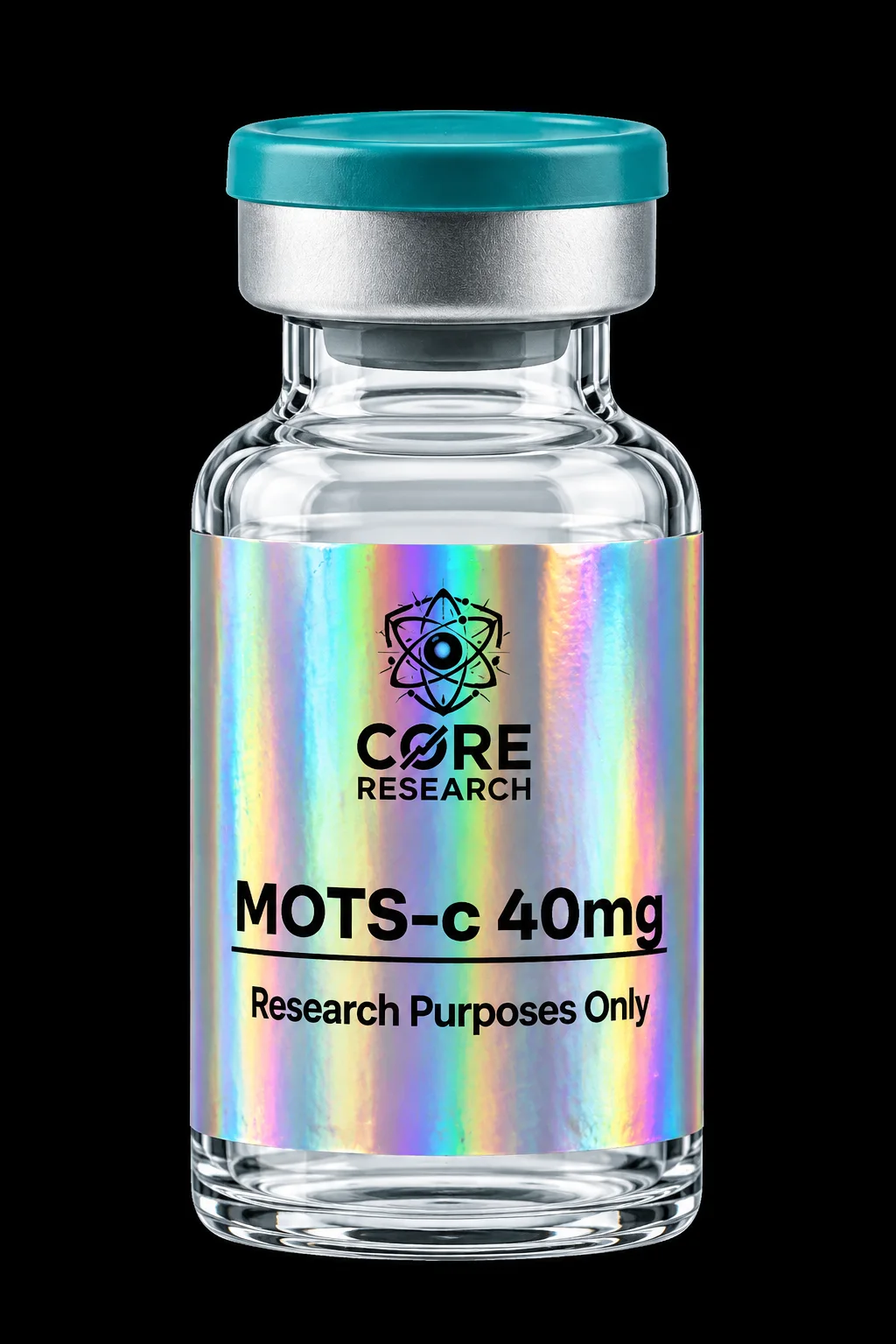
MOTS-c 40mg is the Core Research listing for 40mg nominal in a lyophilised vial. MOTS-c, a mitochondrially encoded 16-amino-acid peptide in the research literature. It is supplied for in-vitro laboratory research only, not for human or veterinary use. The exact supplied chemical form, current batch results and any finished-format specifications must be checked against the documentation applicable to this item.
What you receive and what the label means
The current catalogue identifies this product as MOTS-c 40mg. This page distinguishes the material name and labelled quantity from independently measured content. Stock and current price are supplied by the live WooCommerce purchase panel rather than duplicated as static claims in the description.
The stated nominal amount is not a prepared solution concentration, analytical purity percentage or guarantee of the number of experiments possible. Those further properties depend on the exact material form, documentation and laboratory method.
| Item | Detail |
|---|---|
| Catalogue product | MOTS-c 40mg |
| Labelled amount | 40mg nominal |
| Named material / declared composition | MOTS-c, a mitochondrially encoded 16-amino-acid peptide in the research literature |
| Physical presentation | a lyophilised vial |
| Supply boundary | Laboratory research only; no human or veterinary use |
Which product format is the right catalogue item?
The related listings below differ in presentation and, where stated, composition. Do not assume their packages, compatible hardware, storage conditions or analysed content are identical merely because the molecular name overlaps. vial and pen-format comparison.
| Product | Declared format / relevant distinction |
|---|---|
| MOTS-c 40mg (this item) | 40mg lyophilised vial |
| MOTS-c 40mg Refill | 40mg refill item |
| MOTS-c 40mg Pen | 40mg pen item |
The exact MOTS-c presentation matters
The vial item is a dry, lyophilised 40mg research listing; it is not a cartridge or a working pen.
Research mechanisms and what studies actually found
The following sections distinguish the molecular identity, measured experimental endpoint and limitations of published work. Literature on a pure molecule, animal model or clinical formulation is not analytical evidence for this particular Core Research supply. The cited sources support the described scientific context, not a product-specific efficacy or batch claim.
A mitochondrial-encoded signalling peptide
MOTS-c is a 16-residue peptide reported from a short open reading frame within mitochondrial 12S rRNA. The mitochondrial origin describes endogenous encoding; a commercially supplied synthetic preparation is not evidence of human mitochondrial production, an endogenous concentration or the batch’s chemical identity. 1
Folate–purine metabolism and AMPK signalling
Lee and colleagues used cellular and mouse models to link MOTS-c activity to the folate cycle and de novo purine synthesis, with downstream AMPK-related metabolic responses. In their mouse experiments, resistance to diet-associated metabolic disturbances was reported under particular conditions. These are preclinical endpoints; they do not establish clinical metabolic benefit for this vial, refill or pen. 1
Stress-induced nuclear localisation
Kim and colleagues observed that metabolic stress could promote AMPK-dependent movement of MOTS-c into the nucleus, where it influenced gene-expression patterns and interacted with antioxidant-response-element-related signalling, including NRF2-associated pathways. This is a striking example of mitochondria–nucleus communication, but cellular localisation in a study is not proof of a similar response from every commercial preparation. 2
Exercise and ageing research in mice
Reynolds and colleagues investigated MOTS-c in experimental mouse models, reporting muscle-metabolism and physical-capacity endpoints across age groups and later-life exposure conditions. The paper also examined exercise-associated changes. The animal results must not be presented as a human exercise-performance promise, nor converted into a personal administration schedule. 3
Why the measured endpoint matters
An assay measuring AMPK phosphorylation, nuclear localisation, glucose handling or treadmill performance asks a different question. Each endpoint requires its own experimental model, comparator and quality controls. Calling all of them “energy optimisation” obscures what was actually observed. Finished-format evidence and individual lot properties are separate from each biological study.
Separating mouse exercise findings from claims about the supplied product
MOTS-c exercise and ageing papers report cellular and mouse experiments with specific intervention protocols and endpoints. They do not establish performance enhancement or safety in people, and they did not evaluate this seller’s vial, cartridge or pen. Research on the endogenous mitochondrial gene does not substitute for identity and content testing of a synthetic supplied sample.
Batch documentation and evidence before purchase
For a pre-purchase question, use Request batch documentation or email info@core-research.net, naming MOTS-c 40mg and its vial format. You do not need a previous container lot number to enquire. Ask which dispatch lot and exact presentation any proposed report covers.
Read the certificate for sample identification, test method, analyte(s), units, measured content, chromatographic results and issuer. Identity, chromatographic purity and quantitative content answer different questions; one HPLC peak-area value alone does not prove the labelled mass. Laboratory handling and evidence requirements depend on the actual chemical form.
For context see how to read a peptide CoA, HPLC and purity testing and mass-spectrometry identity testing. These guides explain how documents are read; they do not assert that a current lot passed any unobserved test.
Storage, receipt and handling
Follow the storage instructions supplied for this particular product and lot. A fixed dry-material temperature or shelf life is not stated here without authenticated product-specific evidence. Solution stability, if applicable, is a separate question that can depend on solvent, pH, concentration, container and exposure history.
At receipt, inspect the material label, lot and quantity, packaging and closure against the order; record discrepancies before laboratory use. See the research-product receiving checklist and laboratory storage guidance. For late or unexpectedly warm delivery, consult warm or delayed research shipments.
Ordering and laboratory procurement questions
Can I ask for the lot documentation before ordering?
Yes. The Request batch documentation route accepts product/presentation enquiries before an order. Ask whether the available report covers the lot expected to be supplied; availability and analytical scope must not be assumed.
Where do orders ship from?
Core Research’s published shipping policy describes dispatch from Birmingham, UK, in plain outer packaging. Available carrier options, shipping charges and tracking depend on the actual order and service. The checkout and shipping policy provide the applicable current information.
Does the labelled amount determine experimental concentration?
No. The labelled mass alone does not determine a prepared concentration, method, recovery, sample number or material content verified by assay. Those require defined volume and material-specific laboratory controls; the page provides no personal-use or administration directions.
Can an institution ask for a quotation?
Yes. The Institutional Procurement page provides a quotation and purchase-order-reference enquiry pathway. State the requested item, quantity, delivery details and any need for a particular lot or document before ordering.
What if the item arrives damaged or differs from the order?
Contact info@core-research.net with the order number, labelled product/lot identifiers and photographs. Keep the packaging and segregate the item from laboratory use until the discrepancy is addressed.
Order or enquire about MOTS-c 40mg
Use the native purchase panel for current pricing, stock and quantity selection. For an analytical or format question, contact Core Research before purchase; for shipping information see Shipping & Delivery.
The research discussed above is not a human-use instruction or a claim about medical effects of the supplied item. Read the Research Use Only policy and testing and quality methodology for the published supply and quality framework.
Selected research and identity references
[1] Lee C et al. (2015), Identification of MOTS-c and the folate–purine–AMPK pathway in cellular and mouse models. Cell Metabolism. Source.
[2] Kim KH et al. (2018), AMPK-dependent nuclear localisation under metabolic stress. Cell Metabolism. Source.
[3] Reynolds JC et al. (2021), MOTS-c and age-related physical capacity in mice. Nature Communications. Source.