Description
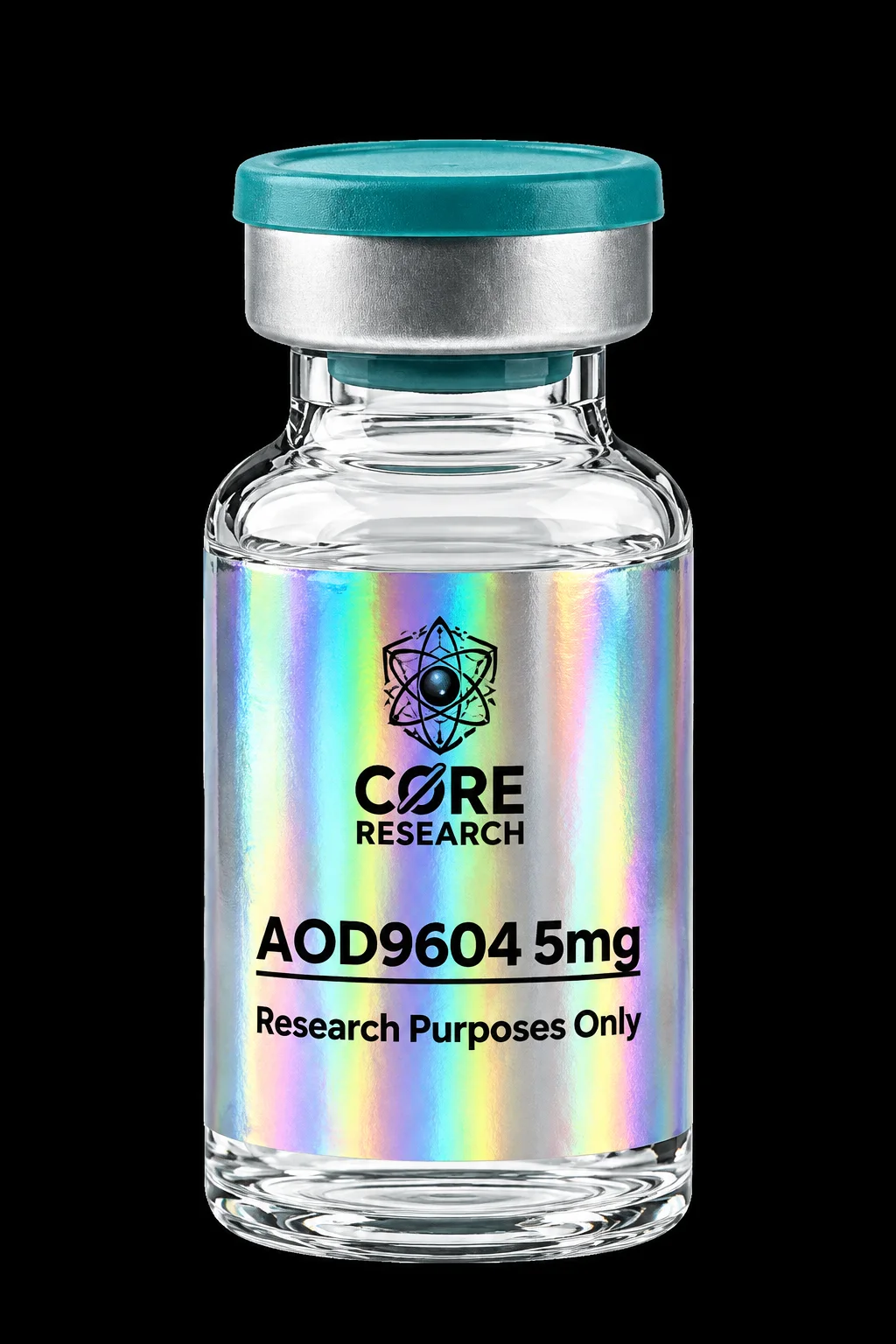
AOD9604 5mg is the Core Research listing for 5mg nominal in a lyophilised vial. AOD9604 peptide; exact form confirmed through product documentation. It is supplied for in-vitro laboratory research only, not for human or veterinary use. The exact supplied chemical form, current batch results and any finished-format specifications must be checked against the documentation applicable to this item.
What you receive and what the label means
The current catalogue identifies this product as AOD9604 5mg. This page distinguishes the material name and labelled quantity from independently measured content. Stock and current price are supplied by the live WooCommerce purchase panel rather than duplicated as static claims in the description.
The stated nominal amount is not a prepared solution concentration, analytical purity percentage or guarantee of the number of experiments possible. Those further properties depend on the exact material form, documentation and laboratory method.
| Item | Detail |
|---|---|
| Catalogue product | AOD9604 5mg |
| Labelled amount | 5mg nominal |
| Named material / declared composition | AOD9604 peptide; exact form confirmed through product documentation |
| Physical presentation | a lyophilised vial |
| Supply boundary | Laboratory research only; no human or veterinary use |
How this format differs from other products
This listing is a distinct purchasable item. Similar names or family research do not establish identical quantities, chemical forms, solution properties or packaging for another catalogue product.
Research mechanisms and what studies actually found
The following sections distinguish the molecular identity, measured experimental endpoint and limitations of published work. Literature on a pure molecule, animal model or clinical formulation is not analytical evidence for this particular Core Research supply. The cited sources support the described scientific context, not a product-specific efficacy or batch claim.
A growth-hormone fragment is not intact growth hormone
AOD9604 research originates from a modified carboxy-terminal region of human growth hormone, frequently identified as Tyr-hGH(177–191). It is not the full 191-residue hormone. Its precise sequence variant, cyclisation/disulphide state and chemical form should be identified from material documentation, rather than relying on catalogue shorthand such as “fragment 176–191.” 1,2
Rodent fat-oxidation experiments
Ng and colleagues investigated the fragment in obese Zucker rats; Heffernan and colleagues studied obese mice, reporting reduced body-weight gain and changes in fat oxidation/lipolytic endpoints under their experimental conditions. The results arose in specific rodent models and cannot simply be recast as measured human weight loss or evidence about this 5mg vial. 1,2
β3-adrenoceptor and receptor specificity
Comparisons with β3-adrenoceptor-deficient animal models support the importance of β3-adrenergic signalling for certain reported metabolic effects. Other experiments found the fragment did not compete for the classical growth-hormone receptor. These observations constrain possible mechanisms; they do not identify a single direct binding target or establish downstream outcomes in every tissue. 2,3
Human trials and their evidentiary scope
Stier, Vos and Kenley published a pooled safety and tolerability account of clinical investigations of AOD9604. It included company-associated research programmes and assessed selected safety measures rather than providing a standalone independently replicated efficacy trial for weight management. The human programmes investigated their own preparations, not the identity, purity or suitability of the product on this page. 4
Why the evidence does not answer a clinical question
Animal lipolysis, human tolerability and validated clinical effectiveness are three different evidence categories. A positive result in an obese animal does not establish benefit in people, and absence of a measured change in a short human safety analysis is not proof of long-term safety. The supplied material is intended for in-vitro laboratory research only.
What human evidence cannot establish
The published pooled tolerability study involves human research formulations and selected assessment periods, not the present 5mg vial. It cannot validate the vial’s analytical quality, prove weight-loss efficacy or establish long-term clinical safety. Distinguish preclinical fat-oxidation measurements from human outcomes and do not infer a personal-use regimen.
Batch documentation and evidence before purchase
For a pre-purchase question, use Request batch documentation or email info@core-research.net, naming AOD9604 5mg and its vial format. You do not need a previous container lot number to enquire. Ask which dispatch lot and exact presentation any proposed report covers.
Read the certificate for sample identification, test method, analyte(s), units, measured content, chromatographic results and issuer. Identity, chromatographic purity and quantitative content answer different questions; one HPLC peak-area value alone does not prove the labelled mass. Laboratory handling and evidence requirements depend on the actual chemical form.
For context see how to read a peptide CoA, HPLC and purity testing and mass-spectrometry identity testing. These guides explain how documents are read; they do not assert that a current lot passed any unobserved test.
Storage, receipt and handling
Follow the storage instructions supplied for this particular product and lot. A fixed dry-material temperature or shelf life is not stated here without authenticated product-specific evidence. Solution stability, if applicable, is a separate question that can depend on solvent, pH, concentration, container and exposure history.
At receipt, inspect the material label, lot and quantity, packaging and closure against the order; record discrepancies before laboratory use. See the research-product receiving checklist and laboratory storage guidance. For late or unexpectedly warm delivery, consult warm or delayed research shipments.
Ordering and laboratory procurement questions
Can I ask for the lot documentation before ordering?
Yes. The Request batch documentation route accepts product/presentation enquiries before an order. Ask whether the available report covers the lot expected to be supplied; availability and analytical scope must not be assumed.
Where do orders ship from?
Core Research’s published shipping policy describes dispatch from Birmingham, UK, in plain outer packaging. Available carrier options, shipping charges and tracking depend on the actual order and service. The checkout and shipping policy provide the applicable current information.
Does the labelled amount determine experimental concentration?
No. The labelled mass alone does not determine a prepared concentration, method, recovery, sample number or material content verified by assay. Those require defined volume and material-specific laboratory controls; the page provides no personal-use or administration directions.
Can an institution ask for a quotation?
Yes. The Institutional Procurement page provides a quotation and purchase-order-reference enquiry pathway. State the requested item, quantity, delivery details and any need for a particular lot or document before ordering.
What if the item arrives damaged or differs from the order?
Contact info@core-research.net with the order number, labelled product/lot identifiers and photographs. Keep the packaging and segregate the item from laboratory use until the discrepancy is addressed.
Order or enquire about AOD9604 5mg
Use the native purchase panel for current pricing, stock and quantity selection. For an analytical or format question, contact Core Research before purchase; for shipping information see Shipping & Delivery.
The research discussed above is not a human-use instruction or a claim about medical effects of the supplied item. Read the Research Use Only policy and testing and quality methodology for the published supply and quality framework.
Selected research and identity references
[1] Ng FM et al. (2000), AOD9604 studies in an obese Zucker rat model. Source.
[2] Heffernan MA et al. (2001), hGH-derived fragment, fat oxidation and weight outcomes in obese mice. Source.
[3] Heffernan MA et al. (2001), β3-adrenoceptor involvement in AOD9604 response. Source.
[4] Stier H, Vos E, Kenley D. (2013), Pooled human-trial safety and tolerability report; not a standalone efficacy demonstration. Source.