Description
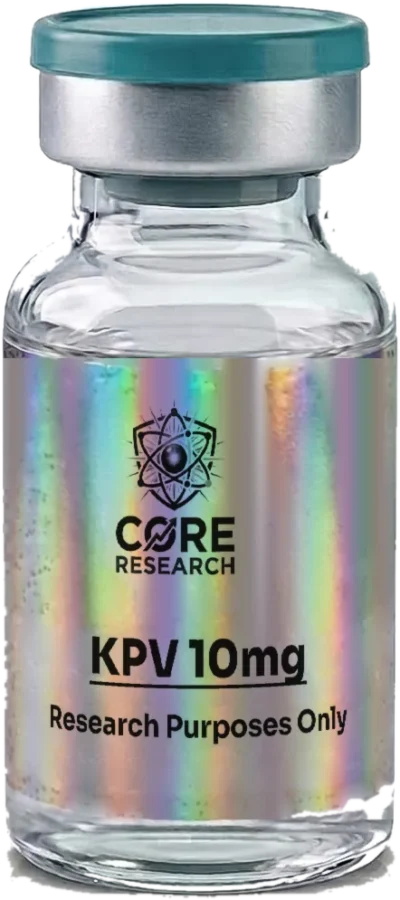
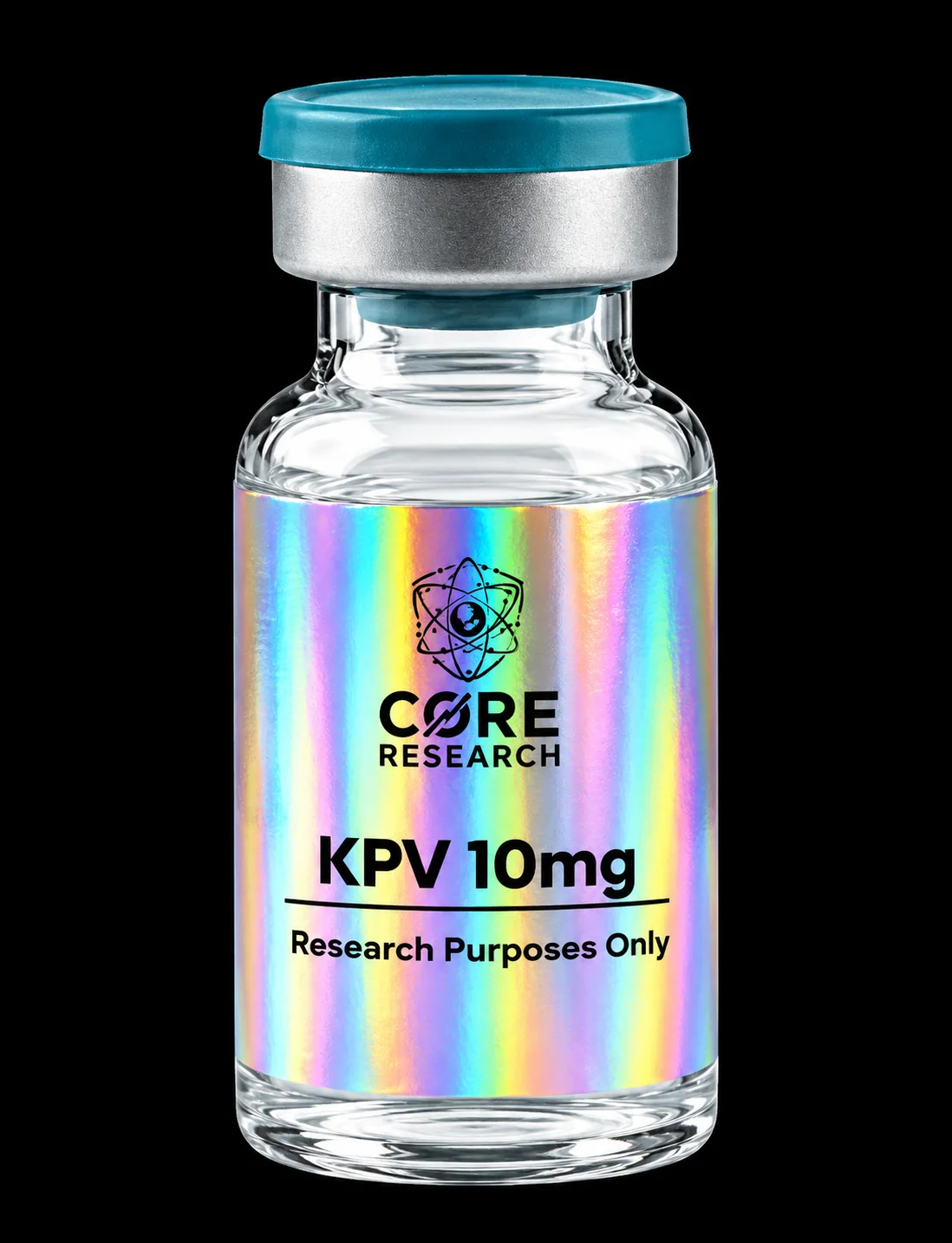
KPV 10mg is a lyophilised research tripeptide supplied in a sealed 10mg vial. KPV stands for lysine–proline–valine, the three-residue sequence occurring at the C-terminal end of alpha-melanocyte-stimulating hormone (α-MSH). Researchers have examined KPV uptake into epithelial and immune cells and downstream responses in inflammatory and oxidative-stress models. Results for a modified nanoparticle formulation or chemically altered KPV cannot automatically be attributed to this unformulated vial. 1 2
For in-vitro laboratory research only, not human or veterinary use. Price and availability remain in the live purchase panel; request the applicable material specification if the exact chemical form matters to your research.
What is supplied in the KPV 10mg product?
| Product detail | Listed information |
|---|---|
| Product | KPV 10mg |
| Sequence shorthand | K–P–V / Lys-Pro-Val |
| Peptide class | Three-amino-acid tripeptide |
| Related parent sequence | α-MSH residues 11–13 |
| Nominal amount | 10mg per vial |
| Presentation | Lyophilised powder in sealed vial |
| Catalogue salt designation | Acetate; exact analytical content basis to be checked against the current specification |
| What is not established by the name alone | Whether terminal groups, water content, counter-ions or measured assay match any particular reference entry |
KPV appears in papers as the unmodified three-residue sequence, C-terminal-amidated KPV and chemically modified derivatives. For example, Songok and colleagues studied glycoalkylation of an amidated KPV model compound. That chemical research does not make every KPV listing the same salt or terminal form. A molecular formula or mass should therefore accompany the exact form, not simply the three-letter name. 3
KPV 10mg vial versus other listed formats
The KPV Refill 10mg and KPV 10mg Pen are separate product records. The nominal peptide name and amount are shared, but packaging, formulation, device inclusion and finished-format evidence must be checked separately. Use the vial-versus-pen comparison for the purchasing distinction. Do not infer pen compatibility or working volume from the vial’s label.
Why is KPV researched?
KPV is relevant to research on cellular transport and inflammatory signalling. The central questions are whether the peptide can enter a particular cell, what inflammatory signals change after exposure, and whether the tested preparation reaches the relevant cells in an experimental model. The context matters: a transporter expressed in one tissue, a nanoparticle targeted to another, and a cell culture under pollutant-induced stress are not equivalent models of effectiveness.
PepT1-mediated uptake: transporting a tripeptide into cells
Dalmasso and colleagues investigated the di-/tripeptide transporter PepT1, which is prominent in intestinal transport biology and can be induced in inflamed colonic tissue. The study examined intestinal epithelial lines, immune cells and two experimentally induced mouse colitis models. They showed that KPV uptake was associated with PepT1 and that exposed cells displayed reduced NF-κB/MAPK activation and selected inflammatory cytokines. The paper links a transport mechanism to measured downstream responses rather than treating the peptide as acting identically on every cell surface. 1
NF-κB is a transcriptional regulator involved in inflammatory gene expression; MAP kinases are signalling proteins that can transmit stress and cytokine inputs. A reduction in a reporter or cytokine measurement is not, on its own, a result for every tissue or a proof of direct binding to a single molecular receptor.
Colonic models: what was actually observed?
In the same work, KPV exposure reduced signs of experimentally induced inflammation in mouse models using DSS or TNBS, alongside changes in tissue and cytokine measurements. These findings suggest a biologically interesting peptide–transporter–response connection; they remain preclinical evidence. The animals and experimental preparations did not test the identity, purity or behaviour of the Core Research vial. 1
Why delivery technology matters
Xiao and colleagues formulated KPV into hyaluronic-acid-functionalised nanoparticles, further incorporated into a polymeric hydrogel delivery system. Their research measured uptake by colonic epithelial cells and macrophages and compared inflammatory and mucosal outcomes in a mouse colitis model. The HA-functionalised system produced stronger effects on selected endpoints than a KPV nanoparticle/hydrogel comparator in that experiment. 2
The crucial limitation is the formulation. A targeted polymeric carrier affects where, when and how much of the tested compound reaches cells; this finding cannot establish equivalent performance for lyophilised KPV on its own. It also does not prove that all nanoparticle designs produce the same response.
Keratinocyte stress: oxidative responses, NF-κB and MAPK
In a 2025 study, Sung and colleagues examined human-derived HaCaT keratinocytes under fine-particulate-matter stress and a three-dimensional skin model. KPV exposure was associated with lower reactive oxygen species, inflammatory signalling and IL-1β measurements, alongside changes in stress-related MAPK and caspase pathways. These were laboratory cell/tissue-model findings, not a clinical cosmetic trial or a test of this research vial’s use on skin. 4
How to interpret the evidence without confusing materials
| Study setting | Research finding | Interpretation limit |
|---|---|---|
| Epithelial and immune cell systems [1] | PepT1-associated KPV uptake and changes in inflammatory signalling | Cell lines and transporter expression are context-dependent |
| Mouse colitis models [1] | Reduced selected inflammatory/tissue measures | Preclinical models do not establish human treatment performance |
| HA-nanoparticle/hydrogel studies [2] | Enhanced targeted delivery and selected experimental endpoints | The carrier is part of the result, not simply KPV alone |
| Keratinocyte and 3D skin experiments [4] | Changes in oxidative and inflammatory stress markers | No finished-cosmetic or commercial-vial effect established |
| Chemical modification research [3] | Feasible modification of an amidated peptide | Chemistry changes can alter the identity being tested |
KPV is not interchangeable with the entire α-MSH molecule: the parent is longer and has other receptor-related functions. Likewise, evidence for one amidated or derivatised sequence should not be silently combined with results from another chemical form.
Identity, purity, content and batch documentation
If your work requires a defined KPV chemical form, ask Core Research for the relevant batch documents using “KPV 10mg, lyophilised vial”. Match the peptide sequence, terminal groups, salt designation and expected mass assignment to the tested material. Where a report lists an HPLC purity percentage, determine its method and basis; where quantitative content is claimed, check the actual assay. Do not treat appearance or a PubChem record as an independent lot-release test.
Use the CoA-reading guide, HPLC reference and mass-spectrometry primer when examining the documents. Before purchase, no existing vial lot number is needed to ask which records are available; after delivery, provide the container lot and order reference.
Storage, delivery and receiving
Keep the material according to the actual supplied vial label and documented material specification. Unopened dry powder and prepared laboratory solutions have different stability questions. This page does not invent a fixed solution lifetime or temperature-excursion allowance. Consult the storage-temperature guide and the laboratory’s validated material-handling procedure.
Core Research states that orders are dispatched from Birmingham, UK, in plain outer packaging, with tracking information where provided. The current shipping policy explains estimated timing and delivery conditions; fees depend on order and destination. On receipt, compare the product, labelled amount and lot with the order, inspect packaging/closure, and retain documents; the receiving guide covers the inspection. Unexpected damage, warmth or delay should be documented and reported promptly.
KPV research-material questions
Is KPV 10mg the same as 10mg of alpha-MSH?
No. KPV is a three-residue sequence related to a segment of the longer α-MSH peptide, not the whole parent molecule. The nominal 10mg describes this listed KPV material, not an alpha-MSH mass or activity measurement.
Is this product a finished skincare preparation?
No. It is a lyophilised laboratory research vial. The cell and 3D skin studies discussed above do not establish that this item is a finished topical product or suitable for any human use.
Is the 10mg amount a solution concentration?
No. It is the labelled total per vial. Concentration requires a defined amount basis and liquid volume. Laboratory calculations require the applicable material specification; this page does not provide administration guidance.
How do I verify the chemical form or request an institutional quotation?
For the chemical specification, use Batch Documentation; for product quantities, quotation and order references, use Institutional Procurement. The native basket and checkout provide current price and availability. Contact Core Research for a specific discrepancy.
Selected references
[1] Dalmasso G et al. (2008). PepT1-mediated tripeptide KPV uptake reduces intestinal inflammation. Gastroenterology 134:166–178. PMID: 18061177.
[2] Xiao B et al. (2017). Orally targeted delivery of tripeptide KPV via hyaluronic acid-functionalized nanoparticles. Molecular Therapy 25:1628–1640.
[3] Songok AC et al. (2018). Structural modification of the tripeptide KPV by reductive glycoalkylation of the lysine residue. PLOS ONE 13:e0199686.
[4] Sung J et al. (2025). Lysine-Proline-Valine peptide mitigates fine dust-induced keratinocyte apoptosis and inflammation. Tissue and Cell 95:102837.