Description
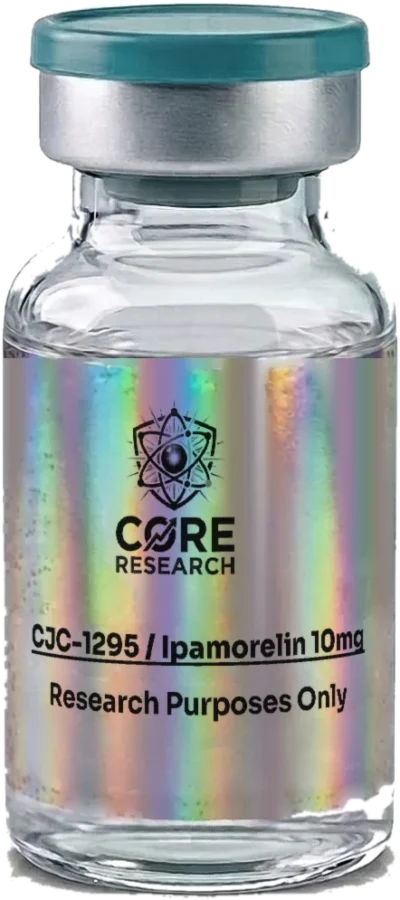
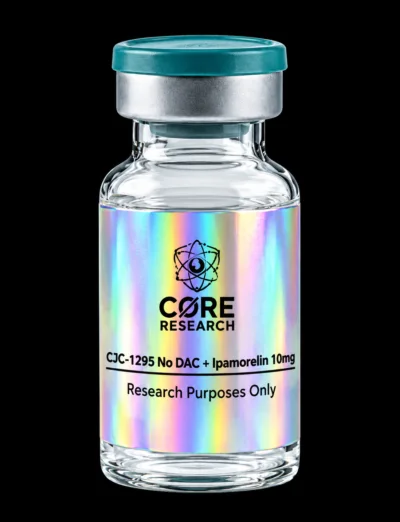
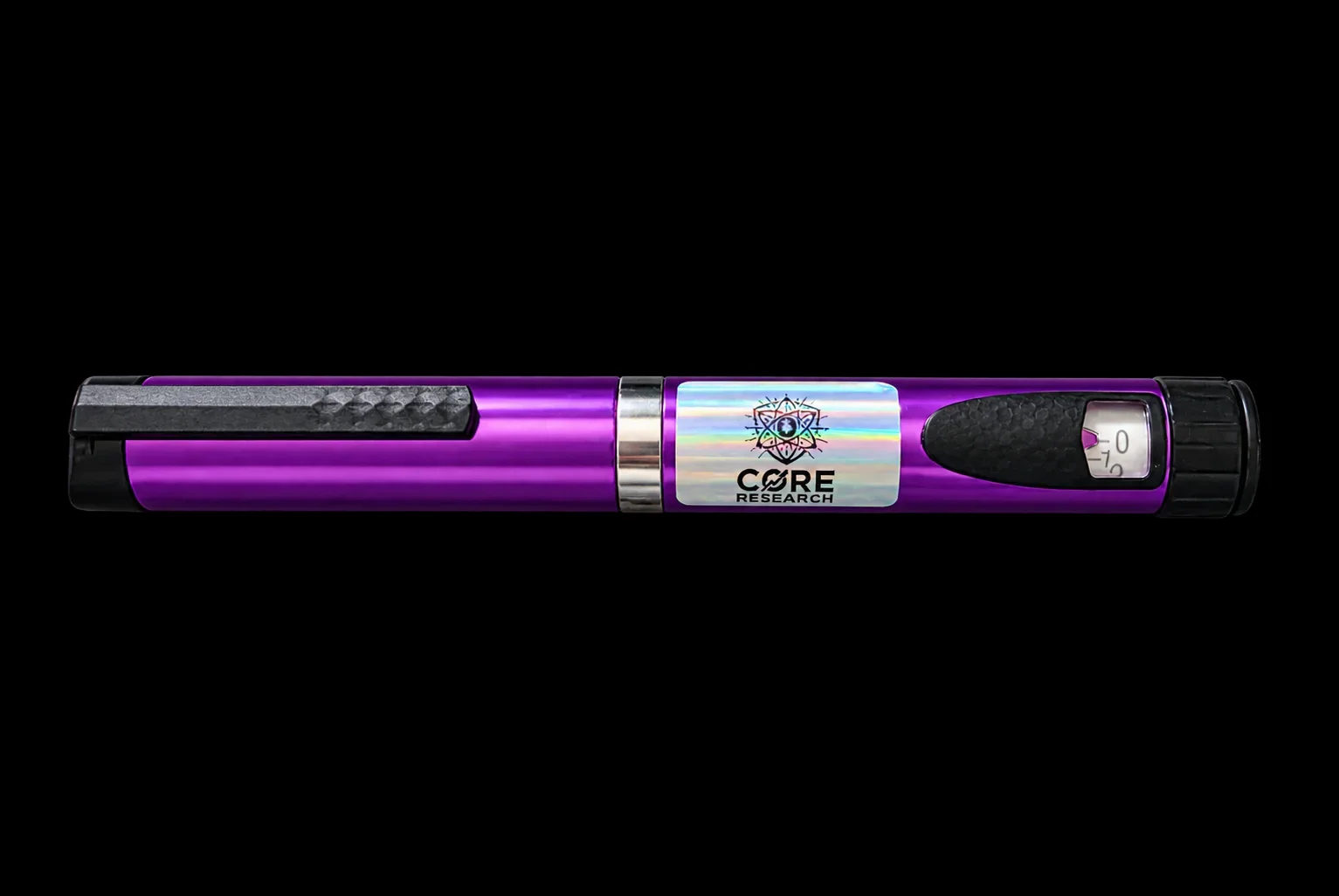
This is a complete CJC-1295 / Ipamorelin 10mg preloaded research pen. The declared composition is 5mg CJC-1295 No DAC plus 5mg Ipamorelin: 10mg combined, not 10mg of each. The pen/device is included; this is not a cartridge-only refill.
The two constituents are studied through different signalling inputs to growth-hormone release. This page explains their research, the No-DAC distinction and what evidence belongs to the actual filled presentation. For laboratory research only; not for human or veterinary use.
What is supplied?
| Detail | This product |
|---|---|
| Named preparation | CJC-1295 / Ipamorelin |
| Listed CJC form | No DAC |
| Declared composition | 5mg CJC-1295 No DAC + 5mg Ipamorelin |
| Total labelled amount | 10mg combined |
| Included presentation | Complete preloaded pen/device |
| Not the same item as | The separately listed vial or refill cartridge |
| Price and availability | Current values in the live purchase panel |
These are the catalogue’s composition and inclusion statements, not an independently measured blend assay. Working volume, vehicle, accessories, compatibility and dispensing performance require their own product-specific information. They cannot be calculated from the total mass alone. Request documentation for the complete pen.
Before ordering: the listed 10mg is a combined total (5mg CJC-1295 No DAC + 5mg Ipamorelin). This is the complete preloaded pen, with device, not a separate refill. The exact working volume, vehicle, device accessories, compatibility and dispensing performance were not established by the records inspected for this draft; do not infer those values from the peptide mass or an image. Ask specifically about the finished pen or request its applicable documentation before purchase when those specifications are material.
Ordering, dispatch and document questions
Can I request documentation before paying?
Yes. The Core Research batch-documentation enquiry accepts pre-purchase requests: name the exact catalogue item and supplied format, and identify which material or analytical specification your laboratory needs. A received-vial lot number is not needed to ask. Once material arrives, match any report to the lot on its container and your order reference. Where an applicable CoA exists for the supplied lot, the site’s published delivery policy says it is issued with the consignment. This is a policy description, not a claim that a particular batch report was inspected for this draft.
Where is the order dispatched from, and when will it arrive?
Core Research states that it dispatches from Birmingham, UK, in plain outer packaging. Published shipping information explains tracking where provided and conditions affecting processing and carrier transit. Exact charges and arrival estimates depend on the order and destination; they are not guaranteed here. The live product panel and checkout remain the sources for current price, availability and the applicable order total.
What if the item or its documentation does not match?
Keep the packaging and the printed lot identifier, take clear photographs of visible discrepancies, and contact Core Research promptly with the item, order reference and evidence. Raise a discrepancy before using the material; see the receiving checklist and delivery-condition guidance.
Why combine CJC-related material and Ipamorelin in research?
CJC-related GRF/GHRH analogues and Ipamorelin investigate different receptor systems with a shared hormonal endpoint. GHRH-related compounds act within the growth-hormone-releasing-hormone pathway; Ipamorelin belongs to the growth-hormone-secretagogue/ghrelin-receptor research class. Neither constituent is growth hormone itself. 1 2
That provides a rationale for comparing separate and combined inputs. It does not establish that a mixture is additive or synergistic, has a particular pulse profile, or reproduces the kinetics of a differently modified compound. The growth-signalling comparison matrix places the constituents in their wider research context.
CJC-1295 with DAC and No DAC: the important distinction
Albumin binding was part of the original design
Jetté and colleagues investigated modified human GRF fragments and albumin bioconjugates. The albumin-linked preparations showed greater stability against the enzyme studied and retained activity in cultured rat pituitary cells. Their selected compound, CJC-1295, was a modified GRF analogue with an added albumin-binding feature. 1
The research question was how to retain activity while extending exposure. Albumin binding was therefore part of the tested molecular design, not a minor formulation detail that can be ignored when citing its duration.
Why the long-acting human findings do not describe this pen
Teichman and colleagues studied long-acting CJC-1295 in two placebo-controlled, double-blind human trials. They reported sustained changes in GH and IGF-I and characterised pharmacokinetics. Those results concern the tested long-acting material, not this No-DAC blend or filled pen. 3
The present catalogue identifies the CJC constituent as No DAC. Match its exact sequence and modification state to the supplier specification; do not transfer an albumin-binding preparation’s half-life to it. The DAC-versus-No-DAC guide explains the structural and research distinction.
Ipamorelin: what selectivity means in the original research
Ipamorelin is a synthetic pentapeptide. Raun and colleagues described the sequence Aib-His-D-2-Nal-D-Phe-Lys-NH₂. The notation includes non-standard residues, stereochemistry and a terminal amide; it identifies the researched molecule rather than chemically analysing this pen. 2
Their primary rat-pituitary experiments showed GH release and antagonist responses consistent with GHRP-like rather than GHRH-receptor activity. In the swine comparison, GHRP-2 and GHRP-6 increased ACTH and cortisol, while the measured Ipamorelin responses were not significantly different from those following GHRH stimulation. 2
That is the context of the reported selectivity finding. It is not evidence of zero cortisol effects under all conditions or proof of absent adverse effects in people. The Ipamorelin-versus-GHRP-2 comparison explores the experimental differences.
Hormonal measurements and clinical outcomes are different questions
Gobburu and colleagues measured Ipamorelin concentrations and GH responses in healthy male volunteers. They modelled a single episode of GH release and found greater between-person variability in response parameters than in concentration parameters. 4
This illustrates the distinction between pharmacokinetics, how concentration changes over time, and pharmacodynamics, the measured response. A labelled amount alone specifies neither. The experiment did not test the current mixture or filled presentation.
A separate postoperative-ileus trial by Beck and colleagues enrolled 117 participants, with 114 in the reported analysis populations. Ipamorelin did not significantly outperform placebo in its key or secondary efficacy analyses; the key meal-tolerance comparison reported p = 0.15. 5
That is not a test of this blend or a universal verdict on endocrine activity. It shows why a plausible receptor mechanism or hormone response cannot guarantee success on a different endpoint. No administration schedule from these studies is provided here.
What is known about the combined preparation?
The references selected here examine individual constituents, an albumin-binding CJC analogue or Ipamorelin in other settings. None of these cited papers tests this commercial No-DAC/Ipamorelin pen. This describes the cited evidence set, not a claim that an exhaustive search found no combination study anywhere.
A useful blend experiment must identify both chemical forms, their quantities and the comparator. Equal labelled masses also do not mean equal numbers of molecules. Any claim of synergy requires the relevant comparison rather than adding the findings of unrelated constituent papers.
The single-material versus blend guide explains why composition and combination evidence need their own interpretation.
Documentation for two constituents and a finished format
| Evidence question | What to match |
|---|---|
| CJC identity | Sequence, modification state and the stated No-DAC form |
| Ipamorelin identity | Relevant peptide identity and supplied chemical form |
| Composition | Declared quantities versus measured component results |
| Report scope | Raw constituent, prepared blend, refill or complete filled pen |
| Traceability | Product name, lot, issuer, report identifier and date |
| Format performance | Evidence specific to any claimed compatibility or dispensing property |
An aggregate chromatographic result cannot automatically establish the identity and quantity of both constituents. A raw-material report also does not automatically describe the finished filled pen.
Use the CoA-reading guide, HPLC guide and mass-spectrometry guide for analytical interpretation. The pre-filled-pen verification guide and dispensing-measurement guide address the presentation separately.
When requesting documents, name CJC-1295 / Ipamorelin 10mg Pen, not just one constituent. Ask which lot and presentation a report covers; retain the relevant lot records.
Complete pen, refill or vial?
| Item | Presentation distinction |
|---|---|
| This 10mg Pen | Complete preloaded pen/device |
| CJC-1295 No DAC + Ipamorelin 10mg vial | Separate lyophilised-vial record |
| CJC-1295 / Ipamorelin Refill 10mg | Separate refill record |
| Ipamorelin 10mg | Single-constituent product, not this blend |
Compare the actual records rather than inferring compatibility from a shared name or image. The format comparison explains the different laboratory and documentation questions.
Receiving and storage
A filled product needs conditions applicable to its actual vehicle, container and packaging. Do not copy a lyophilised vial’s storage period onto a filled presentation. On arrival, check the labelled item, lot and included device against the order, inspect the package and retain the supplied information.
The receiving checklist, storage reference and arrival-condition guide support those records. Contact product support about the preparation or available evidence.
Product questions
Is the pen included, or is this only a refill?
The complete pen/device is included in this listing. The refill cartridge has a separate product record; unspecified accessories should not be assumed to be included.
Is the total 10mg or 20mg?
The declared total is 10mg: 5mg of the listed CJC-1295 No-DAC material plus 5mg Ipamorelin. It is not 10mg of each constituent.
Does “preloaded” prove a particular working volume or dispensing accuracy?
No. It describes the supplied presentation. Volume, formulation and dispensing performance are separate attributes requiring applicable product information.
See Peptide Pens and Growth & Secretagogue Peptides for catalogue navigation, and Shipping & Delivery, Testing & Quality Methodology and the research-use boundary for purchasing context.
Selected references
[1] Jetté L et al. (2005). Human growth hormone-releasing factor (hGRF)1-29-albumin bioconjugates activate the GRF receptor on the anterior pituitary in rats: identification of CJC-1295 as a long-lasting GRF analog. Endocrinology. DOI: 10.1210/en.2004-1286.
[2] Raun K et al. (1998). Ipamorelin, the first selective growth hormone secretagogue. European Journal of Endocrinology 139:552–561. DOI: 10.1530/eje.0.1390552.
[3] Teichman SL et al. (2006). Prolonged stimulation of growth hormone and insulin-like growth factor I secretion by CJC-1295, a long-acting analog of GH-releasing hormone, in healthy adults. Journal of Clinical Endocrinology & Metabolism 91(3):799–805. DOI: 10.1210/jc.2005-1536.
[4] Gobburu JV; Agersø H; Jusko WJ; Ynddal L (1999). Pharmacokinetic-pharmacodynamic modeling of ipamorelin, a growth hormone releasing peptide, in human volunteers. Pharmaceutical Research. DOI: 10.1023/A:1018955126402.
[5] Beck DE; Sweeney WB; McCarter MD; Ipamorelin 201 Study Group (2014). Prospective, randomized, controlled, proof-of-concept study of the ghrelin mimetic ipamorelin for the management of postoperative ileus in bowel resection patients. International Journal of Colorectal Disease. DOI: 10.1007/s00384-014-2030-8.