Description
BPC-157 10mg Pen is a Core Research catalogue product with 10mg BPC-157 (nominal) supplied in a pen-format product using a preloaded cartridge presentation. This page describes the exact listing, its relation to alternative formats, the experimental literature on the named material and what batch or finished-format documentation can establish. It is supplied for laboratory research only, not for human or veterinary use.
What is actually supplied?
| Attribute | This product |
|---|---|
| Catalogue name | BPC-157 10mg Pen |
| Named material | BPC-157 |
| Labelled amount | 10mg BPC-157 (nominal) |
| Presentation | Pen-format product using a preloaded cartridge presentation |
| Purchase price and availability | Current live WooCommerce purchase panel |
| Documentation route | BPC-157 10mg Pen — batch-documentation enquiry |
BPC-157 is a synthetic 15-amino-acid peptide. Its parent-reference sequence is GEPPPGKPADDAGLV. That sequence is a literature identifier, not an independently measured result for the supplied finished cartridge or device.
The listing identifies a pen-format research preparation, but the records reviewed do not independently establish whether a separate reusable housing, cap, accessory kit or specific dispensing mechanism is supplied. Confirm those inclusions before a purchase that depends on them.
Which presentation is the right catalogue item?
The word pen in the catalogue describes this named pen-format preparation. It is not a result from a device-performance test. Working volume, vehicle, cartridge capacity, mechanical compatibility, accuracy and any accessories need product-specific evidence.
| Related product | What is different? |
|---|---|
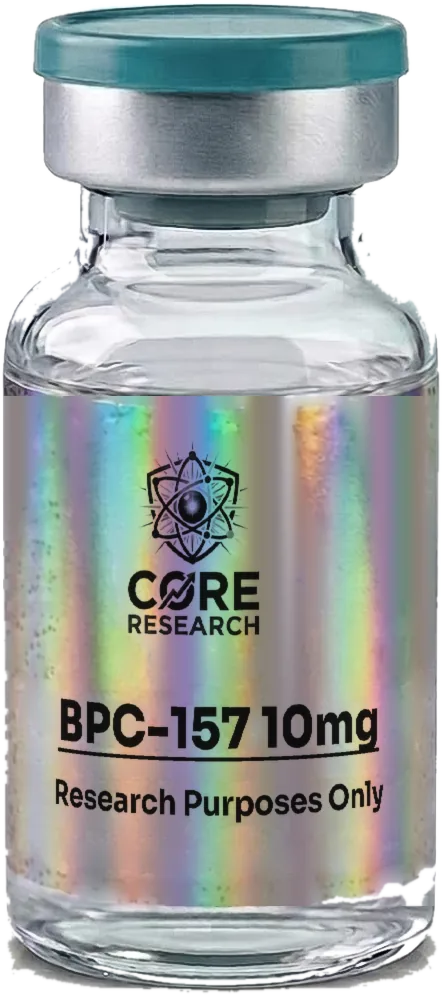
| BPC-157 10mg vial | Standalone lyophilised vial |
| BPC-157 Refill 10mg | Separate refill-cartridge listing |
| BPC-157 / TB-500 Blend 10mg Pen | Pen-format two-constituent blend |
The distinction is practical rather than a claimed difference in biological activity. Compare the exact material, labelled amount, supplied container and documented finished format. The vial-versus-pen format guide explains why a common compound name does not establish matching formulation or hardware compatibility.
Why researchers investigate BPC-157
The studies here explain what was measured in specific preparations and experimental systems. They are compound-level evidence, not quality-control testing or performance trials for the supplied pen. For the detailed research discussion, see the standalone BPC-157 10mg vial research dossier.
Tendon-cell movement is not the same as cell division
In rat tendon explants and cultured tendon fibroblasts, Chang and colleagues observed greater outgrowth, migration and spreading after BPC-157 exposure, along with improved survival under oxidative stress. Their direct proliferation assay did not show increased fibroblast proliferation. FAK and paxillin phosphorylation rose without a change in total protein abundance: an attachment-and-movement signalling result, not proof of faster human tendon repair. 1
Growth-hormone receptor signalling requires the experimental condition
A later rat tendon-fibroblast study reported greater growth-hormone-receptor expression following BPC-157 exposure. Enhanced proliferation-related measurements and JAK2 activation occurred when growth hormone was subsequently added. An effect on receptor expression must not be recast as evidence that BPC-157 is growth hormone, directly binds its receptor, or causes identical responses without that added signal. 2
Vascular models address different endpoints
Endothelial-cell, chick-membrane and rat-ischemia experiments examined vessel-like formation and blood-flow recovery alongside VEGFR2 expression, internalisation and Akt/eNOS signalling. Increased VEGFR2 expression was reported without a corresponding increase in VEGF-A in cultured endothelial cells; this is not a demonstrated direct receptor-binding interaction. 3
Isolated rat aortic-ring experiments addressed vascular relaxation, which differs from creating new vessels. Responses depended on the endothelial lining and nitric-oxide signalling; the study did not show direct relaxation in its three-dimensional smooth-muscle model. Different tissue and assay contexts should remain attached to each finding. 4
Human evidence remains a separate question
A short 2025 pilot reported observations from only two previously exposed people. It cannot establish long-term safety, rare adverse effects, therapeutic outcomes, or anything about the quality of this commercial refill or pen preparation. This page reports compound-level scientific context, not a human-use protocol. 5
How to check evidence for this exact pen
The most useful document identifies the tested sample, actual product, relevant format and lot. Ask whether a document covers source peptide, a filled cartridge, a two-component preparation (where relevant), or the item that would actually be dispatched. Each scope can answer different questions.
For BPC-157, distinguish the parent reference sequence/formula from the actual delivered chemical form and lot. Chromatographic area purity, peptide identity and quantitative mass content are separate analytical questions; none should be equated with a claim about a finished device.
| What you need to know | Relevant evidence or question |
|---|---|
| Named molecular identity | Does the sequence, form and analytical assignment match this product? |
| Nominal amount versus content | Is the quantity only a label declaration or also supported by a calibrated content assay? |
| Purity | Which separation method and reporting basis were used? |
| Product/lot traceability | Does the report match the supplied material, lot and presentation? |
| Finished format | Is cartridge condition, container compatibility or performance separately documented where claimed? |
You may ask for documentation before ordering using Batch Documentation. Include the exact name BPC-157 10mg Pen, state that your enquiry is before purchase and describe what your laboratory needs. After delivery, include the container lot and order number. A report for another lot or product format must not be substituted for the record of the item supplied.
The CoA-reading guide, HPLC interpretation guide, and mass-spectrometry guide explain the limits of the individual methods. The existence of these guides is not evidence that every particular test was performed for this product.
Storage, dispatch and receiving
Use the actual product label and lot-applicable documented conditions for unopened storage, transit excursions and any laboratory preparation. The material reviewed does not establish a universal temperature, fixed expiry, freeze-thaw allowance or solution stability interval for this particular product.
A preloaded cartridge and a lyophilised vial may have different storage questions. Vehicle, fill condition, container, cap and seal matter. The current product evidence reviewed does not establish a working volume, a validated dispensing precision or a prepared-solution shelf life for this item. Do not calculate those values from the nominal peptide amount.
At delivery, compare the item name, nominal amount, packaging and lot with the order. Record any mismatch before using the material. The receiving-inspection checklist, storage-temperature guide, pen-verification guide and dispensing-measurement reference and warm/delayed-delivery guide provide the corresponding supporting checks.
Core Research publishes dispatch from Birmingham, United Kingdom, and plain outer packaging. Actual delivery charges and estimates vary by order and destination: consult Shipping & Delivery and the checkout’s available options. No unconditional next-day service is promised here.
Frequently asked product questions
Is the reusable pen device and accessory kit included?
This is the pen-format catalogue listing with a preloaded cartridge presentation, but the specific included housing and accessories were not independently established from the records reviewed. Confirm the complete supplied components with Core Research before ordering if inclusion matters to your laboratory.
Does the 10mg label specify fill volume or dispensing precision?
No. Nominal material quantity does not establish fluid volume, concentration, device accuracy, or compatibility. Those require product-specific formulation and device information.
Is this item the same as the BPC-157 / TB-500 blend?
No. This listing names BPC-157 alone. A two-component blend is a separate product requiring a separate composition and analytical record.
Can I get the batch report before purchasing?
You can submit a pre-purchase documentation enquiry by naming this exact product and the information needed. Confirm which lot/presentation the available report covers; the request route does not guarantee that every type of test has been completed.
What happens if the shipment arrives damaged or unusually warm?
Retain the parcel and order details, photograph the condition before using the material, and contact Core Research promptly with tracking and available lot information. Use the arrival-condition guide to document the concern.
Ordering and support
The live product purchase panel is the source for current price, stock status, quantity and basket action. If your decision requires a confirmed specification, included components, available testing report or compatible device, contact Core Research product support first with the exact product title. Use Batch Documentation for pre-purchase or received-lot records. The quality-testing methodology, delivery terms and research-use policy give the relevant service context.
For laboratory research only; not for human or veterinary use. Experimental cell, animal and early human observations are not a personal-use or therapeutic protocol for this supplied item.
Selected research references
[1] Chang et al. (2011). The promoting effect of pentadecapeptide BPC 157 on tendon healing involves tendon outgrowth, cell survival, and cell migration. Journal of Applied Physiology.
[2] Chang et al. (2014). Pentadecapeptide BPC 157 enhances the growth hormone receptor expression in tendon fibroblasts. Molecules.
[3] Hsieh et al. (2017). Therapeutic potential of pro-angiogenic BPC157 is associated with VEGFR2 activation and up-regulation. Journal of Molecular Medicine.
[4] Hsieh et al. (2020). Modulatory effects of BPC 157 on vasomotor tone and the activation of Src-Caveolin-1-endothelial nitric oxide synthase pathway. Scientific Reports.
[5] Lee and Burgess (2025). Safety of Intravenous Infusion of BPC157 in Humans: A Pilot Study. Alternative Therapies in Health and Medicine.