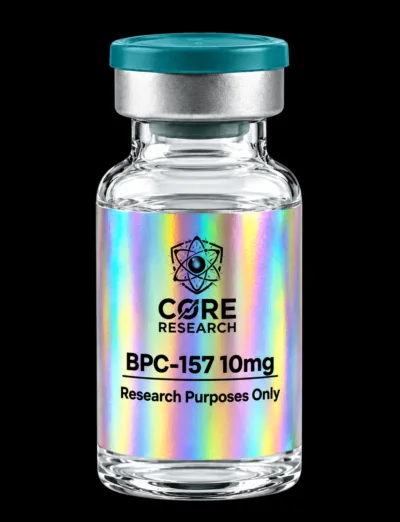
Description
KLOW 80mg is a four-component, lyophilised research blend containing the named constituents BPC-157, TB-500, GHK-Cu and KPV in one vial. 80mg is the catalogue’s nominal combined amount, not 80mg of every component. Core Research’s inspected product record does not establish the amount of each constituent, the exact TB-500 peptide species or a lot-specific assay for the combined preparation. Those details should be matched to the applicable documentation before an experiment that depends on precise component ratios.
For in-vitro laboratory research only. Not for human or veterinary use. This listing describes the supplied research material and the separate scientific literatures; it does not claim that the four-component mixture has proven biological synergy or clinical benefit.
What the KLOW 80mg vial contains
| Product detail | Supplied-item information |
|---|---|
| Catalogue product | KLOW 80mg |
| Presentation | One vial of lyophilised four-component research material |
| Labelled combined quantity | 80mg nominal total; component-by-component amounts not confirmed in the inspected record |
| Named components | BPC-157; TB-500; glycyl-L-histidyl-L-lysine copper complex (GHK-Cu); lysine–proline–valine (KPV) |
| BPC-157 | A synthetic 15-residue peptide; chemical form and actual lot results require applicable material documentation |
| TB-500 | A catalogue designation used for thymosin-beta-4-related materials; exact molecular species must be verified for this blend |
| GHK-Cu | The copper-coordinated GHK tripeptide; do not equate peptide mass, copper mass and counter-ion-inclusive mass |
| KPV | The tripeptide Lys-Pro-Val; any terminal modifications or counter-ions require applicable documentation |
| Research-use boundary | Laboratory research only; no human/veterinary administration |
Total mass is not a constituent assay. Four names on a label do not reveal the four mass fractions, molar ratios or chromatographic identity results. Where a study or validated method depends on an individual constituent’s concentration, the relevant component specification is an essential pre-purchase question, not something to infer by dividing 80mg equally among four materials.
Choosing between the blend and the related formats
The KLOW Refill 80mg is a separate refill-cartridge listing. This page is for the lyophilised vial; a refill’s cartridge, closure and device compatibility cannot be assumed from a vial’s description.
The catalogue also provides separate BPC-157 10mg, TB-500 10mg, GHK-Cu 100mg and KPV 10mg products. Four individual catalogue listings and one combined KLOW preparation are not analytically interchangeable: standalone items allow constituent-specific control, while a combined product introduces co-presence and mixture-stability questions. Separate products also do not automatically provide a matched set of lots, chemical forms or quantities.
| Research purchase question | Standalone material | KLOW combined vial |
|---|---|---|
| How many named peptide constituents? | One, depending on the product | Four named materials in one listing |
| Can component ratios be independently selected? | Each constituent can be chosen separately | Ratio is fixed by the supplied blend and must be confirmed |
| What analytical evidence is needed? | Identity, content and purity for the chosen material | Component identities, component amounts, blend-related analytical interpretation and lot correspondence |
| What can published constituent research establish? | Mechanistic context for the exact studied material/model | Mechanistic context only, not measured outcomes for the four-component mixture |
Read the single-material versus blend research-peptide guide for the experimental-design distinction.
Can I request documentation before ordering?
Yes. Use Batch Documentation or contact info@core-research.net, identifying “KLOW 80mg lyophilised vial”. A pre-purchase enquiry does not require an existing order or container lot number. For a research method requiring a defined formulation, request the per-component labelled quantities, exact molecular species, counter-ions or salt basis where relevant, lot identity and available analytical results before ordering.
A single chromatogram or aggregate purity figure may not settle whether all four named components were present in the declared amounts. Ask how the report establishes identity and quantitative content for each constituent and which lot it covers. HPLC peak-area percentage is not automatically the same measurement as the total milligrams or each peptide’s assay content. The CoA-reading guide, HPLC explainer and mass-spectrometry guide explain the distinction. No current-lot certificate was independently matched to this product during this page refresh.
Why KLOW is a different research question from four separate peptides
A mixture presents four identity questions, four content questions and an additional mixture question. Published work on each constituent may describe cell behaviour, signalling, molecular transport or tissue-model endpoints, but those studies do not prove that combining the materials reproduces each effect, creates an additive outcome or generates synergy. Co-formulation could also change solubility, chemical compatibility, adsorption or stability; no direct four-component KLOW study establishing those properties was identified in the targeted sources inspected for this draft.
The distinctions matter because the literature spans different experimental systems: rat tendon fibroblasts, cultured endothelial cells and isolated rat vessels for BPC-157; protein/actin and wound models for thymosin-beta-4-related peptides; murine inflammatory and fibrotic models for GHK-Cu; and intestinal transporter/cell models for KPV. These are not one validated tissue-repair endpoint. The following sections retain that substantive evidence, with its original context.
BPC-157 constituent research
Tendon-cell migration, stress survival and FAK/paxillin
Chang and colleagues (2011) used rat Achilles-tendon explants and tendon-derived fibroblasts. They observed greater explant outgrowth, cell spreading, migration and survival during hydrogen-peroxide stress after BPC-157 exposure. Direct proliferation in the reported MTT assay did not increase. The investigators also measured higher phosphorylation of FAK and paxillin without higher total amounts of those proteins. FAK/paxillin phosphorylation concerns cell-attachment signalling, so this evidence is more specifically about movement and stress survival than an unqualified claim of cell multiplication. 1
Growth-hormone-receptor expression requires a separate stimulus
In a later rat tendon-fibroblast study, BPC-157 increased growth-hormone-receptor expression at RNA and protein levels. The increased proliferation-related responses and JAK2 activation were observed when growth hormone was additionally supplied. This conditional finding does not contradict the earlier lack of direct proliferation with BPC-157 alone, nor does it establish direct receptor binding or growth-hormone activity by BPC-157. 2
VEGFR2 signalling, new-vessel formation and vascular tone
Hsieh and colleagues (2017) examined endothelial-cell responses, a chick membrane model and blood-flow recovery in a rat hindlimb-ischemia model. They reported VEGFR2 expression and internalisation, and signalling involving Akt and eNOS. In the endothelial experiments, VEGFR2 increased without a corresponding rise in VEGF-A; receptor-expression data alone are not proof of a direct peptide–receptor binding interaction. 3
A separate study (2020) tested existing vessel relaxation in isolated rat aortic rings. It reported an endothelium- and nitric-oxide-associated response involving Src, caveolin-1 and eNOS, with no direct relaxation in the investigated three-dimensional smooth-muscle preparation. Angiogenesis, vessel tone and tendon-cell migration are distinct endpoints even where vascular signalling is involved. Neither experiment tested this KLOW blend. 4
TB-500 constituent research: exact peptide form matters
TB-500 does not uniquely identify a 43-residue protein
The term TB-500 has been used for thymosin-beta-4-related peptides of different lengths and terminal chemistry. Esposito and colleagues (2012) identified an N-terminally acetylated seven-residue fragment, Ac-LKKTETQ, in a particular material called TB-500 using chromatography and high-resolution mass spectrometry. The 43-residue full-length thymosin beta-4 protein, the unacetylated fragment LKKTETQ and Ac-LKKTETQ are chemically different. That study does not establish which species is present in this KLOW lot. 5
Actin binding and context-specific cell movement
Van Troys and colleagues studied full-length thymosin-beta-4 variants and mapped contributions from different regions, including the sequence around residues 17–22, to interaction with actin. A short fragment containing one motif cannot simply inherit every binding property of the full-length protein. 6
Philp and colleagues investigated full-length thymosin beta-4 and a synthetic actin-domain peptide in diabetic- and aged-mouse dermal-wound models, reporting model-specific repair endpoints. The short sequence used in those experiments was not automatically equivalent to acetylated TB-500. 7
The direction of a response also depends on the cell model. Shah and colleagues reported reduced PDGF-BB-induced migration, activation and proliferation in human hepatic stellate cells in the presence of thymosin-beta-4-related interventions. Increased cell movement in one wound model and suppression of stimulated movement in a fibrotic-cell system must not be combined into a universal migration claim. 8
In an analytical and in-vitro screening study, Rahaman and colleagues distinguished TB-500 from metabolites. Their wound-healing screen reported activity for the Ac-LKKTE metabolite rather than simply for every tested parent preparation. Results for a breakdown product should not be attributed to an unverified parent species in KLOW. 9
GHK-Cu constituent research: copper complex and model distinctions
GHK-Cu is not identical to free GHK. Its copper coordination, counter-ion and reported mass basis matter both for chemical identity and for interpreting experiments. The copper complex has been studied in several tissue and cell models, but none of the following studies examined an 80mg four-component KLOW vial.
Epithelial barriers and STAT3-associated signalling
Mao and colleagues (2025) studied GHK-Cu in a DSS-induced mouse colitis model and mouse epithelial-cell/macrophage co-cultures. They reported changes in ZO-1 and occludin junction-related proteins, epithelial healing measurements, cytokines, SIRT1 and phosphorylated STAT3. With STAT3 silenced, some junction-protein and cell-closure responses were lost while anti-inflammatory signals remained. Their molecular docking suggested potential targets; it is not proof of direct molecular binding. These findings concern preclinical barriers and inflammatory systems. 10
Oxidative stress, inflammatory pathways and matrix turnover
Park and colleagues examined LPS-stimulated cells and an acute lung-injury model in mice. They described lower reactive-oxygen and inflammatory signals and changed p38 MAPK/NF-κB activity in that setting. 11 Ma and colleagues studied bleomycin-induced mouse pulmonary fibrosis, reporting lower collagen deposition and changes in oxidative-stress, Nrf2, TGF-β/Smad and matrix-regulation markers. Reduced pathological fibrotic deposition is not the same finding as increased collagen production in dermal-cell experiments. 12
A separate topical-serum investigation reported cell and human appearance-related endpoints for a formulated skin product, not an unformulated research vial. Another small laser-resurfacing study found no significant between-group improvement in several objective skin outcomes. Such formulation-specific observations should not be presented as evidence for KLOW, for a lab vial’s purity or for clinical use. 13 14
KPV constituent research: transport, inflammation and formulation
KPV means Lys-Pro-Val, a three-amino-acid peptide related by sequence to the terminal region of alpha-melanocyte-stimulating hormone. It is not equivalent to full-length alpha-MSH, and free KPV, an amide and a chemically conjugated KPV material need not share the same chemical specification.
PepT1-mediated transport and cell signalling
Dalmasso and colleagues (2008) studied KPV uptake through PepT1, a transporter for short peptides, in intestinal epithelial and immune-cell models. They linked uptake with decreased NF-κB/MAPK signalling and selected inflammatory cytokine measurements; KPV was also studied in mouse colitis models induced by DSS or TNBS. A cellular transcription-factor response and an animal inflammatory endpoint are distinct observations, neither of which demonstrates performance of KLOW as a mixture. 15
Targeted delivery systems and skin-cell stress models
Xiao and colleagues (2017) investigated hyaluronic-acid-functionalised nanoparticle/hydrogel delivery of KPV, with cellular uptake and mouse-colitis outcomes. Effects seen with that targeted carrier cannot be assumed for an ordinary lyophilised blend without the same delivery system. 16
Sung and colleagues (2025) reported changes in oxidative stress, MAPK/NF-κB signalling and inflammatory markers in fine-dust-stressed keratinocyte and skin-model experiments. These were laboratory models, not finished-cosmetic tests or studies of the four-component preparation. 17
How to interpret the four evidence streams
| Evidence type | What it can answer | What it cannot establish about KLOW |
|---|---|---|
| Constituent structural/identity study | Which molecule or fragment the authors examined | Identity or mass fraction of every component in this 80mg vial |
| Cell signalling, uptake or migration experiment | Behaviour in a named cell/model under stated conditions | Clinical effect, consistent response in other tissues, or synergy among four peptides |
| Animal or topical-formulation study | A model- or formulation-specific outcome | Finished KLOW performance, safety or suitability for human/veterinary administration |
| Applicable lot-specific multi-analyte data | Potentially, component identity and content in a named supplied batch | Stability after an untested solvent, compatibility or experimental result without those measurements |
The useful scientific contribution of this page is to keep chemical identity, model, measured endpoint and product evidence separate. That prevents a research finding in an isolated constituent from becoming a claim about the commercially supplied four-component mixture.
Storage, receiving and ordering
Follow only the actual KLOW label and the product- or lot-specific storage instructions. Stability of a dry blend, its response to moisture, and any prepared solution’s stability are different questions. A stability interval for a single peptide or another vendor’s formulation must not be transferred to this product. For laboratory planning, refer to the peptide storage guide and the specific documentation for the material supplied; neither supplies a universal mixture life.
At receipt, check the product name, labelled combined amount, vial, seal, lot and packaging against the order. Record discrepancies before using the material, and retain the relevant photographs or documentation for a product enquiry. The receiving-inspection checklist supports this process.
Core Research publishes dispatch information through its Shipping & Delivery policy. Current price, stock, quantity selection and Add to basket belong to the native WooCommerce purchase panel rather than a hard-coded paragraph. For a university or commercial laboratory, Institutional Procurement supports quotation or purchase-order-reference enquiries; supply the requested material details before ordering.
KLOW 80mg questions
Does 80mg mean 20mg of each of the four compounds?
No such split is established by the inspected product record. The 80mg label is the nominal combined quantity. An equal four-way allocation would be an unsupported assumption. Obtain the applicable component-by-component specification if your method depends on a defined ratio.
Is KLOW the same product as the BPC-157 / TB-500 Blend 10mg?
No. The BPC-157 / TB-500 Blend 10mg is a distinct two-component listing declaring 5mg of each component. KLOW lists four named constituents and 80mg combined, without a verified breakdown in the inspected record. The two products must not exchange composition claims.
Does a paper on TB-500 prove which TB-500 species is in this blend?
No. Published analytical work identified Ac-LKKTETQ in a particular TB-500 preparation. Only documentation matched to this supplied product and lot can establish its actual TB-500 molecular identity.
Is there evidence that all four compounds work better together?
No qualifying direct study of this exact four-component formulation was identified in the targeted literature reviewed for this draft. Constituent findings do not establish a mixture advantage, additive effect or synergy.
Can I request a batch report before paying?
Yes. Use Batch Documentation or info@core-research.net and specify KLOW 80mg, vial presentation, and the individual component or identity details you require. Available documentation must be confirmed for the proposed lot.
Is the 80mg label a solution concentration or research protocol?
No. It states a nominal total material amount. Solution concentration depends on a documented composition, measured amount and preparation conditions; the label does not establish a method, dose or route of administration.
Selected research references
[1] Chang CH et al. (2011). The promoting effect of pentadecapeptide BPC 157 on tendon healing involves tendon outgrowth, cell survival, and cell migration. Journal of Applied Physiology. DOI: 10.1152/japplphysiol.00945.2010.
[2] Chang CH et al. (2014). Pentadecapeptide BPC 157 enhances the growth hormone receptor expression in tendon fibroblasts. Molecules. DOI: 10.3390/molecules191119066.
[3] Hsieh MJ et al. (2017). Therapeutic potential of pro-angiogenic BPC157 is associated with VEGFR2 activation and up-regulation. Journal of Molecular Medicine. DOI: 10.1007/s00109-016-1488-y.
[4] Hsieh MJ et al. (2020). Modulatory effects of BPC 157 on vasomotor tone and the activation of Src–Caveolin-1–endothelial nitric oxide synthase pathway. Scientific Reports. DOI: 10.1038/s41598-020-74022-y.
[5] Esposito S et al. (2012). Synthesis and characterization of the N-terminal acetylated 17–23 fragment of thymosin beta 4 identified in TB-500. Drug Testing and Analysis. DOI: 10.1002/dta.1402.
[6] Van Troys M et al. (1996). The actin binding site of thymosin beta 4 mapped by mutational analysis. EMBO Journal. DOI: 10.1002/j.1460-2075.1996.tb00350.x.
[7] Philp D et al. (2003). Thymosin beta 4 and a synthetic peptide containing its actin-binding domain promote dermal wound repair in db/db diabetic mice and in aged mice. Wound Repair and Regeneration. DOI: 10.1046/j.1524-475x.2003.11105.x.
[8] Shah R et al. (2018). Thymosin β4 inhibits PDGF-BB induced activation, proliferation, and migration of human hepatic stellate cells via its actin-binding domain. Expert Opinion on Biological Therapy. DOI: 10.1080/14712598.2018.1478961.
[9] Rahaman KA et al. (2024). Simultaneous quantification of TB-500 and its metabolites and screening by wound-healing activities in vitro. Journal of Chromatography B. DOI: 10.1016/j.jchromb.2024.124033.
[10] Mao S et al. (2025). Exploring the beneficial effects of GHK-Cu on an experimental model of colitis and the underlying mechanisms. Frontiers in Pharmacology. DOI: 10.3389/fphar.2025.1551843.
[11] Park JR et al. (2016). The tri-peptide GHK-Cu complex ameliorates lipopolysaccharide-induced acute lung injury in mice. Oncotarget. DOI: 10.18632/oncotarget.11168.
[12] Ma WH et al. (2020). Protective effects of GHK-Cu in bleomycin-induced pulmonary fibrosis via anti-oxidative stress and anti-inflammation pathways. Life Sciences. DOI: 10.1016/j.lfs.2019.117139.
[13] Badenhorst T et al. (2016). Effects of GHK-Cu on MMP and TIMP Expression, Collagen and Elastin Production, and Facial Wrinkle Parameters. Journal of Aging Science. DOI: 10.4172/2329-8847.1000166.
[14] Miller TR et al. (2006). Effects of topical copper tripeptide complex on CO₂ laser-resurfaced skin. Archives of Facial Plastic Surgery. DOI: 10.1001/archfaci.8.4.252.
[15] Dalmasso G et al. (2008). PepT1-mediated tripeptide KPV uptake reduces intestinal inflammation. Gastroenterology. DOI: 10.1053/j.gastro.2007.10.026.
[16] Xiao B et al. (2017). Orally targeted delivery of tripeptide KPV via hyaluronic acid-functionalised nanoparticles. Molecular Therapy. DOI: 10.1016/j.ymthe.2016.11.020.
[17] Sung J et al. (2025). Lysine–Proline–Valine peptide mitigates fine-dust-induced keratinocyte apoptosis and inflammation by regulating oxidative stress and modulating MAPK/NF-κB signalling. Tissue and Cell. DOI: 10.1016/j.tice.2025.102837.